
Why Demographic Shifts Influence Market Opportunities
Markets do not grow in isolation. They expand, shrink, and transform based on the people who exist within them, the age groups they belong to, the locations they occupy, and the life stages they move through over time. Demographic shifts refer to these changes in population structure, and they quietly shape almost every business opportunity in the world. When people talk about “good business ideas” or “fast-growing industries,” what they are often really describing is a response to shifting demographics, even if they do not realize it.
At its core, every market is simply a reflection of human needs. But human needs are not static. A society filled with teenagers has very different demands compared to one filled with aging adults. A country experiencing rapid urban migration behaves differently from one where most people remain in rural communities. Even income distribution, family size, and education levels can alter what people buy, how they buy it, and how often they buy it. This is why demographic shifts are not just statistics; they are signals that tell you where future demand will appear.
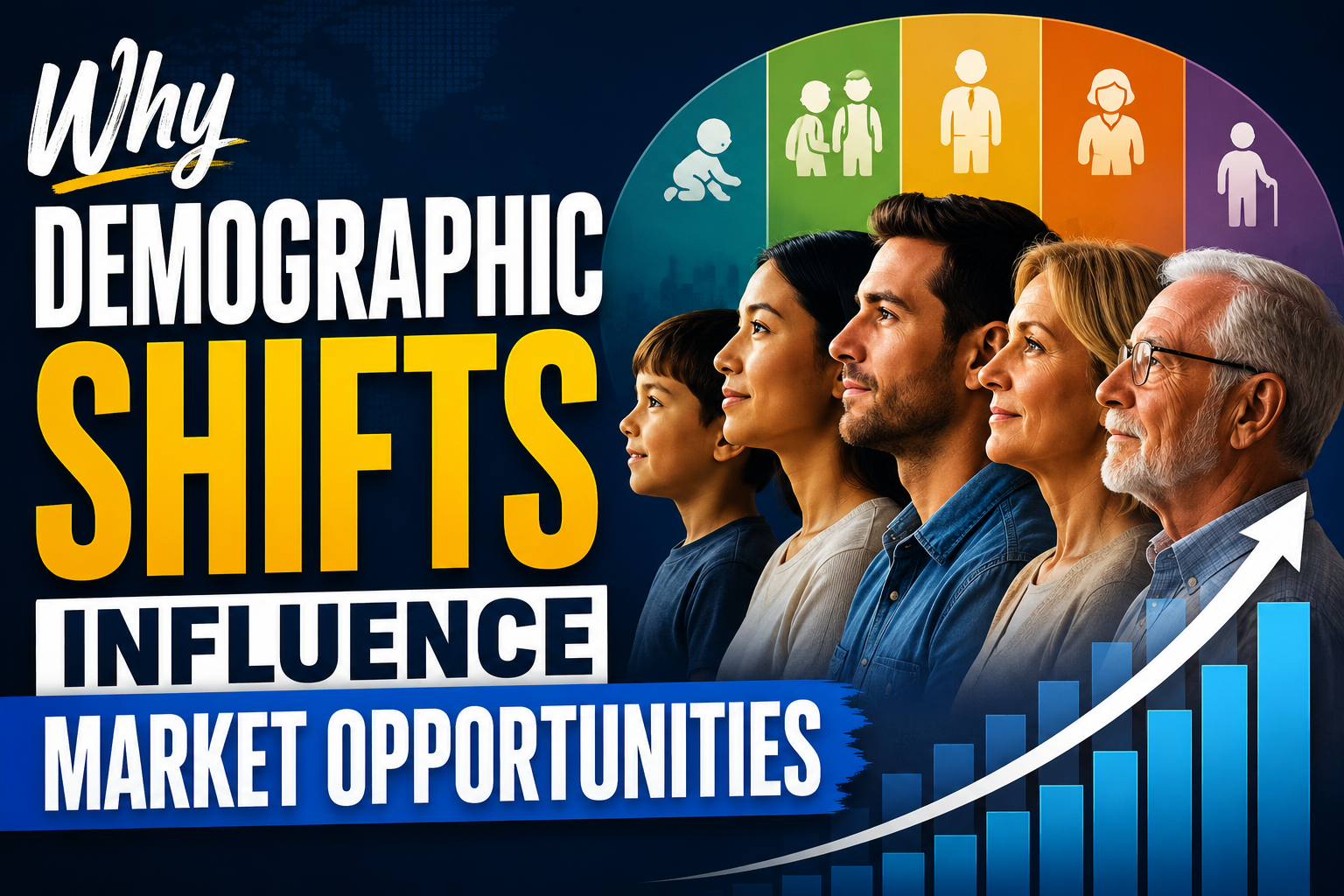
One of the most powerful demographic forces shaping markets is age distribution. When a population is young, there is usually increased demand for education, entry-level jobs, entertainment, fashion, gadgets, and housing for first-time earners. As that same population ages, priorities shift toward healthcare, insurance, retirement planning, home ownership stability, and long-term investments. Businesses that fail to notice these shifts often continue building products for yesterday’s population and gradually lose relevance.
For example, an economy with a rising youth population creates opportunities in digital platforms, online learning, social networking tools, and low-cost consumer goods. Younger populations tend to be more experimental, more connected to technology, and more willing to adopt new trends. On the other hand, an aging population creates demand for convenience services, healthcare technology, assisted living solutions, and financial products designed for stability rather than risk. The same society can therefore produce completely different market leaders within a span of a few decades simply because its age structure has changed.
Urbanization is another demographic force that reshapes markets in profound ways. When people move from rural areas to cities, their lifestyles change dramatically. Access to infrastructure improves, incomes may rise, and consumption patterns become more modernized. Urban populations tend to spend more on convenience, transportation, digital services, packaged goods, and entertainment. This creates entirely new industries that may not have existed or been profitable in rural settings. At the same time, rural markets shrink or transform, forcing businesses to adapt or reposition themselves.
Migration patterns also influence market opportunities. When people relocate across regions or countries, they carry their culture, preferences, and consumption habits with them. This creates hybrid markets where new demand patterns emerge. For example, immigrant populations often introduce new food preferences, fashion styles, and business models to their new environments. Companies that recognize these changes early can build products that serve both the original population and the incoming groups, expanding their customer base significantly.
Income distribution is another critical demographic factor. A society where income levels are rising creates demand for better quality goods, premium services, and lifestyle upgrades. In contrast, economies facing income stagnation tend to prioritize affordability, durability, and necessity-based consumption. Businesses that understand this shift can adjust their pricing strategies, product design, and marketing approach accordingly. Ignoring income demographics often leads to misaligned offerings that fail to connect with the actual purchasing power of the population.
Education levels within a population also influence market opportunities in subtle but powerful ways. A more educated population tends to demand more sophisticated services, better quality products, and more information-driven decision-making tools. It also increases the adoption of technology and digital platforms. This is why industries like fintech, e-learning, software services, and data-driven platforms grow rapidly in highly educated societies. Meanwhile, in less educated populations, simpler products, intuitive user experiences, and trust-based marketing become more important.
Household structure is another demographic trend that shapes consumption behavior. In societies where nuclear families are more common, there is often higher demand for individual consumption products, compact housing, and convenience-based services. In contrast, extended family systems tend to favor bulk purchasing, shared resources, and family-oriented services. Even something as simple as packaging size or product design can succeed or fail depending on how households are structured in a given market.
Technology adoption also interacts with demographics in interesting ways. Younger populations tend to adopt new technologies faster, creating opportunities for digital-first businesses. Older populations may adopt more slowly but often represent stable, high-value customers once they are engaged. This creates a layered market structure where different demographic groups respond differently to the same innovation. Businesses that understand this layering can design segmented strategies rather than one-size-fits-all approaches.
Another important dimension is population growth or decline. Rapidly growing populations create expanding markets with increasing demand for housing, food, education, and infrastructure. Declining populations, on the other hand, often create saturated markets where competition is intense and growth is slower. In shrinking populations, businesses may need to focus more on efficiency, consolidation, or premium positioning rather than volume expansion. This demographic reality often determines whether a business should scale aggressively or optimize carefully.
Even cultural shifts tied to demographics influence market opportunities. As populations evolve, values change. Younger generations may prioritize flexibility, digital convenience, sustainability, and personal expression more than previous generations. These cultural shifts influence everything from fashion trends to investment behavior. Businesses that understand cultural demographics are often able to anticipate demand before it becomes mainstream, giving them a competitive advantage.
The timing of demographic change is also important. Demographics do not shift overnight, but when they do, the effects are long-lasting. A rising youth population today may influence markets for the next twenty to thirty years. An aging population today will shape healthcare systems and retirement industries for decades. This long-term nature of demographic change makes it one of the most reliable indicators for strategic planning. Unlike trends that come and go, demographics provide a slow but predictable foundation for market forecasting.
At a deeper level, demographic shifts influence not just what people buy, but how value itself is created and perceived. In one demographic environment, convenience might be the most valuable feature. In another, durability or prestige may matter more. In some societies, speed of access is critical, while in others, trust and tradition dominate purchasing decisions. Understanding these differences allows businesses to design value propositions that align with the underlying population structure rather than relying on generic assumptions.
Ultimately, demographic shifts influence market opportunities because they determine the composition of human demand. Every business exists to serve people, and when people change, markets change with them. Those who pay attention to these shifts early often find themselves ahead of competition, not because they are more creative, but because they are more observant. They see patterns in population data that others overlook and use those patterns to position themselves where future demand will emerge.
In a world where competition is increasing and attention is limited, understanding demographic movement is not just an academic exercise. It is a practical tool for survival and growth. Whether someone is building a business, investing in industries, or simply trying to understand economic trends, demographic awareness provides a clearer map of where opportunities are likely to appear next.

EarnSmartOnline.com.ng is dedicated to helping readers make smarter financial decisions through practical guides on online income, personal finance, technology, digital business, and wealth creation. Our goal is to provide reliable, easy-to-understand, and actionable content that empowers individuals to earn smarter, build sustainable income streams and achieve long-term financial success.
Recommended: Start Earning Online
- Ultimate Affiliate Marketing Program — learn affiliate marketing with a done-for-you sales system ($15). Check it out
- The Newbie Affiliate Guide — the beginner-friendly starter guide (~$6.68). Check it out
- Easy Dollar Maker — earn in dollars uploading AI images and videos from your phone ($17). Check it out
Disclosure: These are affiliate links. If you buy through them, I may earn a commission at no extra cost to you.



