
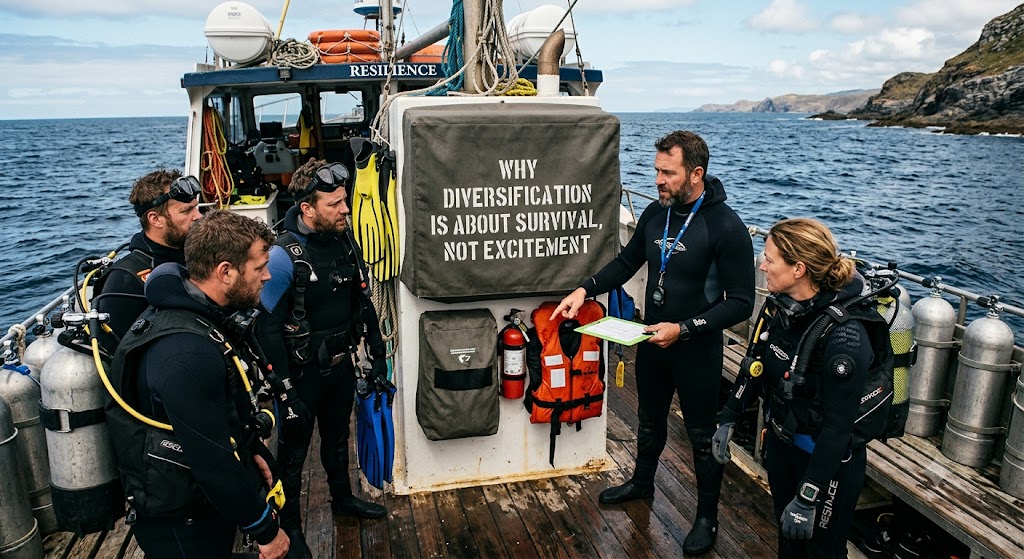
Why Diversification Is About Survival, Not Excitement
Diversification is one of the most misunderstood concepts in personal finance, investing, and wealth creation. Many people hear the word and immediately think about stock portfolios, mutual funds, or large corporations spreading investments across different industries. While those are examples of diversification, the principle itself goes much deeper. Diversification is not about chasing excitement, collecting countless investments, or constantly trying new opportunities simply because they appear attractive. At its core, diversification is about survival. It is about reducing the chances that a single mistake, unexpected event, or economic shock will destroy everything you have worked so hard to build.
History repeatedly shows that nothing remains predictable forever. Companies that once dominated the world have disappeared. Industries that looked unstoppable have collapsed. Technologies that seemed revolutionary became obsolete within a few years. Entire economies have experienced recessions, inflation, currency devaluation, banking crises, political instability, natural disasters, and unexpected global events. The people and businesses that survive these disruptions are rarely those who placed everything on one opportunity. They are usually the ones who understood the importance of spreading risk before problems appeared.
One of the greatest financial mistakes people make is assuming that today’s success guarantees tomorrow’s security. A person earning an excellent salary today may believe that the income will continue indefinitely. A business owner with strong monthly sales may think customers will always keep coming. An investor enjoying years of rising stock prices may conclude that the market only moves upward. These assumptions create dangerous confidence because they ignore one simple reality: every source of income, every investment, and every business carries risk.
Diversification acknowledges uncertainty instead of denying it. Rather than assuming the future will always cooperate, diversified individuals prepare for situations where it does not. They understand that protecting what they have is often more important than chasing spectacular gains. While many people spend years searching for the next big opportunity, experienced investors often spend just as much time asking what could go wrong and how they can minimize the damage if it does.
Many people mistakenly associate diversification with lower returns. They believe concentrating all their resources into one successful investment is the fastest path to wealth. While concentration can indeed produce extraordinary gains when everything goes perfectly, it also creates extraordinary vulnerability. The same decision that multiplies wealth during favorable conditions can wipe out years of progress when circumstances suddenly change.
Imagine someone whose entire financial future depends on a single employer. If that company downsizes, relocates, or closes, the person’s income disappears overnight. The problem is not simply unemployment. The real problem is the absence of alternatives. Someone with multiple income sources, freelance skills, investments, rental income, or an online business may still experience financial pressure, but the impact becomes manageable because no single loss destroys everything.
This same principle applies to businesses. Companies that rely on one major customer often enjoy impressive revenue until that customer leaves. Businesses that depend entirely on one supplier become vulnerable when supply chains break down. Organizations selling only one product face enormous risk if consumer preferences change. The businesses that endure economic uncertainty usually build multiple revenue streams, maintain several suppliers, diversify their customer base, and continuously explore new markets.
Diversification is equally important in investing. Financial markets have always experienced cycles. Stocks rise and fall. Real estate appreciates and declines. Commodities fluctuate. Currencies gain and lose value. Even government policies can dramatically influence investment performance. Investors who spread their money across different asset classes rarely experience the highest returns during boom periods, but they also avoid catastrophic losses when one sector collapses.
The goal of diversification is not perfection. It is resilience. It recognizes that nobody consistently predicts the future with complete accuracy. Even the world’s most respected investors have experienced losses because markets remain influenced by countless unpredictable factors. Diversification accepts human limitations and builds protection around them.
Many people confuse diversification with randomness. Buying dozens of unrelated investments without understanding them is not diversification. Purchasing every new business opportunity that appears online is not diversification either. True diversification requires thoughtful allocation based on understanding risk, correlation, liquidity, time horizon, and personal financial goals. Every investment should serve a purpose rather than simply increasing the number of assets owned.
Another important aspect of diversification involves skills. Modern careers have changed dramatically over the last two decades. Employees who relied on one specialized skill often discovered that automation, artificial intelligence, outsourcing, or technological innovation reduced demand for their expertise. Those who continuously learned complementary skills adapted much more successfully. A software developer who also understands communication, project management, business strategy, and marketing becomes significantly more valuable than someone with technical ability alone.
The same lesson applies to entrepreneurs. A business owner who understands only product development may struggle with sales. Another who excels at marketing but ignores financial management may eventually face cash flow problems. Developing multiple competencies creates flexibility because success rarely depends on one strength alone.
Income diversification has become increasingly important in today’s economy. Relying entirely on one paycheck creates unnecessary vulnerability. This does not mean everyone must start five businesses simultaneously. It simply means building additional income sources gradually over time. Some people earn extra income through consulting. Others create digital products, online courses, dividend investments, rental properties, affiliate marketing, content creation, or freelance services. Each additional stream reduces dependence on any single source.
One reason diversification feels less exciting than concentration is because its greatest benefits often remain invisible. Insurance seems unnecessary until disaster strikes. Emergency savings appear boring until unexpected medical expenses arise. Backup systems feel excessive until primary systems fail. Diversification works in exactly the same way. During stable periods, concentrated investors often appear more successful because their returns may exceed diversified portfolios. However, when uncertainty arrives, diversification reveals its true value.
Financial survival often depends less on making spectacular gains than avoiding devastating losses. Recovering from a fifty percent investment loss requires a one hundred percent gain simply to break even. Avoiding catastrophic losses therefore becomes an essential part of long-term wealth building. Diversification reduces the probability of experiencing those devastating setbacks.
Psychology also plays a significant role. People naturally become emotionally attached to successful investments. After experiencing repeated gains, confidence increases. Eventually confidence becomes overconfidence. Investors convince themselves they understand markets better than they actually do. They begin increasing exposure because recent success creates the illusion of certainty. History repeatedly demonstrates how dangerous this mindset becomes.
Every financial bubble shares similar characteristics. Whether examining the dot-com bubble, housing market collapse, cryptocurrency volatility, or countless historical investment manias, participants often believed the rules had changed permanently. Diversification appeared unnecessary because everyone expected prices to continue rising indefinitely. When reality returned, concentrated investors suffered the greatest damage.
Diversification also protects against risks people cannot control. Political changes, regulatory decisions, inflation, currency fluctuations, natural disasters, technological disruption, international conflicts, pandemics, and changing consumer preferences can significantly impact investments and businesses. Since these events remain largely unpredictable, spreading risk becomes far more practical than attempting perfect forecasts.
The principle extends beyond finance into everyday life. Businesses diversify suppliers to reduce disruptions. Countries diversify energy sources to improve national security. Farmers diversify crops to protect against weather conditions and changing market prices. Manufacturers diversify production facilities across different regions to reduce operational risk. Even ecosystems demonstrate diversification through biological variety, making them more resilient against disease and environmental changes.
One overlooked benefit of diversification is improved decision-making. Individuals whose financial survival depends entirely on one investment often experience tremendous emotional pressure. Every market fluctuation feels personal. Every negative headline creates anxiety. Diversification reduces emotional intensity because no single event determines overall success. This emotional stability allows investors to make more rational decisions during periods of uncertainty.
Patience becomes easier when survival is secure. Someone who knows their entire future depends on one investment may panic during temporary declines. A diversified investor can remain focused on long-term objectives because temporary setbacks in one area are balanced by stability elsewhere.
Diversification should also include geographical considerations. Economic conditions differ across countries and regions. Industries expand at different rates. Political environments change independently. Currency values fluctuate continuously. Investors and businesses operating across multiple regions often reduce dependence on the economic health of any single location.
Age and life stage also influence diversification strategies. Younger individuals often possess greater capacity to recover from financial setbacks because they have more working years ahead. Older individuals approaching retirement usually prioritize preserving accumulated wealth rather than maximizing aggressive growth. Diversification allows financial strategies to evolve alongside changing personal circumstances.
Technology has made diversification more accessible than ever before. Investors can now access international markets, diversified exchange-traded funds, fractional shares, digital businesses, and global income opportunities using relatively modest amounts of capital. Information that once belonged exclusively to institutional investors is now widely available. However, increased access also requires greater discipline because unlimited choices often encourage unnecessary complexity.
It is equally important to recognize that over-diversification exists. Spreading resources too thinly across hundreds of investments may reduce returns without providing meaningful additional protection. Effective diversification balances risk reduction with practical management. Every investment should contribute genuine value to the overall strategy rather than simply increasing complexity.
Many successful entrepreneurs initially concentrate their efforts while building a business. Once meaningful profits emerge, they gradually diversify how those profits are invested. This distinction is important. Concentrated effort often creates wealth, but diversification frequently preserves it. Building wealth and protecting wealth require different mindsets. One emphasizes opportunity while the other emphasizes sustainability.
Generational wealth rarely survives through aggressive concentration alone. Families that preserve wealth across decades typically diversify businesses, investments, geographic exposure, education, and financial planning. They understand that preserving capital allows future generations to continue building upon previous success instead of repeatedly starting from zero after preventable financial disasters.
Another overlooked dimension of diversification involves relationships. Building professional networks across multiple industries creates resilience during career changes. Individuals who know people from different sectors often discover new opportunities much faster than those whose entire network exists within one organization. Social diversification increases adaptability because opportunities frequently emerge through unexpected connections.
Knowledge diversification provides similar advantages. Reading broadly across economics, psychology, technology, business, history, communication, leadership, and science creates mental flexibility. Many breakthrough ideas emerge by combining concepts from different disciplines rather than specializing exclusively within one narrow field. Diverse knowledge helps people recognize risks earlier and identify opportunities others overlook.
Health diversification also deserves attention. Depending entirely on one aspect of health while neglecting others creates vulnerability. Physical fitness, proper nutrition, adequate sleep, stress management, preventive healthcare, and emotional well-being work together to improve long-term resilience. Financial success becomes difficult to enjoy without maintaining personal health.
One reason diversification receives less public attention than spectacular investment success stories is because survival rarely makes headlines. News organizations celebrate extraordinary gains, rapid wealth creation, and dramatic financial victories. They spend much less time covering people who quietly avoided catastrophic losses through disciplined risk management. Yet these individuals often achieve greater long-term financial security.
Successful investing is not always about finding the highest return. It is often about staying in the game long enough for compounding to work. Compounding rewards consistency far more than occasional brilliance. Diversification helps investors remain invested through difficult periods because catastrophic losses become less likely.
Economic uncertainty will always exist. Markets will continue rising and falling. New technologies will replace old industries. Consumer preferences will evolve. Governments will change policies. Global events will surprise even experienced experts. None of these realities eliminate the value of diversification. Instead, they strengthen its importance.
The most financially secure individuals are rarely those who bet everything on one prediction. They are usually those who accepted uncertainty as a permanent feature of life and built systems capable of surviving it. Their wealth grows not because they avoided every mistake, but because no single mistake destroyed everything.
Ultimately, diversification is not about eliminating risk because that is impossible. Every investment, career, business, and financial decision involves uncertainty. The objective is to ensure that one unfavorable outcome does not erase years of discipline, sacrifice, and hard work. Survival creates the opportunity for future success. Without survival, future opportunities become irrelevant.
That is why diversification remains one of the most powerful principles in finance, business, and life. It is not designed to make every year exciting or every investment extraordinary. It exists to ensure that unexpected setbacks become temporary obstacles instead of permanent endings. Excitement may generate headlines, but survival builds lasting wealth. Those who understand this distinction position themselves not only to endure uncertainty but also to take advantage of opportunities that inevitably appear after every period of disruption. In the long run, the greatest financial victories often belong not to those who took the biggest risks, but to those who managed risk wisely enough to remain standing when others were forced to start over.

EarnSmartOnline.com.ng is dedicated to helping readers make smarter financial decisions through practical guides on online income, personal finance, technology, digital business, and wealth creation. Our goal is to provide reliable, easy-to-understand, and actionable content that empowers individuals to earn smarter, build sustainable income streams and achieve long-term financial success.
Recommended: Start Earning Online
- Ultimate Affiliate Marketing Program — learn affiliate marketing with a done-for-you sales system ($15). Check it out
- The Newbie Affiliate Guide — the beginner-friendly starter guide (~$6.68). Check it out
- Easy Dollar Maker — earn in dollars uploading AI images and videos from your phone ($17). Check it out
Disclosure: These are affiliate links. If you buy through them, I may earn a commission at no extra cost to you.



