
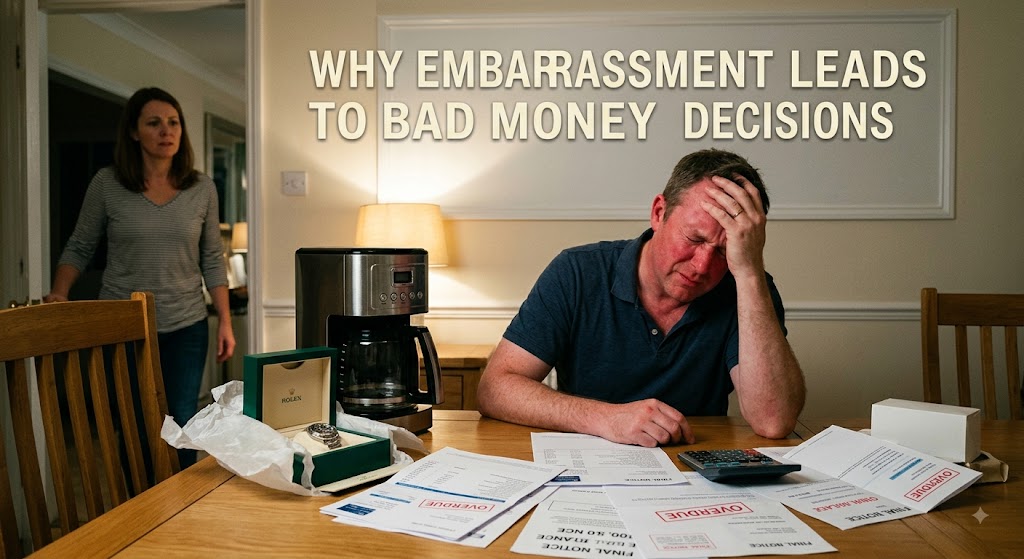
Money decisions are rarely as logical as we like to believe. We often imagine that people look at their income, expenses, savings, debts and financial goals before deciding what to do with their money. In reality, emotions play a powerful role in financial behaviour. Fear, excitement, anger, jealousy, pressure and even embarrassment can influence a decision long before logic gets the opportunity to speak. One of the most overlooked emotional influences on personal finance is embarrassment. Understanding why embarrassment leads to bad money decisions can help you recognise when emotions are quietly pushing you towards financial choices that may create bigger problems later.
Embarrassment can make people spend money they do not have, borrow money they cannot comfortably repay, hide financial problems, accept unnecessary financial pressure and make purchases simply to protect an image. The decision may feel reasonable at the moment because the immediate goal is not really about buying something. It is about escaping an uncomfortable feeling. Unfortunately, when money is used to solve emotional discomfort, the financial consequences can remain long after the embarrassment has disappeared. Why Embarrassment Leads to Bad Money Decisions
Imagine someone attending a social gathering where almost everyone appears to be financially comfortable. People are wearing expensive clothes, using the latest phones, discussing holidays and talking about restaurants they visit. The person may have planned to spend very little that day, but when the bill arrives, they suddenly feel uncomfortable about admitting that they cannot afford the same lifestyle. Instead of being honest, they reach for their card or transfer money they had reserved for something more important. They may even borrow money to avoid appearing financially limited.
That decision might produce temporary relief. Nobody knows that the person cannot comfortably afford the expense. Nobody sees the anxiety that follows. The embarrassment disappears, but the financial problem remains.
This is one of the clearest reasons why embarrassment leads to bad money decisions. Embarrassment creates a strong desire to escape the present moment, and financial consequences are often pushed into the future. When the brain is focused on avoiding humiliation, long term consequences can suddenly appear less important than immediate social comfort.
Many people have experienced some version of this situation. You are with friends and everyone decides to eat somewhere expensive. You know your budget is tight, but you do not want to be the person who says, “I cannot afford this.” So you stay quiet. Perhaps you order something you would not normally buy. Maybe you contribute more than you planned. Afterwards, you tell yourself that it was only one occasion.
But financial problems are often created through repeated small decisions rather than one dramatic mistake. One embarrassing situation becomes another. One unnecessary purchase becomes several. One borrowed amount becomes a pattern of borrowing. Eventually, a person can find themselves spending significant amounts of money simply because they are trying to maintain an appearance.
The problem becomes even more serious when embarrassment is connected to status. Modern society constantly gives people reasons to compare themselves with others. Social media makes this worse because people are exposed to carefully selected images of luxury, success and comfort. Someone may see friends travelling, buying cars, wearing designer clothing, celebrating expensive birthdays or moving into beautiful homes. Instead of asking whether those things fit their own financial situation, they may begin asking how they can avoid looking unsuccessful.
That is where emotional spending can begin.
A person who feels embarrassed about an old phone may buy a new one even though the existing phone works perfectly. Someone embarrassed about driving an older car may take on a loan for a newer vehicle. Someone who feels uncomfortable living in a modest neighbourhood may stretch themselves financially to move somewhere they cannot comfortably afford. Another person may spend thousands on clothing because they are afraid of being judged by colleagues.
None of these purchases are automatically bad. There is nothing wrong with buying a better phone, a nicer car, better clothes or living in a more comfortable home when those choices fit your financial reality. The danger appears when the primary reason for the purchase is emotional protection rather than genuine financial capacity or personal value.
This distinction is important because the same purchase can be financially healthy for one person and financially destructive for another. The problem is not necessarily the object being purchased. The problem is the emotional reason behind the decision.
Why Embarrassment Leads to Bad Money Decisions
Embarrassment can also prevent people from asking for help. Someone struggling with debt may avoid speaking to a financially knowledgeable friend because they are ashamed of their situation. A person who has lost income may continue pretending that everything is fine instead of adjusting their lifestyle. Someone who made a poor investment may refuse to admit the mistake because they do not want others to know they were wrong. Why Embarrassment Leads to Bad Money Decisions
Instead of confronting the problem early, they hide it.
Unfortunately, hiding a financial problem does not make the problem disappear. In many cases, it allows the problem to grow. A small debt that could have been managed through an honest conversation can become a serious burden. An unsustainable lifestyle can continue for months because the person is afraid to admit that their income has changed. An investment loss can become larger because the investor refuses to accept reality.
Embarrassment therefore does not only cause bad spending decisions. It can also cause bad financial inaction.
One of the most dangerous effects of embarrassment is the pressure to prove yourself. When someone feels that other people are looking down on them, they may become determined to demonstrate that they are doing well. This can lead to what might be called financial performance. Instead of using money to build security, they use money to communicate success.
The person is no longer asking, “What will improve my financial future?”
They are asking, “What will make people think I am doing well?”
Those are completely different questions.
Financial security is often invisible. An emergency fund sitting in a savings account does not attract attention. A retirement contribution does not impress a crowd. A debt repayment rarely receives applause. Avoiding an unnecessary purchase does not generate social media likes. But an expensive car, holiday, outfit, phone or party can immediately communicate a particular image.
This creates an uncomfortable truth about money. The things that make someone look wealthy are not always the things that make someone financially secure.
Someone can look incredibly successful while being deeply indebted. Another person can look ordinary while quietly building substantial savings and investments. If embarrassment causes you to prioritise appearances over financial stability, you may end up sacrificing your future to protect an image in the present.
Peer pressure can intensify the problem. Human beings naturally want to belong. Nobody wants to feel like the person who cannot participate. This is particularly powerful among friends, colleagues and social groups where spending is treated as normal.
Suppose a group of friends regularly meets at expensive restaurants. You cannot comfortably afford the lifestyle, but you do not want to be excluded. Every time you attend, you spend more than you planned. Eventually, you begin using credit or borrowing money. The emotional reward is belonging, while the financial cost accumulates quietly.
The difficult part is that nobody may actually be judging you as harshly as you imagine.
This is another reason why embarrassment leads to bad money decisions. Embarrassment often exaggerates the importance of other people’s opinions. We assume people are paying close attention to our clothes, cars, phones, homes and spending habits. In reality, most people are far more occupied with their own lives.
The person you are trying so hard to impress may not remember what you wore last week. The friends you are trying to impress may also be struggling financially. The colleague you believe has everything together may be carrying substantial debt. The person driving an expensive car may be financing it with payments that consume a large portion of their income.
You can therefore make a terrible financial decision while trying to impress people who are themselves financially uncertain.
Embarrassment can also make people spend money after making a mistake. Imagine someone forgetting a birthday, missing an important event or feeling guilty about not doing enough for someone they care about. Instead of addressing the situation honestly, they may attempt to compensate financially. They buy an expensive gift, pay for something they cannot afford or spend beyond their budget because they believe money can remove the uncomfortable feeling.
Sometimes generosity is wonderful. But generosity motivated by guilt or embarrassment can become financially unhealthy.
There is a difference between giving because you genuinely want to give and giving because you are afraid of what someone will think if you do not give. The first comes from choice. The second comes from pressure.
This distinction matters because healthy personal finance requires the ability to say no.
Saying no can be uncomfortable. You may have to admit that something is outside your budget. You may need to decline an invitation. You may need to wear the same clothes again. You may need to drive an older vehicle. You may have to tell friends that you cannot participate in an expensive activity. You may even need to admit that you made a financial mistake.
These moments can feel embarrassing, but financial maturity requires learning to tolerate temporary discomfort.
A powerful financial skill is the ability to accept a little embarrassment today in exchange for greater peace tomorrow.
That might mean saying, “I cannot afford that right now.”
It might mean saying, “I am trying to reduce my spending.”
It might mean saying, “I am paying off debt, so I need to be more careful.”
It might mean saying, “I would rather save the money.”
Those statements may feel uncomfortable at first, but they can protect you from financial decisions made purely to satisfy social expectations.
Another reason why embarrassment leads to bad money decisions is that embarrassment can trigger impulsive thinking. When people experience an uncomfortable emotional state, they often look for immediate relief. Spending money can provide that relief because purchasing something can create excitement, confidence or a temporary feeling of control.
This is why emotional spending can become addictive for some people. The purchase is not really about the item. It is about the emotional transformation that comes with the purchase. Someone feels inadequate, buys something expensive and temporarily feels better. Later, they regret the purchase, feel guilty and perhaps become embarrassed about their financial situation. That embarrassment creates more emotional discomfort, which can lead to more spending.
A cycle develops.
Embarrassment leads to spending. Spending creates financial pressure. Financial pressure creates shame. Shame creates more embarrassment. Embarrassment encourages further emotional decisions.
Breaking that cycle requires recognising the emotion before acting on it.
One useful approach is to create a waiting period for emotionally charged purchases. If you suddenly feel that you must buy something because you are embarrassed, give yourself time. It could be twenty four hours, several days or even longer depending on the purchase. Ask yourself whether you would still want the item if nobody else knew you owned it.
That question can reveal a lot.
If nobody could see the car, would you still want it?
If nobody knew the brand of your clothes, would you still buy them?
If nobody would ever see your phone, would you still upgrade it?
If you could not post the holiday online, would you still take it?
If the answer changes dramatically when other people’s opinions are removed, then your decision may be influenced more by social pressure than genuine need.
Another powerful question is, “Can I afford this without damaging my important financial goals?”
Affordability should not simply mean having enough money in your account today. A purchase can technically be affordable while still being financially unwise. You should consider your existing obligations, emergency savings, debt, future expenses and long term goals.
Money decisions should serve your life, not your image.
This is especially important for people trying to build wealth. Wealth building often requires doing things that do not look impressive. You may need to save while your friends spend. You may need to invest while others upgrade their lifestyles. You may need to live below your means while people around you appear to be living above theirs.
That can feel embarrassing.
But there is nothing embarrassing about financial discipline.
There is nothing shameful about refusing to spend money you do not have.
There is nothing embarrassing about building an emergency fund.
There is nothing embarrassing about paying off debt.
There is nothing embarrassing about choosing a cheaper option.
There is nothing embarrassing about starting small.
The real danger is allowing embarrassment to convince you that financial discipline is something to hide.
People often celebrate financial results without seeing the discipline that produced them. They see the successful business but not the years of sacrifice. They see the investment portfolio but not the months when the investor avoided unnecessary spending. They see the beautiful house but not the financial planning behind it.
If you constantly spend money to look successful, you may destroy the very foundation required to become successful.
It is also important to understand that embarrassment is not always a sign that you are doing something wrong. Sometimes embarrassment simply means you are stepping outside a social expectation. If your friends expect everyone to spend heavily and you choose to budget, you may feel uncomfortable. That does not mean your decision is bad. If your colleagues expect everyone to upgrade their phones and you decide to keep yours, you may feel awkward. That does not mean you are behind.
Emotional discomfort and financial irresponsibility are not the same thing.
Learning to separate them is a major part of financial maturity.
Before making a money decision under social pressure, pause and ask yourself what you are actually trying to accomplish. Are you buying something because you need it? Are you spending because it brings genuine value to your life? Are you helping someone because you genuinely want to? Or are you simply trying to prevent someone from thinking less of you?
That final question can save you a surprising amount of money.
It is also worth remembering that financial privacy is healthy. You do not owe everyone an explanation for your financial decisions. You do not need to announce your income. You do not need to justify your savings strategy. You do not need to explain why you declined an expensive invitation. You do not need to prove your financial worth to people who are not responsible for your bills.
Your financial life does not need to be a public performance.
If embarrassment has already caused financial damage, the answer is not to feel even more ashamed. Shame rarely solves financial problems. Honesty does. Sit down, look at the numbers and acknowledge what happened. Identify the decisions that were driven by emotional pressure. Determine what needs to change and begin making smaller, healthier decisions.
Perhaps you need to reduce unnecessary spending. Perhaps you need to stop borrowing for social activities. Perhaps you need to establish a realistic budget. Perhaps you need to have an honest conversation with someone. Perhaps you need to stop comparing your life with what you see online.
Whatever the solution is, facing the problem is better than hiding it.
Financial progress requires courage because sometimes the financially responsible decision is also the socially uncomfortable one.
You may have to disappoint people.
You may have to say no.
You may have to admit that you cannot afford something.
You may have to accept that someone else has a lifestyle you cannot currently maintain.
You may have to stop trying to look rich and start trying to become financially secure.
That transition can be uncomfortable, but it is powerful.
The next time you feel embarrassed about money, do not immediately reach for your wallet. Pause. Recognise what you are feeling. Ask yourself what you are afraid someone will think. Then ask whether protecting that image is worth the financial cost.
You might discover that the purchase you were about to make was never really about the purchase.
It was about approval.
And approval can be one of the most expensive things a person ever buys.
Understanding why embarrassment leads to bad money decisions is therefore more than a lesson about spending. It is a lesson about self worth, emotional control, social pressure and financial independence. Money becomes easier to manage when you stop using it to prove something to other people.
You do not need to look wealthy to build wealth. You do not need to impress everyone to make progress. You do not need to participate in every expensive activity to maintain friendships. You do not need to hide your financial limitations. Most importantly, you do not need to sacrifice your future simply to avoid a few uncomfortable moments today.
The person who can calmly say, “That is outside my budget,” may feel embarrassed for thirty seconds, but they may save themselves from months or years of financial pressure.
The person who refuses to borrow money just to maintain appearances may look less impressive today, but they may be far more financially secure tomorrow.
The person who accepts a modest lifestyle while building savings may not receive applause, but they are quietly purchasing something far more valuable than status.
They are purchasing freedom.
That is ultimately the lesson. Embarrassment is temporary, but financial consequences can last much longer. A moment of social discomfort should never automatically become a long term financial obligation. When you learn to tolerate embarrassment instead of spending money to escape it, you gain more than better financial habits. You gain control.
And sometimes the smartest financial decision you can make is simply being comfortable enough to admit that you cannot afford to impress anybody.

EarnSmartOnline.com.ng is dedicated to helping readers make smarter financial decisions through practical guides on online income, personal finance, technology, digital business, and wealth creation. Our goal is to provide reliable, easy-to-understand, and actionable content that empowers individuals to earn smarter, build sustainable income streams and achieve long-term financial success.
Recommended: Start Earning Online
- Ultimate Affiliate Marketing Program — learn affiliate marketing with a done-for-you sales system ($15). Check it out
- The Newbie Affiliate Guide — the beginner-friendly starter guide (~$6.68). Check it out
- Easy Dollar Maker — earn in dollars uploading AI images and videos from your phone ($17). Check it out
Disclosure: These are affiliate links. If you buy through them, I may earn a commission at no extra cost to you.



