
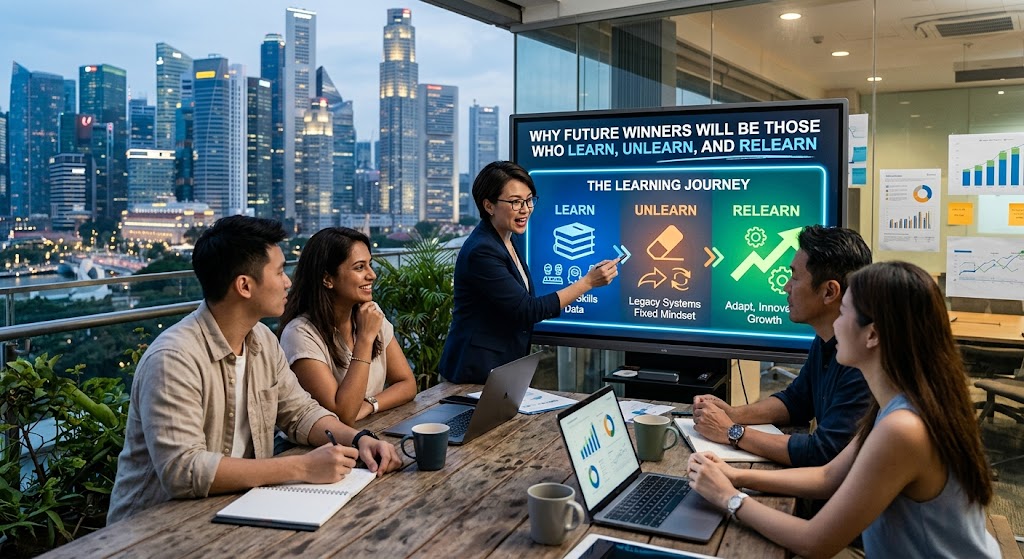
Why Future Winners Will Be Those Who Learn, Unlearn and Relearn
The world has never changed as quickly as it is changing today, and yet tomorrow it will move even faster. Industries that once remained stable for decades now transform within a few years. Technologies that once seemed revolutionary become outdated almost overnight. Careers that once guaranteed lifelong security disappear, while entirely new professions emerge from innovations that did not exist a few years earlier. In this constantly evolving environment, success no longer belongs to the strongest, the richest, or even the smartest people. It belongs to those who can continuously learn, unlearn, and relearn. This ability has quietly become one of the most valuable skills any individual can develop, because the future rewards adaptability more than certainty. Why Future Winners Will Be Those Who Learn, Unlearn, and Relearn.
For generations, education was viewed as a destination rather than a journey. People attended school, graduated, secured employment, and expected their knowledge to remain useful throughout their careers. That model worked reasonably well in a slower world where technological advances happened gradually and industries evolved at a predictable pace. Today, that assumption has become increasingly dangerous. Knowledge expires much faster than ever before. Skills that once guaranteed employment can become obsolete within a few years. Entire business models disappear as new technologies reshape customer expectations and market demands.
Learning is no longer something people do only in classrooms. It has become a lifelong responsibility. Every new technological breakthrough introduces fresh opportunities while simultaneously making certain skills less valuable. Artificial intelligence, automation, cloud computing, digital marketing, blockchain, biotechnology, robotics, and countless other innovations continue to redefine the global economy. Those who refuse to keep learning risk becoming irrelevant, regardless of how successful they were in the past.
However, learning alone is no longer enough. Many people continue collecting knowledge while holding tightly to outdated assumptions. This creates a dangerous illusion of competence. They possess information, but their thinking remains trapped in yesterday’s realities. This is where unlearning becomes equally important. Unlearning means deliberately letting go of beliefs, habits, strategies, and assumptions that no longer serve their purpose. It requires admitting that what worked yesterday may no longer work today. This process is often uncomfortable because human beings naturally become attached to familiar ways of thinking. Yet growth rarely happens without discomfort.
History provides countless examples of individuals and organisations that failed because they refused to unlearn. Many successful companies dominated their industries for decades before disappearing almost entirely. They believed their previous success guaranteed future success. Instead of adapting to changing customer preferences, they defended outdated business models until competitors overtook them. The market rarely rewards nostalgia. It rewards relevance.
The same principle applies to individuals. Someone who mastered a valuable skill twenty years ago cannot assume that skill alone will secure future opportunities. Software developers constantly learn new programming languages. Doctors continuously update their medical knowledge. Financial professionals adapt to changing regulations and technologies. Business owners revise their strategies as consumer behaviour evolves. Even artists embrace new platforms and creative tools to reach modern audiences. Continuous adaptation has become the price of remaining competitive.
Relearning represents the final stage of this powerful cycle. Once outdated ideas are discarded, new knowledge must replace them. Relearning is not simply repeating what was learned before. It involves developing entirely new perspectives based on current realities. It requires rebuilding mental models that better reflect how the world actually works today. Every period of technological disruption demands new thinking, new approaches, and new solutions.
One reason many people struggle with relearning is pride. Experience often creates confidence, but confidence can quietly transform into arrogance. Individuals who have achieved success sometimes assume they already know enough. They stop asking questions. They resist new perspectives. They dismiss younger generations whose ideas challenge traditional thinking. Ironically, the very experience that once made them successful becomes the obstacle preventing future growth.
Humility plays a critical role in lifelong learning. Truly successful people recognise that no matter how much they know, there will always be more to discover. They remain curious rather than defensive. They welcome evidence that challenges their assumptions. They understand that changing their minds is not a sign of weakness but a demonstration of intellectual strength.
Technology has accelerated this need for adaptability more dramatically than any previous era. Artificial intelligence alone is transforming industries at remarkable speed. Tasks that once required specialised expertise can now be completed with intelligent software in minutes. This does not necessarily eliminate human value, but it certainly changes where that value exists. Routine knowledge becomes less valuable when machines can access information instantly. Human creativity, critical thinking, emotional intelligence, ethical judgment, innovation, leadership, and problem-solving become increasingly important because these qualities remain difficult to automate.
Many professionals worry that technology will replace them. A more accurate concern may be that people who effectively use technology will replace those who refuse to embrace it. Throughout history, technological revolutions have consistently rewarded those willing to adapt while creating difficulties for those who resisted change. The printing press transformed communication. Electricity reshaped industry. The internet revolutionised global commerce. Artificial intelligence represents another significant shift, and those who continuously learn its possibilities will enjoy advantages unavailable to those who ignore it.
Learning extends beyond technical skills. Human relationships continue to evolve alongside technology. Communication styles change. Leadership expectations develop. Consumer preferences shift. Global cultures interact more frequently than ever before. Emotional intelligence, cultural awareness, negotiation, collaboration, and effective communication remain essential because every technological innovation ultimately serves human needs. Understanding people remains one of the most valuable forms of knowledge anyone can acquire.
The workplace itself has undergone remarkable transformation. Remote work, hybrid employment, freelancing, digital entrepreneurship, online education, virtual collaboration, and global hiring have created opportunities unimaginable only a decade ago. Success increasingly depends on flexibility rather than routine. Employers seek individuals capable of learning independently, adapting quickly, and solving unfamiliar problems. Degrees and certificates still matter, but demonstrated adaptability often matters even more.
Business owners face similar realities. Customer expectations evolve continuously. Marketing channels change rapidly. Consumer attention shifts between platforms. Companies that once relied entirely on physical locations now operate globally through digital platforms. Businesses that refuse to update their methods often struggle, while those embracing continuous improvement remain competitive despite economic uncertainty.
One fascinating aspect of learning is its compound effect. Every new skill connects with previous knowledge, creating unexpected opportunities. Someone who understands finance and technology may recognise opportunities invisible to specialists focused on only one field. Someone combining psychology with marketing develops deeper insight into consumer behaviour. Individuals who learn across multiple disciplines frequently become more innovative because they connect ideas others overlook.
Curiosity fuels this entire process. Curious people naturally ask better questions. Instead of assuming they understand everything, they remain fascinated by how things work. They explore unfamiliar topics, challenge accepted beliefs, and actively seek different viewpoints. This curiosity becomes a competitive advantage because learning begins with genuine interest.
Reading remains one of the simplest yet most effective ways to sustain lifelong learning. Books expose readers to centuries of accumulated human knowledge. Every biography offers lessons from another person’s successes and failures. Every business book presents strategies tested across different industries. Every scientific publication expands understanding of how the world operates. Consistent reading gradually transforms thinking without dramatic effort because knowledge compounds quietly over time.
Learning also requires practical application. Information without action rarely produces meaningful results. Countless individuals consume endless educational content yet never implement what they discover. Real learning occurs when knowledge influences behaviour. Reading about leadership differs significantly from leading people. Understanding financial principles differs from managing personal finances effectively. Watching tutorials differs from building practical skills through consistent practice.
Failure becomes an essential teacher within this process. Many people fear mistakes because they associate failure with incompetence. In reality, failure often accelerates learning more effectively than success. Every unsuccessful attempt provides valuable feedback about what requires improvement. Individuals committed to learning interpret failure as information rather than personal defeat. They adjust, improve, and continue progressing.
The ability to unlearn becomes especially important after failure. Sometimes people repeatedly apply unsuccessful strategies simply because those approaches once produced positive results. Instead of questioning the strategy, they blame external circumstances. Genuine growth requires asking whether existing assumptions remain valid. This willingness to abandon ineffective methods creates room for better alternatives.
Generational differences further highlight the importance of relearning. Younger generations naturally embrace emerging technologies because they grow alongside them. Older generations possess valuable experience but occasionally struggle adapting to unfamiliar tools. Neither group possesses every advantage. Young people benefit from technological familiarity, while experienced professionals contribute wisdom developed through real-world challenges. The most successful individuals combine both perspectives by remaining teachable regardless of age.
Education systems themselves increasingly recognise this reality. Memorising information becomes less valuable when search engines provide instant access to facts. Critical thinking, creativity, collaboration, adaptability, and problem-solving receive greater emphasis because these skills remain valuable despite technological advancement. The future belongs not merely to people who know answers but to those capable of asking meaningful questions and finding innovative solutions.
Economic uncertainty further reinforces the importance of lifelong learning. Global markets fluctuate unexpectedly. Industries expand and contract. New regulations emerge. Consumer priorities shift. Individuals possessing diverse, adaptable skills navigate uncertainty more successfully because they remain capable of creating value under changing conditions. Specialisation remains valuable, but adaptability protects against unexpected disruption.
Entrepreneurs demonstrate this principle daily. Launching a successful business rarely follows a perfect plan. Markets respond unpredictably. Customer feedback reveals overlooked weaknesses. Competitors introduce unexpected innovations. Successful entrepreneurs continuously learn from customers, unlearn ineffective strategies, and relearn improved methods based on real-world experience. Their willingness to evolve often determines whether their businesses survive.
Leadership has also changed dramatically. Traditional command-and-control management styles increasingly give way to collaborative leadership models. Modern leaders inspire rather than merely instruct. They encourage experimentation, support continuous development, and cultivate learning cultures within their organisations. Leaders unwilling to evolve often struggle retaining talented employees who value growth opportunities.
Personal development follows similar patterns. Individuals seeking healthier relationships, stronger finances, improved health, or greater happiness frequently discover that lasting transformation begins internally. Old beliefs must be challenged. Limiting habits require replacement. New behaviours demand consistent practice. Personal growth rarely occurs by simply adding knowledge. It often requires removing outdated thinking before meaningful progress becomes possible.
Social media illustrates both opportunities and challenges for lifelong learning. Never before has educational content been so widely accessible. Experts share insights freely through articles, podcasts, videos, courses, and discussions. Simultaneously, misinformation spreads rapidly. Successful learners develop critical thinking skills that help distinguish reliable information from persuasive but inaccurate claims. Learning today requires both curiosity and discernment.
Resilience becomes stronger through continuous adaptation. Individuals accustomed to learning respond more confidently when circumstances change unexpectedly. Instead of viewing disruption as catastrophe, they interpret it as another opportunity to acquire valuable knowledge. Their identity becomes rooted not in existing expertise but in their capacity to develop new capabilities whenever necessary.
Confidence itself changes meaning within this framework. True confidence no longer comes from believing one already knows everything. Instead, confidence grows from trusting one’s ability to learn whatever becomes necessary. This subtle distinction creates remarkable psychological freedom. Uncertainty becomes less intimidating because learning provides a reliable response to unfamiliar situations.
The pace of future change will likely exceed anything experienced so far. Artificial intelligence will continue evolving. Biotechnology may redefine healthcare. Quantum computing could transform entire industries. Space exploration, renewable energy, advanced robotics, and countless emerging innovations will reshape society in ways difficult to predict today. Nobody possesses complete knowledge about tomorrow’s opportunities. The greatest advantage belongs to those prepared to keep learning regardless of what changes occur.
Parents, educators, employers, and governments all play important roles in encouraging lifelong learning cultures. Children benefit when curiosity receives greater praise than memorisation. Employees thrive when organisations invest in continuous development. Communities prosper when education extends beyond formal schooling into lifelong personal improvement. Entire economies become stronger when citizens embrace adaptability instead of resisting change.
Ultimately, learning, unlearning, and relearning represent far more than educational concepts. They describe a mindset capable of thriving amid uncertainty. Individuals embracing this mindset remain flexible without becoming directionless. They honour valuable experience without becoming trapped by it. They welcome innovation without abandoning timeless principles. They understand that growth requires both acquiring new knowledge and releasing outdated assumptions.
Future winners will not necessarily possess the highest intelligence, the greatest wealth, or the most prestigious qualifications. They will be individuals who remain endlessly teachable. They will recognise that every ending creates another beginning, every disruption creates another opportunity, and every challenge offers another lesson. They will approach life with curiosity rather than fear, adaptability rather than rigidity, and humility rather than arrogance.
The future cannot be predicted with complete accuracy, but one truth becomes increasingly clear with every passing year. Change is inevitable, continuous, and accelerating. Those determined to keep learning, courageous enough to unlearn, and disciplined enough to relearn will consistently position themselves ahead of those who remain attached to yesterday’s knowledge. In a world where change has become the only constant, the greatest competitive advantage is no longer what you know today. It is how quickly and willingly you can become the person tomorrow requires.

EarnSmartOnline.com.ng is dedicated to helping readers make smarter financial decisions through practical guides on online income, personal finance, technology, digital business, and wealth creation. Our goal is to provide reliable, easy-to-understand, and actionable content that empowers individuals to earn smarter, build sustainable income streams and achieve long-term financial success.
Recommended: Start Earning Online
- Ultimate Affiliate Marketing Program — learn affiliate marketing with a done-for-you sales system ($15). Check it out
- The Newbie Affiliate Guide — the beginner-friendly starter guide (~$6.68). Check it out
- Easy Dollar Maker — earn in dollars uploading AI images and videos from your phone ($17). Check it out
Disclosure: These are affiliate links. If you buy through them, I may earn a commission at no extra cost to you.



