
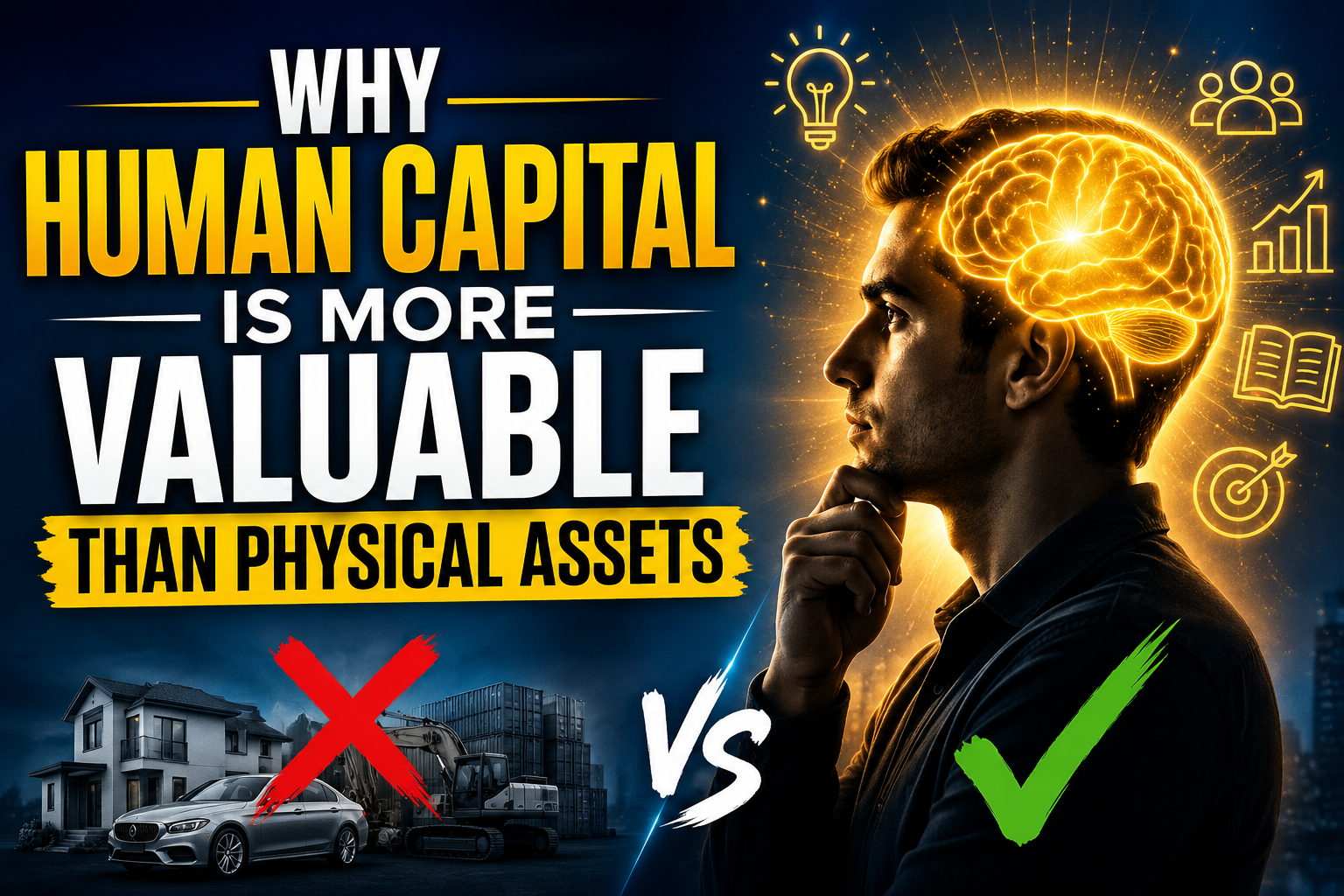
Why Human Capital Is More Valuable Than Physical Assets
Human capital has quietly become the most powerful force shaping modern wealth creation, yet many people still focus almost entirely on physical assets like land, buildings, machines, or inventory as the true markers of financial success. This mindset is deeply rooted in older economic systems where tangible property defined status and power. However, in today’s world, the real engine of value has shifted. The knowledge, skills, experience, adaptability, and creativity of individuals now generate more long term wealth than most physical assets ever could. Understanding this shift is essential for anyone who wants to build sustainable success in a rapidly changing economy.
Human capital refers to the collective value of a person’s abilities, education, training, intelligence, health, and experience. It is not something you can touch or store in a warehouse, yet it directly determines how much value a person can produce in the marketplace. Unlike physical assets that depreciate over time, human capital has the potential to appreciate. A skill learned today can become more valuable tomorrow as it is refined, combined with other skills, or applied in new environments. This compounding effect makes human capital one of the most powerful long term investments anyone can make.
Physical assets, on the other hand, are limited by their nature. A building can only occupy a fixed space. A machine can only perform specific tasks within its design. Even land, which is often considered one of the most stable assets, has boundaries and depends heavily on external factors like location, regulations, and market demand. While these assets can generate income, they require maintenance, are vulnerable to depreciation, and often depend on human input to maintain their value. Without human capital, physical assets are inert and unproductive.
One of the strongest arguments for the superiority of human capital is its scalability. A single individual with high level skills can impact thousands or even millions of people through digital platforms, intellectual property, or scalable services. A software engineer can create a product that serves a global audience. A content creator can influence markets and shape behavior without owning any physical infrastructure. A strategist can guide organizations to multiply revenue far beyond the value of any single building or machine. The scale of impact is determined not by physical ownership but by intellectual capacity.
Another critical factor is adaptability. Physical assets are rigid. They are designed for specific purposes and require significant cost and time to repurpose. Human capital, however, is flexible. A skilled individual can learn new tools, pivot industries, adapt to market changes, and continuously evolve. In an economy where technology and consumer behavior shift rapidly, adaptability is not just an advantage but a necessity. Those who rely heavily on physical assets often struggle during disruption, while those who invest in their human capital are able to adjust and thrive.
The digital age has further amplified the value of human capital. Today, information is widely accessible, but interpretation, application, and innovation remain rare skills. Two people can have access to the same knowledge, but the one with stronger analytical ability, creativity, and execution skills will produce significantly better outcomes. This is why industries increasingly reward problem solvers, critical thinkers, and innovators rather than just owners of assets. The ability to think effectively has become more valuable than the ownership of physical tools.
Another important dimension is income potential. Physical assets typically generate linear income. A rental property produces a fixed monthly return. A machine produces output within its operational capacity. However, human capital can generate exponential income. A highly skilled individual can build systems, create intellectual property, launch scalable businesses, or develop expertise that commands premium compensation. The more a person develops their human capital, the more leverage they gain over their income potential.
It is also important to recognize that physical assets often require human capital to function at all. A factory without skilled workers cannot produce goods. A company without capable managers cannot scale. Even automated systems require engineers, analysts, and decision makers to design, monitor, and improve them. This means that the true foundation of any productive system is not the physical infrastructure but the human intelligence behind it.
One of the most overlooked aspects of human capital is its compounding nature. Unlike physical assets, which may depreciate over time, skills and knowledge tend to grow in value when they are used consistently. Experience builds intuition. Repetition builds mastery. Exposure builds insight. Over time, these elements combine to create individuals who can solve increasingly complex problems with greater efficiency. This compounding effect is similar to financial interest, but instead of money growing, capability grows.
Health is also a critical component of human capital that is often ignored. A person’s ability to work, think clearly, and remain productive is directly tied to their physical and mental well being. Without good health, even the most valuable skills become underutilized. Physical assets do not face this limitation. They do not experience fatigue, stress, or decline in cognitive function. This makes human capital both powerful and fragile, requiring intentional care and maintenance.
Education plays a foundational role in building human capital, but it is not limited to formal schooling. Real human capital is developed through continuous learning, practical experience, mentorship, and problem solving in real world situations. Formal education provides structure, but true value is created when knowledge is applied and tested in dynamic environments. This is why individuals who continuously learn outside traditional systems often outperform those who rely solely on academic qualifications.
Another reason human capital is more valuable than physical assets is its portability. Physical assets are tied to location. A building cannot move, and land cannot be transferred without complex processes. Human capital, however, travels with the individual. Skills, knowledge, and experience can be applied anywhere in the world, across industries, and in different economic conditions. This mobility creates resilience and opens up global opportunities that physical assets cannot provide.
Trust and reputation further enhance the value of human capital. People do business with individuals they trust. A strong reputation can open doors that no physical asset can. In fact, trust often determines access to resources, partnerships, and opportunities. While physical assets may represent wealth, human capital determines access to wealth-building opportunities in the first place. Without credibility, even large physical holdings may fail to generate meaningful impact.
In modern economies, the most successful individuals are those who continuously invest in themselves. They learn new skills, adapt to technological changes, build strong networks, and refine their ability to solve problems. They understand that their personal growth directly determines their financial growth. Instead of relying solely on external assets, they focus on becoming more capable, more knowledgeable, and more valuable over time.
The rise of entrepreneurship and the digital economy has made this even more evident. Many of the most successful businesses today were built with minimal physical assets at the beginning. What they had instead was strong human capital, vision, creativity, and execution ability. Over time, these intangible qualities attracted resources, funding, and infrastructure. The foundation came from people, not property.
Ultimately, the comparison between human capital and physical assets reveals a clear truth. Physical assets are tools, but human capital is the force that uses those tools. Without skilled individuals, assets remain inactive and unproductive. With strong human capital, even limited resources can be transformed into significant value. This is why the most forward thinking individuals and organizations prioritize people development over asset accumulation.
In a world that continues to evolve rapidly, the greatest security does not come from owning things but from becoming someone capable of creating value in any environment. Human capital provides that security. It cannot be easily taken away, it grows with use, and it adapts to change. While physical assets may still play a role in wealth creation, they are secondary to the intelligence, creativity, and capability of the individuals who control them.
The future belongs to those who understand that investing in themselves is the highest form of investment. Buildings may decay, machines may become obsolete, and markets may shift, but human capital remains relevant across all eras. It is the foundation upon which all other forms of wealth are built, and it will continue to outperform physical assets in every meaningful measure of long term success.

EarnSmartOnline.com.ng is dedicated to helping readers make smarter financial decisions through practical guides on online income, personal finance, technology, digital business, and wealth creation. Our goal is to provide reliable, easy-to-understand, and actionable content that empowers individuals to earn smarter, build sustainable income streams and achieve long-term financial success.
Recommended: Start Earning Online
- Ultimate Affiliate Marketing Program — learn affiliate marketing with a done-for-you sales system ($15). Check it out
- The Newbie Affiliate Guide — the beginner-friendly starter guide (~$6.68). Check it out
- Easy Dollar Maker — earn in dollars uploading AI images and videos from your phone ($17). Check it out
Disclosure: These are affiliate links. If you buy through them, I may earn a commission at no extra cost to you.



