
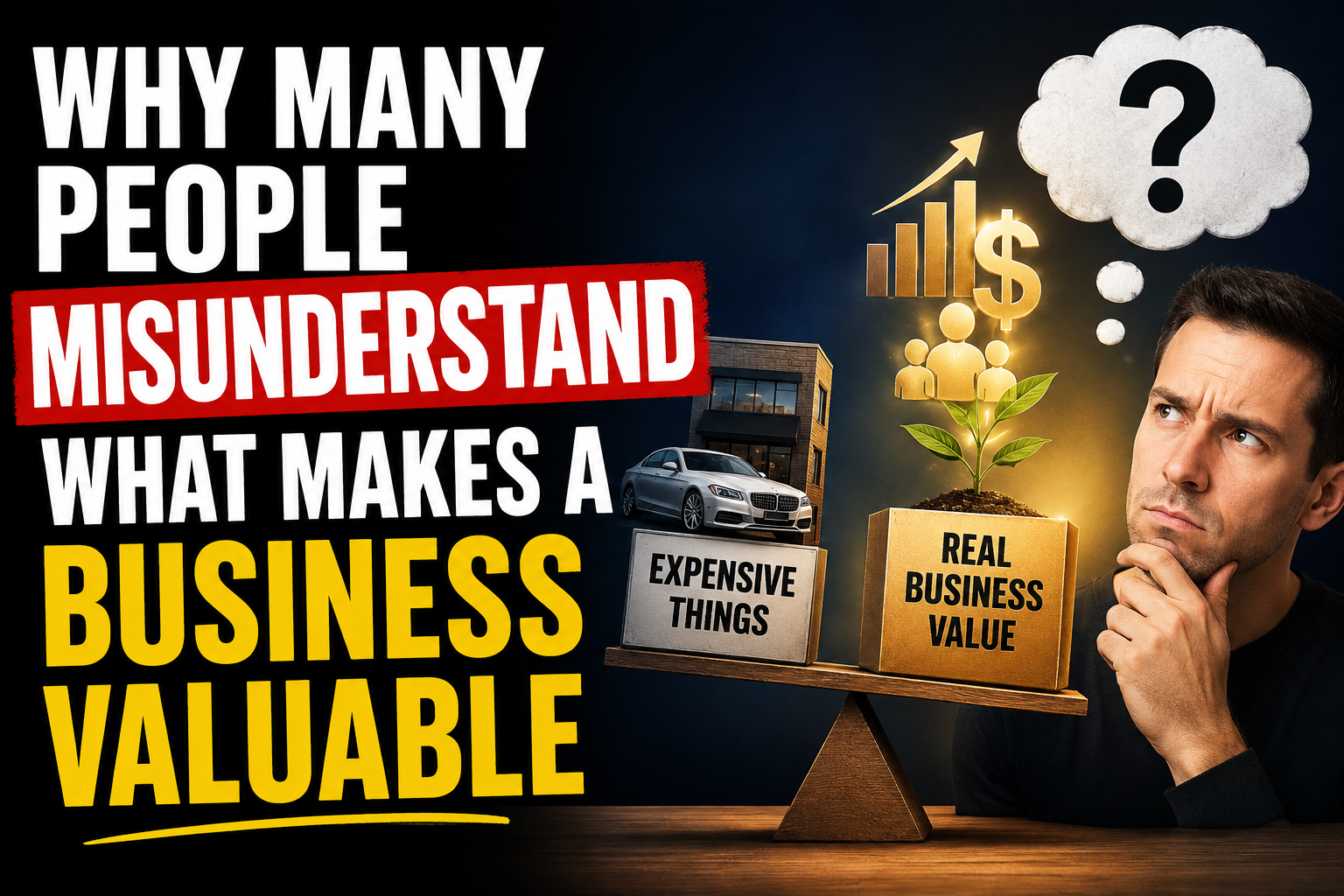
Why Many People Misunderstand What Makes a Business Valuable
Most people look at a business and immediately judge its value using the wrong lens. They see revenue, physical assets, or how busy the owner looks and assume that is what determines success. But in reality, business value is rarely about visible activity. It is about invisible structure. This misunderstanding is one of the biggest reasons many entrepreneurs struggle for years without building something truly scalable or sellable. Why Many People Misunderstand What Makes a Business Valuable.
A common belief is that a business is valuable because it makes money. While income is important, it is not the full picture. A business can generate high revenue and still collapse the moment the owner steps away. Another can earn modest income but steadily increase in value because it is built on systems, processes, and repeatable demand. The difference lies in stability and independence from the founder. Real value begins when a business can operate, grow, and adapt without constant personal intervention.
Many people confuse effort with value. They assume that the more physically involved the owner is, the more valuable the business must be. In truth, heavy dependence on personal effort often signals weakness, not strength. If a business cannot function without one person, then it is not truly a business in the scalable sense. It is a job disguised as ownership. True value emerges when tasks are transferable, operations are documented, and outcomes are predictable.
Another misunderstanding comes from focusing too much on profit without understanding consistency. A business that makes a large profit one month and nothing the next is not stable. Buyers, investors, and even long term thinkers look for consistency over spikes. Predictable income shows that demand is not accidental but structural. It means the business is solving a real, ongoing problem rather than benefiting from temporary attention or luck.
People also underestimate the importance of systems. A system is simply a repeatable way of achieving results without reinventing the process every time. Businesses with strong systems can grow without increasing stress or workload proportionally. Without systems, growth becomes a burden instead of an advantage. This is why some businesses collapse when they expand too quickly. The structure cannot support the scale, so everything breaks under pressure.
Another layer of misunderstanding comes from ignoring customer behavior. Many business owners focus too much on what they sell instead of why people buy. The real value of a business is deeply tied to customer psychology. If a business understands its audience at a deep level, it can adjust offers, pricing, and communication in ways that maintain demand even in changing conditions. Businesses that fail to understand this often struggle to retain customers, even if their product is decent.
Brand perception also plays a major role in value, but it is often misunderstood. A strong brand is not just a logo or visual identity. It is the level of trust and expectation people attach to a business. When customers believe a business consistently delivers quality, they are more likely to return and recommend it. This reduces marketing cost and increases long term profitability. Yet many entrepreneurs treat branding as decoration instead of strategy.
Scalability is another concept that is frequently misunderstood. A business is scalable when it can increase output without a proportional increase in cost or effort. Many people build businesses that are capped by time and energy. If every new sale requires the same amount of personal input, growth becomes limited. Scalable businesses use leverage such as automation, delegation, or digital systems to multiply results without multiplying strain.
There is also confusion about assets versus income. Income is what comes in regularly, but assets are what continue generating value even without active input. A business becomes truly valuable when it builds assets such as customer databases, intellectual property, automated systems, or strong distribution channels. These assets continue producing results even when the owner is not actively working. Many people never reach this stage because they focus only on short term earnings.
Market demand is another area where misunderstanding is common. Some entrepreneurs believe a good idea alone is enough to build value. However, ideas only matter when there is consistent demand behind them. A business that solves a real, urgent, and widespread problem will always outperform one that is creative but unnecessary. Value is determined by relevance, not originality. This is why some simple businesses outperform highly innovative but impractical ones.
Timing also plays a subtle but powerful role. A business can have a good product and strong effort behind it but still fail because the market is not ready. On the other hand, average ideas launched at the right time can grow rapidly. Understanding timing is part of understanding value. It requires awareness of trends, customer readiness, and economic conditions.
Another misunderstanding comes from overestimating competition. Many people assume that a crowded market means there is no opportunity. In reality, competition often confirms demand. The key is not avoiding competition but finding differentiation. Businesses become valuable when they position themselves uniquely within a known demand space. Competing without differentiation leads to price wars, but strategic positioning creates long term advantage.
Operational efficiency is another hidden factor. A business that wastes resources, time, or energy internally loses value even if it appears successful externally. Efficiency determines how much profit is retained after all costs. Many businesses generate revenue but leak value through poor operations, unnecessary complexity, or weak management systems. Over time, these inefficiencies reduce both profitability and attractiveness to investors.
Customer retention is often more important than customer acquisition, but many entrepreneurs focus in the opposite direction. Acquiring new customers is expensive and uncertain, while retaining existing ones is more stable and cost effective. A business that keeps customers returning builds predictable revenue streams. Yet this aspect is often ignored in favor of short term growth metrics.
Another major misunderstanding is ignoring the role of distribution. Even the best product has little value if it cannot reach the right audience. Distribution determines visibility, and visibility determines revenue potential. Businesses that master distribution channels, whether digital or physical, tend to outperform those with better products but weaker reach. Value is not just what you offer, but how effectively it reaches people who need it.
Emotional intelligence in business is also underestimated. Understanding how people feel, decide, and respond plays a critical role in pricing, marketing, and negotiation. Businesses that lack emotional awareness often miscommunicate value and lose potential customers. Those that understand emotional triggers can position their offerings more effectively without necessarily changing the product itself.
Many people also misunderstand ownership. Owning a business does not automatically mean owning value. If all critical functions depend on the founder, then ownership is incomplete. True ownership means the business can operate independently, generate income consistently, and be transferred or scaled without collapsing. This separation between owner and operation is what transforms a job into a real asset.
In the end, business value is not defined by what is visible on the surface. It is defined by structure, systems, demand, scalability, and independence. Many people remain stuck because they evaluate businesses based on effort and appearance instead of underlying mechanics. Once this perspective shifts, everything changes. The focus moves from working harder to building smarter, from income chasing to asset building, and from short term survival to long term value creation.

EarnSmartOnline.com.ng is dedicated to helping readers make smarter financial decisions through practical guides on online income, personal finance, technology, digital business, and wealth creation. Our goal is to provide reliable, easy-to-understand, and actionable content that empowers individuals to earn smarter, build sustainable income streams and achieve long-term financial success.
Recommended: Start Earning Online
- Ultimate Affiliate Marketing Program — learn affiliate marketing with a done-for-you sales system ($15). Check it out
- The Newbie Affiliate Guide — the beginner-friendly starter guide (~$6.68). Check it out
- Easy Dollar Maker — earn in dollars uploading AI images and videos from your phone ($17). Check it out
Disclosure: These are affiliate links. If you buy through them, I may earn a commission at no extra cost to you.



