
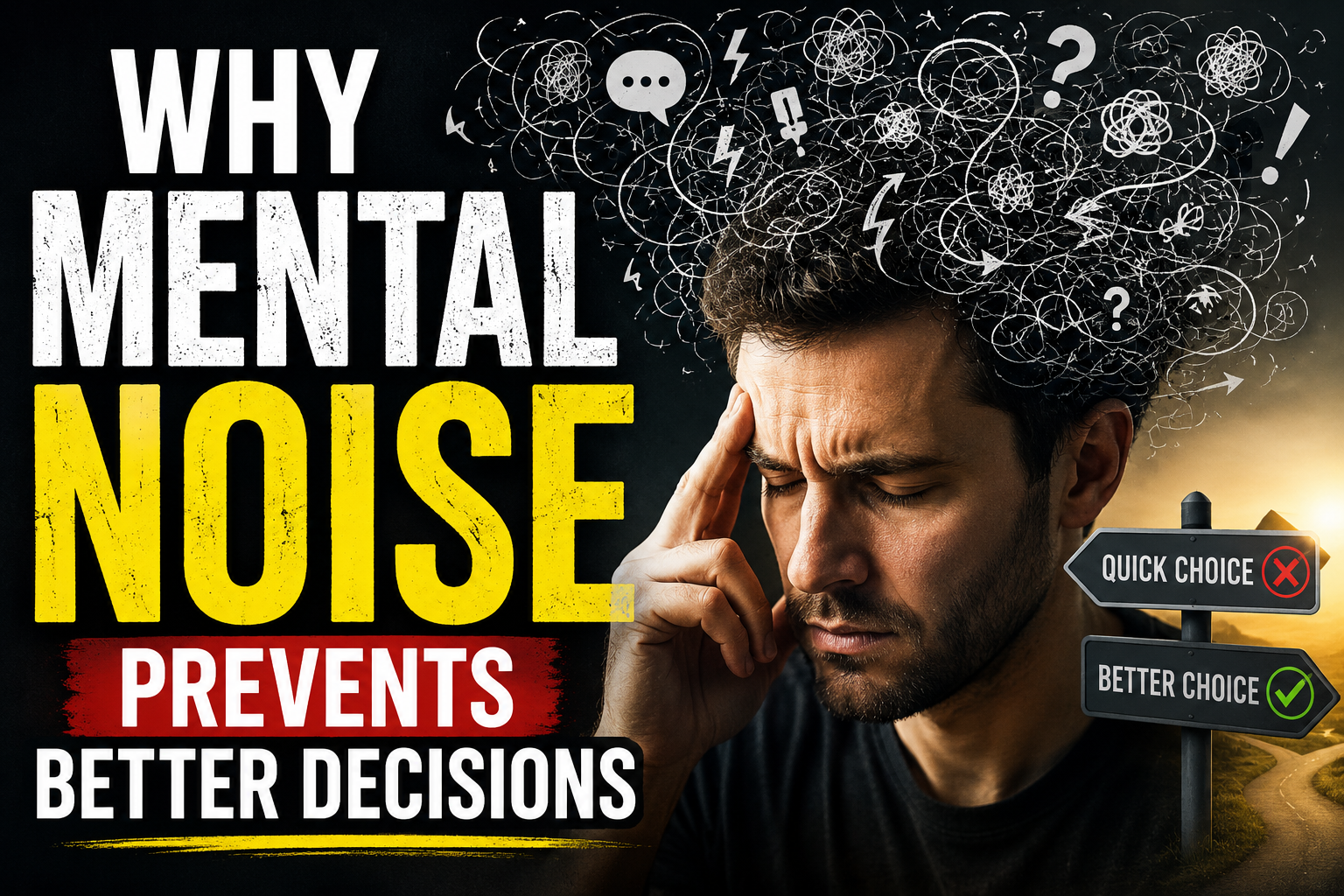
Why Mental Noise Prevents Better Decisions
Most people assume poor decisions come from lack of intelligence or lack of information. In reality, one of the most overlooked causes of bad decision making is something far less obvious and far more common. It is mental noise. Mental noise is the constant background activity in the mind made up of overthinking, emotional reactions, internal arguments, worries about the future, regrets about the past, and the endless stream of unrelated thoughts that compete for attention at the moment a decision is needed. When the mind is crowded in this way, clarity becomes difficult, even when the correct answer is already available.
Mental noise does not feel like noise in the traditional sense. It does not always announce itself loudly. Instead, it shows up as hesitation, confusion, second guessing, or the feeling that every option is slightly wrong. A person may sit in front of a simple decision and suddenly feel overwhelmed by unrelated thoughts. What should be a straightforward choice becomes complicated not because the situation is complex, but because the mind is overloaded. In that state, decisions are no longer guided by logic alone. They become influenced by stress, impulse, fear, or emotional discomfort.
One of the most damaging effects of mental noise is that it reduces the brain’s ability to prioritize information. Every decision requires filtering. The mind is supposed to identify what matters and ignore what does not. But when mental noise is high, everything feels important at the same time. A small detail carries the same emotional weight as a major factor. This creates internal confusion where the brain struggles to assign value correctly. Instead of focusing on the most relevant facts, attention is scattered across too many competing thoughts.
Another issue is that mental noise distorts perception of risk. A calm mind evaluates risk based on probability and evidence. A noisy mind evaluates risk based on emotion. This is why people often overestimate danger when they are anxious and underestimate it when they are overly excited. Mental noise amplifies emotional reactions and makes them feel like accurate signals. As a result, decisions become reactive rather than reflective. The person is no longer choosing based on reality but on the emotional state of the moment.
Mental noise also creates a false sense of urgency. When the mind is cluttered, even small decisions can feel time sensitive or life changing. This is because the brain interprets internal chaos as external pressure. Instead of slowing down to think clearly, the person rushes into action just to escape discomfort. Many poor decisions are not made because people lack time, but because they feel mentally pressured to end the discomfort of thinking. The decision becomes a relief mechanism rather than a deliberate choice.
Another subtle way mental noise interferes with decision making is through mental replay. People often replay past mistakes, imagining alternative outcomes and criticizing themselves for what they did or did not do. This consumes cognitive energy that should be used for present thinking. When the mind is occupied with rewriting the past, it loses its ability to fully engage with the present. This creates a loop where the person is partially living in yesterday while trying to decide about today.
Mental noise also reduces confidence in one’s own judgment. When thoughts are scattered, it becomes difficult to trust any single conclusion. Even when a logical answer emerges, it is quickly questioned by another internal voice. This leads to decision paralysis. The person keeps searching for more information, not because it is necessary, but because silence feels unsafe. In reality, the issue is not lack of information but lack of mental stillness. Without clarity, even correct answers feel uncertain.
In many cases, people confuse thinking more with thinking better. They assume that more mental activity leads to better outcomes. However, there is a difference between deep thinking and noisy thinking. Deep thinking is structured, focused, and directional. Mental noise is random, fragmented, and reactive. One leads to insight, the other leads to confusion. When the mind is full of unnecessary internal dialogue, it becomes difficult to distinguish between productive thought and mental distraction.
Emotions play a major role in increasing mental noise. Unresolved stress, frustration, fear, or excitement all generate internal movement in the mind. These emotions do not stay isolated. They spread into unrelated decisions, affecting judgment in areas that have nothing to do with the original emotional trigger. For example, someone stressed about work may make poor financial decisions, or someone emotionally excited may take unnecessary risks. Mental noise acts like a bridge that connects unrelated emotional states to decisions that require neutrality.
Another important factor is external stimulation. Modern life exposes the mind to constant input from messages, social media, conversations, and information overload. This constant input prevents the mind from settling into a calm state. Instead of processing one thought fully, the brain is continuously interrupted by new information. Over time, this creates a habit of fragmented attention. When it is time to make a decision, the mind struggles to focus long enough to evaluate options properly.
Mental noise also weakens intuition. Intuition is often misunderstood, but at its core it is the brain’s ability to recognize patterns quickly based on experience. However, intuition works best in quiet mental conditions. When the mind is overloaded, intuitive signals are drowned out by louder internal thoughts. This is why people sometimes ignore correct instincts and instead follow confusing reasoning that leads to worse outcomes. The signal is still there, but it is buried under mental clutter.
Another consequence is reduced patience. A noisy mind prefers fast conclusions because waiting feels uncomfortable. This leads to rushed judgments and incomplete evaluation of consequences. In contrast, a calm mind can tolerate uncertainty long enough to allow better information to emerge. Patience is not just a personality trait, it is a cognitive advantage. Without it, decisions are shaped by urgency rather than understanding.
Mental noise also creates inconsistency in decision making. One moment a person feels confident about a choice, and the next moment they feel doubtful. This inconsistency is not due to changing facts but due to shifting internal states. When the mind is unstable, decisions become unstable. Over time, this leads to a pattern where the person struggles to follow through on commitments, not because they lack discipline, but because their mental environment is constantly changing.
One of the most powerful truths about decision making is that clarity is not created by adding more thoughts, but by reducing unnecessary ones. The brain does not need infinite input to make a good decision. It needs relevant input organized in a stable mental space. When mental noise is reduced, the important factors naturally become more visible. Decisions that once felt complicated begin to simplify themselves because irrelevant noise is no longer competing for attention.
Silence in the mind does not mean absence of thought. It means the removal of unnecessary interference. In that state, thinking becomes more precise. Choices become easier to evaluate. Emotional reactions become easier to separate from logic. The mind stops reacting and starts observing. This shift alone dramatically improves the quality of decisions across every area of life, from personal relationships to financial planning to long term goals.
Ultimately, mental noise prevents better decisions because it disrupts the natural order of thinking. It replaces clarity with confusion, patience with urgency, logic with emotion, and confidence with doubt. Many people believe they need better strategies or more information to improve their decisions, but in many cases what they truly need is a quieter mind. A mind with less noise sees more clearly, thinks more accurately, and chooses more wisely.
When mental noise is reduced, decision making becomes less of a struggle and more of a natural process. Instead of forcing answers, the mind begins to recognize them. Instead of reacting to pressure, it responds with understanding. And instead of being pulled in multiple directions, it moves with direction and purpose. In that state, better decisions are not just possible, they become inevitable.

EarnSmartOnline.com.ng is dedicated to helping readers make smarter financial decisions through practical guides on online income, personal finance, technology, digital business, and wealth creation. Our goal is to provide reliable, easy-to-understand, and actionable content that empowers individuals to earn smarter, build sustainable income streams and achieve long-term financial success.
Recommended: Start Earning Online
- Ultimate Affiliate Marketing Program — learn affiliate marketing with a done-for-you sales system ($15). Check it out
- The Newbie Affiliate Guide — the beginner-friendly starter guide (~$6.68). Check it out
- Easy Dollar Maker — earn in dollars uploading AI images and videos from your phone ($17). Check it out
Disclosure: These are affiliate links. If you buy through them, I may earn a commission at no extra cost to you.



