
Why Minimalists Often Feel Wealthier is a question that becomes increasingly interesting in a world where success is often measured by how much a person owns, how expensive their possessions look, and how frequently they upgrade their lifestyle. Modern culture constantly encourages people to buy more, earn more, display more and chase the next level of consumption. Yet there is a growing group of people discovering something surprisingly different. They may own fewer clothes, fewer gadgets, fewer decorative items, fewer vehicles or even live in smaller homes, but they often report feeling more satisfied with their lives. In many cases, they also feel wealthier.
The reason is simple but profound. Wealth is not only about how much money you have. It is also about how much freedom, time, peace, control and satisfaction you experience. A person can have a high income and still feel financially trapped, while another person with a modest income can feel comfortable because their lifestyle requires less money to maintain. This is one of the central reasons why minimalists often feel wealthier. They have reduced the number of things competing for their money, attention and emotional energy.
Minimalism is often misunderstood as simply owning very few possessions. While possessions are certainly part of minimalist living, the deeper idea is about intentionally choosing what deserves space in your life. A minimalist does not necessarily hate luxury, expensive products or comfortable living. Instead, minimalism encourages people to question whether the things they buy genuinely improve their lives. The goal is not to own as little as possible. The goal is to stop allowing unnecessary possessions, expenses and commitments to control your life.
This distinction matters because many people spend money not because they need something, but because they have been conditioned to associate purchasing with happiness. Advertising tells us that a new phone will make us more successful, a bigger house will make us happier, designer clothing will make us more attractive, and a more expensive car will make us more respected. Social media adds another layer of pressure by constantly showing carefully selected images of people enjoying seemingly perfect lifestyles. The result is a never ending comparison game.
Minimalists often step away from that game. Instead of asking, “What can I afford?” they may ask, “What actually adds value to my life?” That question can completely change financial behaviour.
Imagine two people earning the same amount of money every month. The first person has a large house, several subscriptions, expensive clothing, multiple loans, frequent restaurant bills, constant gadget upgrades and a strong desire to maintain a particular image. The second person lives in a smaller home, owns fewer things, avoids unnecessary debt, cooks regularly, limits subscriptions and spends intentionally on experiences and priorities that matter to them.
On paper, both people may have identical incomes. Emotionally and financially, however, they may live completely different lives. The first person may constantly feel that money is disappearing. The second person may feel comfortable because there is less financial pressure. This is why minimalists often feel wealthier even when their bank balances are not necessarily enormous.
One of the biggest advantages of minimalist living is that it can reduce lifestyle inflation. Lifestyle inflation happens when people increase their spending as their income increases. Someone may receive a salary increase and immediately move into a more expensive apartment, buy a newer vehicle, upgrade their wardrobe, increase entertainment spending and take on new financial commitments. Their income rises, but their sense of financial freedom may not improve.
Minimalism challenges this cycle. Instead of automatically increasing consumption when income increases, a minimalist may keep some expenses stable and direct additional income towards savings, investments, debt reduction or meaningful experiences. Over time, this can create a stronger financial foundation.
The psychological effect can be powerful. When fewer things demand your money, you may feel as though you have more money. When fewer bills arrive every month, your income may feel larger. When fewer possessions require maintenance, your time may feel more abundant. When you stop constantly comparing your lifestyle with other people’s lifestyles, your existing life may suddenly feel much more valuable.
This is another important reason why minimalists often feel wealthier: they redefine what wealth means.
Traditional definitions of wealth tend to focus on possessions and financial numbers. Someone is considered wealthy because they own a large house, drive an expensive car, wear luxury clothing or have a large investment portfolio. These things can certainly represent financial success, but they do not automatically create a feeling of wealth.
Real wealth can also mean waking up without overwhelming financial pressure. It can mean having enough time to spend with family. It can mean being able to leave a toxic job because you have savings. It can mean not being afraid of an unexpected bill. It can mean having a home that feels peaceful rather than a storage facility filled with things you rarely use.
Why Minimalists Often Feel Wealthier
Minimalism brings attention to these less visible forms of wealth.
Consider time. Every possession comes with some form of responsibility. Clothes need organising and washing. Cars need servicing. Houses need cleaning and maintenance. Electronics need updates and repairs. Furniture takes up space. Subscriptions need monitoring. Even valuable possessions can create responsibilities. When someone deliberately reduces unnecessary possessions, they can also reduce the amount of time spent managing those possessions.
That extra time can become a form of wealth.
A person who spends less time shopping, comparing products, cleaning unnecessary clutter and worrying about upgrades may have more time for reading, learning, exercising, creating, resting or connecting with loved ones. Although these activities may not appear on a bank statement, they can dramatically improve quality of life.
Minimalism can also make people more aware of opportunity cost. Every amount of money spent on something unnecessary is money that cannot be used somewhere else. A £100 purchase is not simply a £100 purchase. It could represent £100 that could have gone into savings, debt repayment, an investment, education or an important future goal.
The same principle applies to attention. Every hour spent scrolling through shopping websites or comparing lifestyles online is an hour that cannot be spent building something meaningful.
Once people understand opportunity cost, they often become more selective. They stop asking only whether they can afford something and begin asking what they are sacrificing by purchasing it.
This can lead to a powerful form of financial confidence.
Minimalists often feel wealthier because they become less dependent on consumption to feel successful. Instead of constantly needing something new, they learn to appreciate what they already have. A phone can remain useful even when a newer model appears. A good pair of shoes does not become worthless because another pair has been released. A comfortable home does not become inadequate simply because someone else has a larger one.
This mindset can protect people from one of the most expensive habits in modern life: upgrading things that are already good enough.
There is nothing inherently wrong with buying new things. The problem begins when purchasing becomes automatic. If someone constantly replaces functional products simply because a newer version exists, the financial cost can become significant. Minimalism introduces a pause between desire and purchase.
That pause is extremely valuable.
Instead of immediately buying something, a person might ask, “Do I need this?” “Will I still want this in three months?” “Do I already own something that performs the same function?” “Am I buying this because I genuinely value it or because I want other people to notice me?”
These questions can prevent countless unnecessary purchases.
Minimalism can also reduce the emotional burden of clutter. A crowded environment can make people feel as though there is always something to organise, clean or deal with. When possessions accumulate faster than they are used, the home can become a constant reminder of unfinished decisions.
Removing unnecessary items can therefore create psychological space.
There is also an important connection between minimalism and financial independence. Financial independence is not necessarily about becoming extremely rich. It is about increasing the gap between what you earn and what you need to spend. The larger that gap becomes, the more flexibility you have.
Someone who needs a huge monthly income to maintain their lifestyle may have less freedom than someone whose basic lifestyle is inexpensive. The second person may be able to save more, invest more, change careers more easily or take time away from work when necessary.
This explains why someone earning less can sometimes experience more financial freedom than someone earning significantly more.
The minimalist lifestyle can also make saving feel less restrictive. Traditional approaches to saving sometimes focus heavily on cutting expenses and denying yourself everything enjoyable. That can create frustration. Minimalism takes a different approach. Instead of cutting everything, it encourages people to spend heavily on the things they genuinely value while reducing spending on things they do not care about.
For example, someone might happily spend money travelling while rarely buying clothes. Another person might value books and education while caring little about expensive restaurants. Someone else might prioritise a comfortable home and avoid expensive gadgets.
Minimalism does not require everyone to have identical priorities. It encourages intentionality.
This is why minimalist living should not be confused with poverty. Poverty is a lack of resources and choices. Minimalism, when practised voluntarily, is about making deliberate choices about resources. A minimalist may own fewer possessions because they have consciously decided that fewer possessions create a better life.
The difference is choice.
Minimalists often feel wealthier because they experience greater control over their consumption. Instead of being pulled from one purchase to another, they decide what deserves their money. That sense of control can be deeply satisfying.
Another reason minimalists often feel wealthier is that they become less vulnerable to comparison. Comparison is one of the fastest ways to make an otherwise comfortable person feel poor. You can have a perfectly functional car until you see your neighbour’s new vehicle. You can be happy with your home until you see someone’s luxury apartment online. You can appreciate your wardrobe until social media convinces you that you need something new every week.
There will always be someone with more.
If your definition of wealth depends on having more than other people, you can never permanently win. There will always be another person with a bigger house, newer car, larger investment portfolio or more impressive holiday photos.
Minimalism offers an escape from that competition by shifting attention from what others have to what you actually need.
That shift can produce gratitude.
Gratitude is not a substitute for financial planning, but it can change the way people perceive their resources. Someone who appreciates what they already own is less likely to experience constant dissatisfaction. They may still pursue financial growth, but their happiness is no longer completely dependent on reaching the next financial milestone.
This is an important distinction between ambition and dissatisfaction. You can want more without believing that what you currently have is worthless.
Minimalists often learn this balance.
They may still pursue higher income, investments, business opportunities and financial goals. The difference is that they are less likely to automatically turn every increase in income into an increase in consumption.
That can have a compounding effect.
If your income rises but your expenses remain relatively controlled, your ability to save and invest can increase dramatically. Over many years, the difference can become substantial. What began as a simple decision to buy fewer unnecessary things can eventually contribute to greater financial security.
Minimalism therefore has the potential to transform the relationship between money and happiness. Instead of using money primarily to acquire things, people can use money to purchase freedom.
Money can buy time when it allows you to outsource tasks. It can buy flexibility when it creates an emergency fund. It can buy opportunities when it funds education or business development. It can buy experiences that become lasting memories. It can provide security when it is invested responsibly.
The goal is not simply to accumulate money. The goal is to make money serve your values.
This is perhaps the deepest reason why minimalists often feel wealthier. They are not necessarily measuring wealth by the size of their possessions. They are measuring it by the quality of their lives.
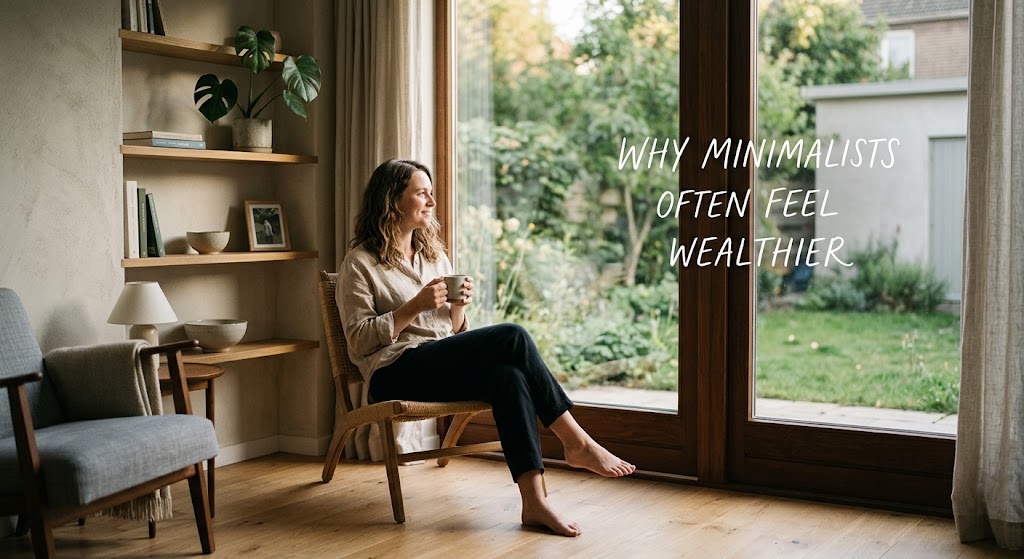
A person can sit in a small home, drink coffee from an ordinary cup, use an older phone and wear simple clothing while feeling incredibly rich because they have peace of mind, meaningful relationships, financial breathing room and control over their time.
Meanwhile, someone surrounded by luxury may feel poor if they are trapped by debt, pressure, comparison and the endless need to maintain an expensive lifestyle.
The lesson is not that everyone should become a minimalist. Different people have different personalities, responsibilities, cultures and goals. There is no single perfect lifestyle. The valuable lesson is to examine whether your consumption is serving you or controlling you.
Ask yourself what you own that genuinely improves your life. Ask yourself what you continue buying simply because everyone else seems to have it. Ask yourself how much of your income is being used to maintain an image. Ask yourself whether your lifestyle gives you freedom or constantly demands more money.
These questions can be uncomfortable, but they can also be liberating.
Minimalism is ultimately less about having an empty house and more about having a life that is not overcrowded by unnecessary demands. It is about making room for what matters. It is about recognising that more possessions do not automatically equal more happiness, more spending does not automatically equal more success and a higher income does not automatically equal greater wealth.
Why Minimalists Often Feel Wealthier becomes easier to understand when wealth is viewed through this wider lens. They may feel richer because they have fewer financial obligations, fewer distractions, fewer unnecessary purchases and fewer reasons to compare themselves with others. They may have more time, more control, more peace and more appreciation for what they already possess.
In a culture that constantly says “buy more”, minimalism asks a different question: “What if you already have enough?”
That question can change everything.
The pursuit of wealth does not have to mean endlessly increasing consumption. Sometimes becoming financially stronger means reducing what you need. Sometimes freedom comes not from earning more money but from needing less of it. Sometimes the most valuable upgrade is not a new device, bigger house or more expensive lifestyle, but a simpler life that allows you to keep more of your money, time and attention.
That is why minimalists often feel wealthier. They have discovered that wealth is not only about what you can afford to buy. It is also about what you no longer feel compelled to buy. It is about having enough and knowing that enough is enough.
In the end, the richest life may not be the one filled with the most possessions. It may be the one filled with the fewest unnecessary burdens and the greatest amount of freedom. When you can enjoy what you own, control what you spend, protect your time and stop measuring your life against somebody else’s highlight reel, you may discover a form of wealth that no shopping centre can sell and no social media platform can display.
Perhaps the real question is not whether you have enough money to buy more. Perhaps the more important question is whether you have enough freedom to enjoy what you already have.

EarnSmartOnline.com.ng is dedicated to helping readers make smarter financial decisions through practical guides on online income, personal finance, technology, digital business, and wealth creation. Our goal is to provide reliable, easy-to-understand, and actionable content that empowers individuals to earn smarter, build sustainable income streams and achieve long-term financial success.
Recommended: Start Earning Online
- Ultimate Affiliate Marketing Program — learn affiliate marketing with a done-for-you sales system ($15). Check it out
- The Newbie Affiliate Guide — the beginner-friendly starter guide (~$6.68). Check it out
- Easy Dollar Maker — earn in dollars uploading AI images and videos from your phone ($17). Check it out
Disclosure: These are affiliate links. If you buy through them, I may earn a commission at no extra cost to you.



