
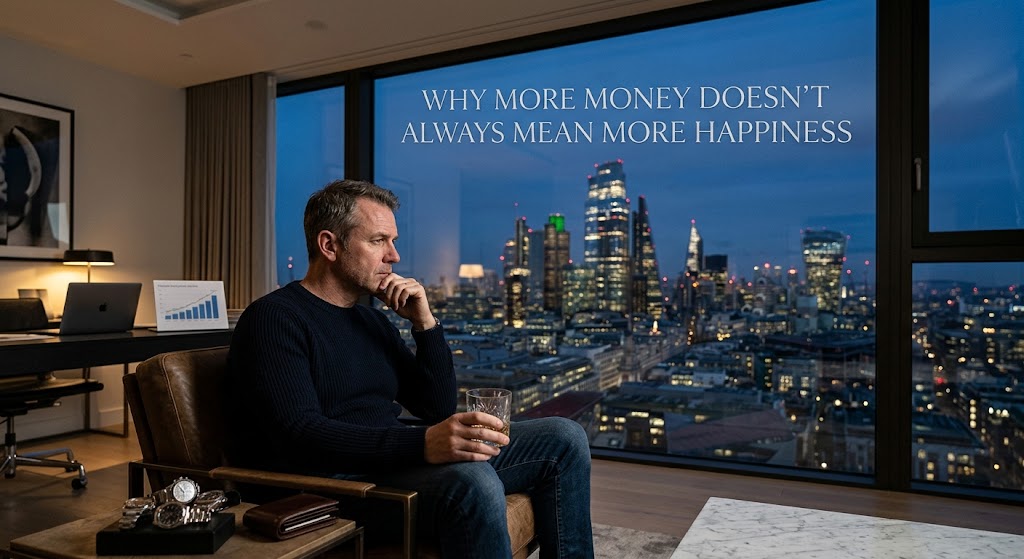
Why More Money Doesn’t Always Mean More Happiness is a question that becomes increasingly important as people chase higher salaries, bigger businesses, better cars, larger houses and more impressive lifestyles. Money is undeniably important. It can provide food, shelter, education, healthcare, security and opportunities that would otherwise be difficult to access. It can reduce certain forms of stress and give people greater freedom over how they spend their time. Yet, despite all these benefits, the relationship between money and happiness is far more complicated than many people realise.
Society often teaches us to believe that happiness is waiting for us somewhere in the future, usually after we reach a particular financial milestone. We tell ourselves that we will finally relax when we earn more. We will be happier when we move into a better house. We will feel successful when we buy the car we have always wanted. We will enjoy life properly when our bank account reaches a certain amount. We will stop worrying when we become financially comfortable. The problem is that the target keeps moving.
Someone earning a modest income may dream of earning twice as much. When that person reaches the target, the excitement can be real, but it may not last. Soon, the new income becomes normal. Then a bigger target appears. The person who once wanted enough money to pay their bills now wants a luxury apartment. The person who once dreamed of owning a car now wants a more expensive model. The person who once wanted financial security may eventually find themselves comparing their lifestyle with people who earn ten times more.
This is one of the reasons why Why More Money Doesn’t Always Mean More Happiness is such an important topic. Money can solve many problems, but it cannot automatically solve the emotional, relational and psychological problems that determine how deeply satisfied a person feels with life.
Imagine someone who has worked for years to become wealthy. They have a beautiful house, expensive clothes, several cars and enough money to travel whenever they want. From the outside, their life may appear perfect. Yet they may feel lonely because they have neglected their family. They may be constantly stressed because their business requires their attention every waking hour. They may struggle to trust people because they are unsure whether others genuinely care about them or simply want access to their money. They may have achieved financial success while losing peace of mind.
Now imagine another person who has considerably less money but has meaningful friendships, a loving family, good health, a sense of purpose and enough financial stability to meet their basic needs. Their lifestyle may not impress social media, but they may wake up with gratitude and go to bed with peace. They may not be rich by conventional standards, but they may feel rich in the things that matter most.
This does not mean poverty is desirable or that people should stop pursuing financial improvement. That would be an irresponsible conclusion. Lack of money can create serious problems. When someone cannot afford food, rent, school fees, medical treatment or transportation, financial pressure can have a major impact on their emotional wellbeing. Money matters enormously when basic needs are not being met.
The important distinction is that money can contribute to happiness without being the same thing as happiness.
Money can buy a comfortable bed, but it cannot guarantee peaceful sleep. It can buy a beautiful house, but it cannot create a loving family. It can pay for an expensive meal, but it cannot manufacture genuine companionship. It can provide access to entertainment, travel and luxury, but it cannot automatically give life meaning. It can purchase medicine, but it cannot guarantee perfect health. It can make certain problems easier to handle, but it cannot prevent every painful experience.
One of the biggest traps in modern life is confusing comfort with fulfilment. Comfort is valuable. Nobody should feel ashamed of wanting a comfortable life. However, comfort alone can become an endless pursuit.
The moment people become accustomed to a certain standard of living, that standard can begin to feel ordinary. A person who once considered a basic smartphone a luxury may eventually become dissatisfied because their device is not the latest model. Someone who once felt grateful to have a small apartment may eventually feel unsuccessful after constantly seeing mansions online. Someone who once celebrated earning enough to support their family may begin feeling poor because they compare themselves with someone who owns multiple businesses.
Comparison can destroy the happiness that money was supposed to create.
Social media has made this problem even more powerful. People are constantly exposed to carefully selected images of wealth, success and luxury. We see expensive cars, exotic holidays, designer clothes, huge houses, business achievements and seemingly perfect families. What we rarely see are the debts, anxiety, arguments, failed investments, sleepless nights, broken relationships and personal sacrifices behind those images.
A person can spend hours looking at someone else’s highlight reel and conclude that their own life is inadequate.
This creates a dangerous psychological cycle. Instead of asking, “Do I have enough to live a meaningful life?” people begin asking, “Do I have as much as the person I am watching?”
Those are completely different questions.
There is nothing wrong with wanting more money. Ambition can be healthy. Wanting to improve your income can motivate you to learn new skills, build a business, pursue better opportunities and become more financially responsible. The problem begins when money becomes the only measurement of personal worth.
If your identity depends entirely on how much you earn, then every financial setback can feel like a personal failure. If your confidence depends on what you own, then someone with more possessions can make you feel inferior. If your happiness depends on reaching a particular financial number, then you may spend your entire life chasing a finish line that keeps moving.
Money is a tool. It becomes dangerous when it becomes an identity.
Another reason Why More Money Doesn’t Always Mean More Happiness is that human beings adapt to circumstances. The excitement of acquiring something new often fades. A new car may feel extraordinary for the first few weeks. Eventually, it becomes the car you drive to work. A new house may feel like a dream come true at first. Eventually, it becomes the place where you live. A salary increase may feel life changing when it arrives. After several months, you may barely remember what your previous salary felt like.
This does not mean material possessions are useless. It means their emotional impact is often temporary.
The human mind is remarkably capable of turning extraordinary circumstances into ordinary routines. That is why constantly upgrading your lifestyle may not produce the permanent happiness you expect. Each upgrade can provide a temporary emotional boost, but eventually your mind adjusts and begins looking for the next thing.
This is where gratitude becomes powerful.
Gratitude does not mean refusing to grow. It means learning to appreciate what is already present while continuing to work towards what you want. You can desire a bigger house without hating your current home. You can work towards a higher income without believing your present income makes you worthless. You can dream of financial freedom while appreciating the people, experiences and opportunities already available to you.
Without gratitude, more can become a prison.
You keep acquiring, but you never feel that you have arrived.
Another important factor is time. Many people spend their healthiest and most energetic years chasing money, believing they will eventually use their wealth to enjoy life. Sometimes that plan works. Sometimes it does not.
There is a point at which a person must ask themselves what they are sacrificing in exchange for financial success.
If earning more requires working every waking hour, missing important family moments, destroying your health, abandoning friendships and living under constant stress, the additional income may come at a much higher cost than the bank statement reveals.
Money can give you options, but time is one of the most valuable things those options are supposed to help you protect.
A person who earns more but has no time to enjoy their life may not feel as wealthy as their income suggests.
This is why financial success should not be measured only by income. A healthier definition of financial success includes stability, freedom, responsible spending, manageable obligations, savings, meaningful relationships and the ability to enjoy life without constant financial fear.
Sometimes the goal should not be “How can I become extremely rich?” but “How can I create a life where money supports the things that matter to me?”
That question can completely change the way a person approaches wealth.
Money can also amplify existing habits. If someone is naturally generous, having more money may allow them to help more people. If someone is constantly dissatisfied, having more money may simply give them more expensive things to be dissatisfied about. If someone is disciplined, wealth can create opportunities. If someone is reckless, greater financial resources can magnify the consequences of their recklessness.
More money does not automatically create a better character.
In fact, financial success can sometimes expose weaknesses that were previously hidden. A person who was already obsessed with status may become even more obsessed when they become wealthy. Someone who struggled with insecurity may attempt to use expensive possessions to prove their worth. Someone who feared rejection may use money to gain approval.
This is why building character alongside wealth is so important.
There is also the issue of relationships. Human beings are social creatures. Genuine connection is one of the strongest sources of fulfilment. You can have thousands of followers and still feel lonely. You can have millions in your bank account and still desperately want someone you can trust. You can own a magnificent house and still wish there were people inside it who truly understood you.
Money can attract attention, but attention is not the same as love.
It can attract people, but being surrounded by people is not the same as belonging.
It can create opportunities to meet others, but it cannot guarantee genuine friendship.
Some of the most valuable experiences in life are not expensive. Sitting with someone you love and having an honest conversation costs nothing. Laughing with friends can cost nothing. Watching a child grow can cost nothing. Taking a quiet walk can cost nothing. Helping someone who genuinely needs assistance may cost little but create enormous emotional value.
This is not an argument against luxury. Enjoying beautiful things is part of being human. There is nothing inherently wrong with a luxury holiday, a beautiful home or an expensive car. The issue is expecting these things to carry the emotional weight that relationships, purpose, peace and personal fulfilment are supposed to carry.
Another reason people become unhappy despite having more money is that wealth can create new responsibilities. More money can mean more investments, more assets, more employees, more business decisions, more expectations and more people depending on you. Financial success can bring freedom, but it can also bring complexity.
Someone with very little may worry about paying their bills. Someone with substantial wealth may worry about protecting investments, managing businesses, dealing with financial risks or deciding whom to trust. The problems may change rather than disappear.
This is why the belief that money will eventually eliminate every problem is unrealistic.
Life will always contain uncertainty.
You can become financially successful and still experience heartbreak. You can become wealthy and still lose someone you love. You can have money and still face disappointment. You can own everything you once dreamed about and still wake up wondering what your life is actually about.
Why More Money Doesn’t Always Mean More Happiness
The goal, therefore, should not be to reject money but to put money in its proper place.
Money should serve your life rather than become your entire life.
A healthy relationship with money involves understanding what it can do and what it cannot do. Money can buy security, convenience, access and opportunities. It can reduce certain forms of stress. It can give you greater control over your choices. But it cannot replace purpose, character, love, friendship, health, peace or meaningful experiences.
The happiest person is not necessarily the person with the largest bank account. It may be the person who has enough financial stability to live without constant fear, enough wisdom to recognise what truly matters and enough gratitude to enjoy what they already have.
This is particularly important for young people who are constantly being told that success means becoming rich as quickly as possible. There is nothing wrong with ambition, but ambition without balance can become self destruction.
You do not need to prove your worth through your possessions.
You do not need to live a life designed to impress strangers.
You do not need to destroy your peace simply because someone else appears to be ahead of you.
Build wealth, but build wisdom too.
Increase your income, but increase your emotional intelligence too.
Develop your career, but develop your relationships too.
Save money, but save time for the people you love.
Invest financially, but invest in your health and character as well.
A meaningful life is rarely built from one ingredient.
Perhaps the real question is not whether money can make us happy. Of course, money can contribute to happiness. The deeper question is whether we have allowed money to become responsible for a job it was never designed to perform.
Money can make life easier.
It cannot automatically make life meaningful.
Money can create comfort.
It cannot guarantee contentment.
Money can give you choices.
It cannot tell you which choices are worth making.
Money can provide a beautiful environment.
It cannot guarantee that you will enjoy being there.
Money can help you escape certain problems.
It cannot make you immune to life.
This is the central lesson behind Why More Money Doesn’t Always Mean More Happiness. Financial growth is valuable, but financial growth should be part of a meaningful life rather than a substitute for one.
The healthiest approach is to pursue money without worshipping it. Work hard without making work your entire identity. Build wealth without measuring your worth by your net worth. Enjoy success without constantly comparing yourself with people who have more. Improve your lifestyle without becoming incapable of appreciating a simple one.
There will always be someone richer.
There will always be someone with a bigger house, a newer car, a larger business or a more impressive lifestyle. If your happiness depends on being ahead of everyone else, you have created a competition you can never permanently win.
Instead, measure progress against the person you used to be.
Are you more financially responsible than you were five years ago? Are you wiser? Are your relationships healthier? Are you taking better care of yourself? Do you have greater peace? Are you using your resources to create opportunities for yourself and others? Do you have something meaningful to wake up for?
Those questions may tell you more about the quality of your life than the amount of money in your account.
Ultimately, money is neither the enemy nor the answer to everything. It is a powerful resource. Used wisely, it can improve lives, create opportunities and provide freedom. Used as a replacement for love, purpose, identity and fulfilment, it can leave a person surprisingly empty.
The goal should not simply be to become richer.
The goal should be to become richer without becoming poorer in the things money cannot buy.
Because at the end of the day, the person who has the most money is not automatically the person who has won. True wealth is having enough resources to live responsibly, enough freedom to make meaningful choices, enough relationships to feel loved, enough purpose to feel useful, enough gratitude to appreciate what you have and enough wisdom to know that your bank balance is only one small part of your life.
That is why Why More Money Doesn’t Always Mean More Happiness is a lesson worth remembering. Chase financial stability. Build wealth. Increase your income. Create opportunities. Dream bigger. But never become so obsessed with getting more that you forget to live with what you already have.
Because there is a difference between having more money and having more life.
And sometimes, the richest person in the room is not the person with the most expensive possessions. It is the person who can go home, sleep peacefully, laugh genuinely, love deeply, wake up with purpose and honestly say, “I have enough to appreciate today while I work towards tomorrow.”

EarnSmartOnline.com.ng is dedicated to helping readers make smarter financial decisions through practical guides on online income, personal finance, technology, digital business, and wealth creation. Our goal is to provide reliable, easy-to-understand, and actionable content that empowers individuals to earn smarter, build sustainable income streams and achieve long-term financial success.
Recommended: Start Earning Online
- Ultimate Affiliate Marketing Program — learn affiliate marketing with a done-for-you sales system ($15). Check it out
- The Newbie Affiliate Guide — the beginner-friendly starter guide (~$6.68). Check it out
- Easy Dollar Maker — earn in dollars uploading AI images and videos from your phone ($17). Check it out
Disclosure: These are affiliate links. If you buy through them, I may earn a commission at no extra cost to you.



