
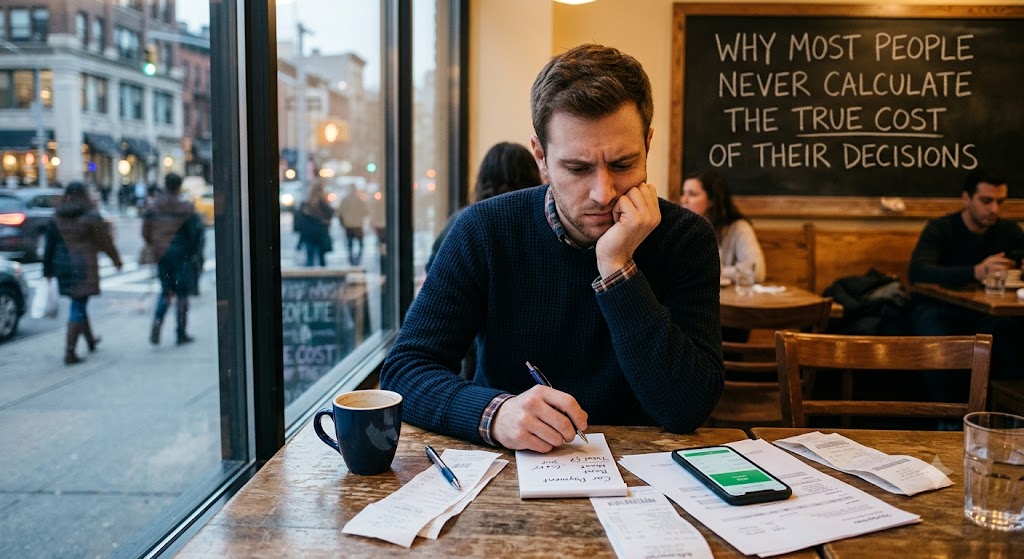
Why Most People Never Calculate the True Cost of Their Decisions
Every day, people make hundreds of decisions without giving much thought to the consequences that follow. Some choices appear too small to matter, while others seem so obvious that they barely require any consideration. Buying a new phone, skipping a workout, borrowing money, accepting a job, delaying a business idea, staying in an unhealthy relationship, wasting a few hours scrolling through social media, or refusing to learn a new skill may all seem like isolated events. In reality, every decision carries a cost, whether that cost is visible or hidden. The greatest mistake many people make is assuming that the price they pay today is the only price that exists.
The true cost of a decision is rarely found on a receipt or displayed on a bank statement. It often appears months or years later in the form of missed opportunities, broken relationships, poor health, financial struggles, lost confidence, and unrealised potential. While people are naturally drawn to immediate rewards and quick satisfaction, they often overlook the long term consequences quietly attached to every choice. This is why many individuals spend years wondering why life has become difficult, never realising that today’s circumstances are often the accumulated result of yesterday’s decisions.
One of the biggest reasons people fail to calculate the true cost of their decisions is because the human mind is wired to focus on the present. Immediate pleasure feels more real than future consequences. Buying an expensive gadget provides instant excitement, while saving that same money for investment offers no immediate emotional reward. Staying in bed instead of exercising feels comfortable now, while the benefits of fitness seem distant and uncertain. Choosing entertainment over education satisfies the moment, but the knowledge that could have changed a person’s future remains forever unexplored.
This preference for immediate gratification explains why so many intelligent people repeatedly make choices that work against their own interests. Intelligence alone does not protect anyone from poor decision making. Without discipline and long term thinking, even highly educated individuals can spend years making expensive mistakes disguised as harmless decisions.
Money provides one of the clearest examples of hidden costs. When someone spends money, most people only think about the amount leaving their account. They rarely think about what that money could have become if invested wisely. Spending fifty thousand naira on unnecessary luxury may seem insignificant today, but if that money had been invested consistently over several years, it could have multiplied many times over. The purchase itself is only part of the cost. The investment opportunity that disappears forever is often much more expensive.
Economists refer to this as opportunity cost, yet many people never consciously apply this principle to their daily lives. Every choice automatically eliminates countless alternatives. Saying yes to one thing means saying no to something else, whether that trade off is obvious or invisible. Time spent watching endless videos cannot simultaneously be used to learn a valuable skill. Money spent on status symbols cannot also be used to build assets. Energy wasted on unnecessary arguments cannot also strengthen meaningful relationships.
The tragedy is that opportunity costs are invisible. Since people never physically see the future they sacrificed, they convince themselves that nothing important was lost. This illusion creates a dangerous habit of undervaluing every decision they make.
Time itself carries one of the highest hidden costs imaginable. Unlike money, time can never be earned back. Every hour wasted is permanently removed from life’s limited supply. Yet many individuals casually exchange precious years for temporary distractions without recognising the enormous value of what they are spending.
Young people often believe they have unlimited time simply because they are young. This false sense of abundance leads them to postpone important decisions. They delay learning, investing, building businesses, improving their health, developing relationships, and creating opportunities because they assume there will always be another chance. Unfortunately, opportunities have expiration dates, even when people cannot see them.
The years between twenty and thirty, for example, often determine the direction of the next several decades. Skills learned during this period continue generating income for years. Habits developed become deeply rooted. Networks established create future opportunities. Investments started early benefit from the extraordinary power of compounding. Yet countless people spend these critical years chasing temporary excitement without calculating the enormous future cost.
Relationships also demonstrate how hidden costs accumulate quietly. Every harsh word spoken in anger creates emotional damage that may never fully disappear. Every ignored phone call slowly weakens friendships. Every broken promise reduces trust. Every dishonest action creates consequences beyond the immediate situation.
Many people believe relationships end because of one major incident. In reality, they usually collapse under the accumulated weight of thousands of small decisions that seemed insignificant at the time. Trust is rarely destroyed overnight. It erodes one decision at a time until eventually nothing solid remains.
Career decisions reveal another area where hidden costs become life changing. Accepting a comfortable job with no room for growth may provide immediate financial stability, but it may also delay personal development for years. Refusing to learn emerging technologies because current skills seem sufficient may appear harmless today, but it can eventually leave someone unemployable in an evolving economy.
The modern workplace changes faster than ever before. Industries disappear. New careers emerge. Artificial intelligence automates repetitive work. Companies seek adaptable individuals rather than those who simply possess outdated qualifications. Every year spent refusing to upgrade skills quietly increases future risk, even if everything appears stable in the present.
Health decisions may carry the most irreversible costs of all. Poor eating habits rarely produce immediate consequences. Smoking one cigarette does not instantly destroy the lungs. Missing one night’s sleep does not immediately ruin health. Avoiding exercise for one week rarely creates visible problems.
Because negative effects develop slowly, people assume no real damage is occurring. Yet inside the body, small decisions compound daily. Blood pressure gradually rises. Fat accumulates. Muscles weaken. Energy declines. Disease develops silently long before symptoms appear. By the time consequences become obvious, reversing them often requires enormous effort, money, and emotional resilience.
The same principle applies to positive habits. Reading ten pages of a good book every day appears insignificant. Saving a small percentage of every income feels almost meaningless. Exercising for thirty minutes seems too little to matter. Practising a valuable skill for one hour daily may not produce immediate mastery.
However, compound improvement transforms these seemingly ordinary actions into extraordinary results over time. Just as negative habits quietly destroy lives, positive habits quietly build remarkable futures. Unfortunately, because progress is gradual, many people abandon beneficial behaviours before experiencing meaningful results.
Emotions also distort people’s ability to calculate true costs. Decisions made while angry, fearful, excited, jealous, or desperate often ignore long term consequences. Someone overwhelmed by temporary frustration may resign from a stable job without another opportunity prepared. Another person may invest money recklessly after hearing stories of quick wealth. Others may enter unhealthy relationships because loneliness temporarily clouds their judgment.
Emotions are powerful, but they are poor financial advisers, unreliable business consultants, and dangerous life planners. Wise individuals recognise emotional influence while refusing to let temporary feelings permanently shape their future.
Social pressure introduces another hidden expense rarely considered. Many purchases occur not because people genuinely need something but because they fear appearing unsuccessful. Luxury cars, expensive clothing, extravagant weddings, lavish parties, and unnecessary gadgets often serve one purpose: impressing people whose opinions provide little lasting value.
Ironically, many individuals sacrifice genuine financial security to create an illusion of prosperity. They calculate the monthly payment but ignore years of financial pressure, anxiety, and missed investment opportunities created by those unnecessary expenses.
The digital age has introduced entirely new forms of hidden costs. Endless scrolling consumes attention that could have generated ideas, businesses, relationships, or valuable knowledge. Notifications interrupt concentration. Constant comparison damages self esteem. Misinformation shapes poor decisions. Hours disappear without producing anything meaningful.
Attention has become one of the world’s most valuable resources because wherever attention goes, time follows. Wherever time goes, life follows. Every unnecessary distraction quietly steals part of a person’s future without demanding immediate payment.
Many successful entrepreneurs understand this principle deeply. They protect their attention as carefully as they protect their money because they understand both resources produce future value. They recognise that saying yes to every invitation, every meeting, every notification, and every request creates enormous opportunity costs.
Education itself should never be viewed only through the cost of tuition. The real cost of education includes the knowledge gained, opportunities created, confidence developed, networks established, and income potential unlocked. Likewise, refusing to invest in personal development also carries a cost, although that cost often remains invisible for years.
People frequently complain that courses, books, seminars, certifications, or coaching programmes are expensive. Yet they rarely compare those expenses to the financial losses created by remaining uninformed. One good decision based on quality knowledge can repay educational investments many times over.
Failure to calculate hidden costs also explains why many businesses collapse despite promising beginnings. Business owners often focus entirely on visible expenses such as rent, salaries, equipment, or advertising while ignoring invisible costs like poor customer service, damaged reputation, inefficient systems, declining innovation, weak leadership, or employee dissatisfaction.
These invisible factors rarely appear in accounting software, yet they eventually influence revenue more than any visible expense ever could. By the time declining sales expose deeper problems, repairing damaged trust often becomes far more expensive than preventing the problem in the first place.
Every decision creates a chain reaction extending far beyond its original moment. One conversation leads to a friendship. One friendship creates a business partnership. One business opportunity transforms financial circumstances. One wise investment funds children’s education. One healthy habit extends life by many years. One disciplined decision inspires future generations.
Likewise, one reckless choice can begin an equally powerful chain of negative consequences. This is why mature decision makers rarely evaluate choices only by immediate outcomes. They ask deeper questions. They consider not only what they will gain today but also what they might lose tomorrow. They recognise that every action creates both visible and invisible consequences.
People who consistently build successful lives often possess no extraordinary intelligence unavailable to others. Instead, they simply calculate costs more completely. They understand that every decision involves far more than immediate pleasure, convenience, or financial expense. They think in years instead of days. They evaluate consequences before emotions take control. They appreciate compounding in both positive and negative directions. Most importantly, they understand that life itself is largely the accumulated result of countless ordinary decisions made consistently over time.
The true cost of a decision is rarely obvious in the moment it is made. It quietly unfolds through the months and years that follow, shaping opportunities, relationships, finances, health, reputation, and personal fulfilment. Those who learn to recognise these hidden costs gain an extraordinary advantage because they begin making decisions that serve not only the present but also the future. In the end, success is seldom determined by one dramatic choice. It is built through thousands of seemingly ordinary decisions whose true value was understood long before everyone else could see their results.

EarnSmartOnline.com.ng is dedicated to helping readers make smarter financial decisions through practical guides on online income, personal finance, technology, digital business, and wealth creation. Our goal is to provide reliable, easy-to-understand, and actionable content that empowers individuals to earn smarter, build sustainable income streams and achieve long-term financial success.
Recommended: Start Earning Online
- Ultimate Affiliate Marketing Program — learn affiliate marketing with a done-for-you sales system ($15). Check it out
- The Newbie Affiliate Guide — the beginner-friendly starter guide (~$6.68). Check it out
- Easy Dollar Maker — earn in dollars uploading AI images and videos from your phone ($17). Check it out
Disclosure: These are affiliate links. If you buy through them, I may earn a commission at no extra cost to you.



