
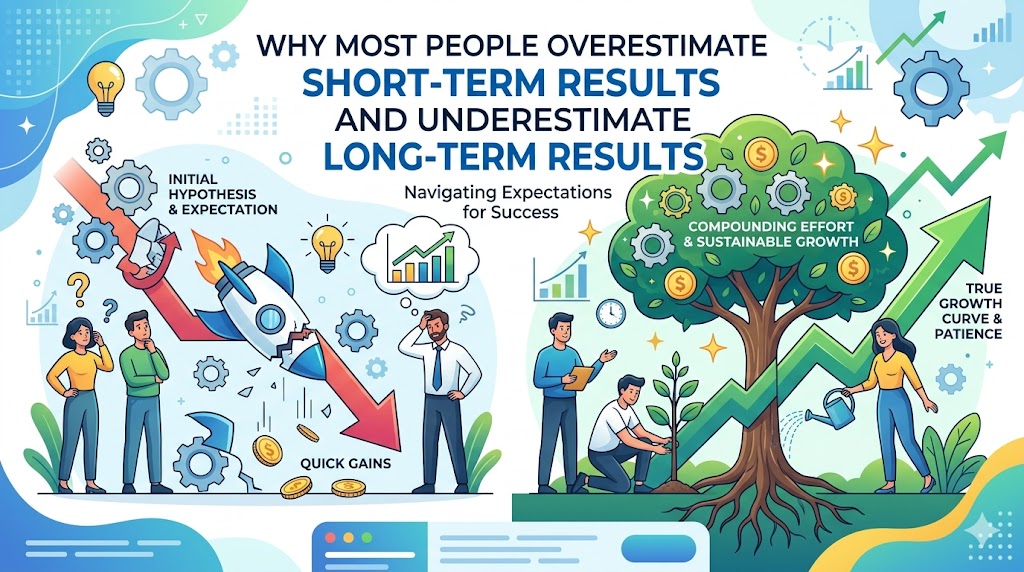
Why Most People Overestimate Short-Term Results and Underestimate Long-Term Results
Most people tend to evaluate success through a very narrow lens of time. They look at what is happening today, this week, or at best this month, and they assume those outcomes reflect the true direction of their life, business, or career. This creates a distorted sense of reality where short bursts of progress feel like real success, while slow and steady growth feels like failure. Because of this mindset, many people chase fast results, abandon meaningful processes too early, and misjudge the real value of their actions. The truth is that short term results are often noisy, misleading, and heavily influenced by luck, timing, and emotional decisions, while long term results are where true patterns of success are revealed. Why Most People Overestimate Short-Term Results and Underestimate Long-Term Results.
One of the biggest reasons people overvalue short term results is because of psychological reinforcement. The human brain is wired to respond quickly to immediate feedback. When something works instantly, it creates excitement and validation. When something takes time, it feels like it is not working at all. This is why people celebrate sudden wins even if they are not sustainable, and feel discouraged by gradual progress even if it is extremely powerful. A person can make a small amount of money quickly and feel successful, while another person building a foundation that will generate wealth for years may feel like they are falling behind. This bias toward immediacy leads to poor decision making because it confuses emotional satisfaction with actual progress.
Short term thinking also creates an illusion of control. When people see immediate outcomes, they believe they fully understand the cause and effect behind them. For example, if someone tries a new strategy and gets quick results, they assume the strategy is inherently effective in all conditions. But they fail to account for randomness, timing, or external factors that may have contributed to the outcome. This leads to overconfidence in short term success and underestimation of the complexity behind sustainable growth. As a result, people often double down on temporary wins and ignore the systems that actually produce consistent long term results.
Another major factor is social comparison. Society tends to highlight visible success stories that happen quickly. People rarely see the years of effort, failure, and refinement behind those outcomes. What is visible is the breakthrough moment, not the long preparation period. This creates a distorted perception that success happens suddenly, and that long term effort is unnecessary. Because of this, people feel pressure to achieve visible milestones quickly, and when they do not, they assume they are on the wrong path. This misunderstanding pushes many individuals to abandon strategies that would have worked if given enough time to mature.
Long term results, on the other hand, operate differently. They are built through accumulation, repetition, and compounding effects that are not immediately visible. Small improvements made consistently over time eventually create outcomes that appear sudden to outside observers. However, the reality is that nothing about them is sudden. They are the result of hundreds or thousands of small actions that were too small to be impressive individually but powerful when combined. The challenge is that most people do not have the patience to stay committed during the invisible phase of growth, where effort is not yet matched by visible reward.
Another important aspect is that long term results filter out inconsistency. In the short term, almost anything can look successful under the right conditions. A bad strategy can produce good results temporarily, and a good strategy can appear ineffective if the timing is wrong. But over time, only systems that are fundamentally sound continue to produce results. This is why long term thinking is more reliable. It removes noise and exposes truth. However, because humans are naturally impatient, they often abandon systems before they have enough time to reveal their real effectiveness.
The misunderstanding between short term and long term thinking also affects financial decisions. Many people prefer immediate gains over delayed but larger rewards. They choose options that provide quick satisfaction rather than building assets that grow over time. This behavior is not limited to money alone. It extends to skills, relationships, health, and career development. For example, someone might choose comfort today instead of investing time in learning a high value skill that could transform their future. The immediate cost of effort feels too high compared to the distant benefit, even though the long term payoff is significantly greater.
Another reason long term results are underestimated is because they require faith in processes that do not produce instant validation. It is difficult to stay committed to something when progress is not obvious. People naturally seek reassurance that they are moving in the right direction, and when that reassurance is missing, they assume failure. However, many of the most meaningful outcomes in life do not provide constant feedback. They require persistence through uncertainty. This is where most people give up, not because the system is wrong, but because their patience runs out before the system has time to work.
Overemphasis on short term results also encourages reactive behavior. Instead of following a consistent plan, people frequently change direction based on recent outcomes. If something works today, they repeat it excessively. If something fails once, they abandon it completely. This creates instability in their approach and prevents them from building momentum. Long term success requires staying aligned with a strategy long enough for compounding effects to take place. Without consistency, even the best strategy cannot produce meaningful results.
In contrast, long term thinking rewards discipline, patience, and delayed gratification. It encourages people to focus on systems rather than outcomes, and processes rather than moments. When someone commits to a direction and stays consistent long enough, the results begin to multiply in ways that are not immediately predictable. Over time, the difference between someone who thinks short term and someone who thinks long term becomes massive. One person is constantly restarting their progress, while the other is building on previous efforts.
The challenge is that long term results often feel invisible in the beginning. This invisibility creates doubt, and doubt leads to abandonment. But what most people do not realize is that invisibility is part of the process. Growth does not always announce itself. It accumulates quietly until it reaches a point where it becomes undeniable. By the time it is obvious, it has already been developing for a long time. Those who understand this dynamic are able to stay consistent even when results are not visible, and that consistency becomes their competitive advantage.
Ultimately, the difference between short term and long term thinking is the difference between reacting and building. Short term thinking reacts to what is happening now, while long term thinking builds for what will happen later. One is driven by emotion, the other by strategy. One creates temporary spikes in progress, while the other creates lasting transformation. When people learn to value long term results more than short term validation, their decisions begin to change. They become more patient, more intentional, and more focused on what truly matters.
The most successful individuals are not those who achieve the fastest results, but those who understand how to wait for meaningful ones. They recognize that real success is not measured by immediate outcomes but by sustained progress over time. Once this understanding is developed, it becomes easier to ignore distractions, stay consistent, and trust the process even when results are not yet visible. In the end, long term thinking is not just a strategy, it is a fundamental shift in how success is perceived and pursued.

EarnSmartOnline.com.ng is dedicated to helping readers make smarter financial decisions through practical guides on online income, personal finance, technology, digital business, and wealth creation. Our goal is to provide reliable, easy-to-understand, and actionable content that empowers individuals to earn smarter, build sustainable income streams and achieve long-term financial success.
Recommended: Start Earning Online
- Ultimate Affiliate Marketing Program — learn affiliate marketing with a done-for-you sales system ($15). Check it out
- The Newbie Affiliate Guide — the beginner-friendly starter guide (~$6.68). Check it out
- Easy Dollar Maker — earn in dollars uploading AI images and videos from your phone ($17). Check it out
Disclosure: These are affiliate links. If you buy through them, I may earn a commission at no extra cost to you.



