
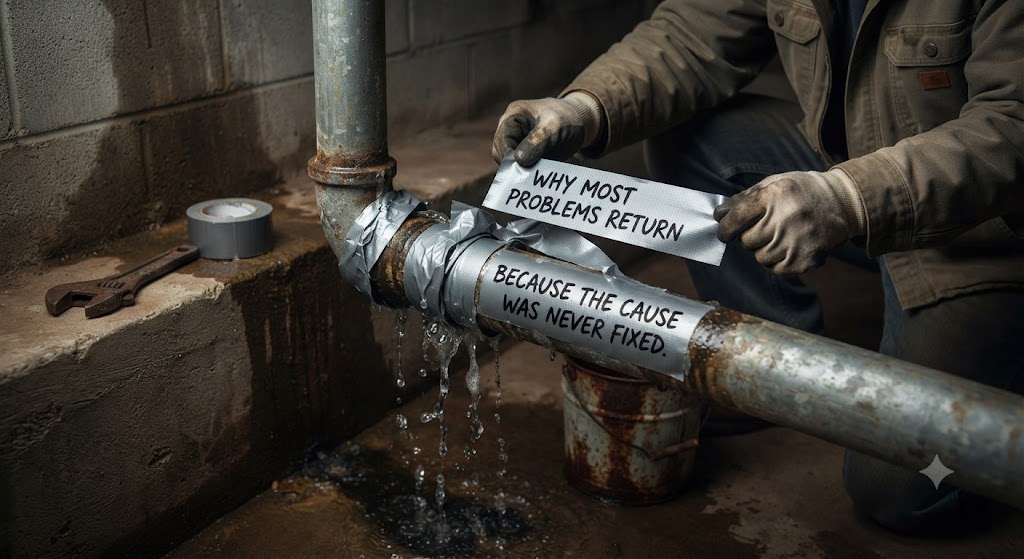
Why Most Problems Return Because the Cause Was Never Fixed
Every person has experienced the frustration of solving a problem only to watch it return days, weeks, or even months later. It happens in families, businesses, relationships, careers, finances, health, education, and even entire nations. A leaking roof is patched but never replaced. A company loses customers and responds with discounts instead of improving service. A family argues over the same issue every month without addressing the real source of conflict. Someone struggles financially and blames low income without recognising destructive spending habits. The pattern repeats because the visible problem receives attention while the hidden cause remains untouched. This is why most problems return because the cause was never fixed. Understanding this principle can completely change the way you approach challenges and make decisions, leading to longer-lasting solutions and fewer recurring setbacks.
One of the biggest mistakes people make is confusing symptoms with causes. Symptoms are what we can easily see. Causes are often hidden beneath the surface. Imagine a tree with unhealthy leaves. Cutting off the damaged leaves may improve its appearance temporarily, but if the roots are diseased, the tree will continue producing unhealthy leaves. The leaves are merely symptoms. The roots are the real issue. In life, many people spend enormous amounts of time trimming the leaves while completely ignoring the roots. As a result, they become trapped in a frustrating cycle of repeating the same battles over and over again.
This pattern appears everywhere in modern society. Businesses often notice declining sales and immediately increase advertising budgets. More people may visit their website, but customers still leave without buying because the real issue is poor product quality, weak customer service, or confusing pricing. The increased marketing temporarily masks the problem without eliminating it. Eventually, sales decline again because the root cause remains untouched.
Personal finances provide another excellent example. Many individuals believe earning more money will solve all their financial problems. They receive salary increases, bonuses, or additional income, yet remain financially stressed. The reason is simple. Their spending habits, lack of budgeting, poor saving discipline, and impulsive financial decisions were never corrected. Higher income simply fuels larger expenses. Until the underlying financial behaviours change, money problems continue regardless of how much income increases.
Relationships also demonstrate this principle. Couples frequently argue about money, household chores, communication, or parenting. These arguments seem to revolve around specific incidents, but they often originate from deeper issues such as lack of trust, poor communication skills, unresolved resentment, unrealistic expectations, or emotional insecurity. Unless these deeper issues are addressed honestly, the same arguments will continue under different circumstances. The topics change, but the conflict remains remarkably familiar because its true source still exists.
Health offers perhaps the clearest illustration. Someone experiences constant headaches and relies on painkillers every day. The medication relieves the pain temporarily, but if the headaches result from chronic stress, dehydration, poor sleep, or an underlying medical condition, the headaches inevitably return. Treating symptoms without identifying their origin rarely produces lasting improvement. True healing begins when the actual cause receives proper attention.
Many organisations unknowingly create cycles of recurring problems because they reward quick fixes instead of permanent solutions. Managers often focus on meeting immediate deadlines, satisfying quarterly targets, or reducing visible complaints. They rarely invest sufficient time investigating why problems occurred in the first place. As a result, employees repeatedly solve identical issues, consuming valuable time, energy, and financial resources that could have been used for innovation and growth.
Human psychology contributes significantly to this behaviour. Most people naturally prefer immediate relief over long-term solutions. Fixing symptoms is usually easier, faster, and less uncomfortable than confronting root causes. Root causes often require admitting mistakes, changing habits, investing money, learning new skills, or having difficult conversations. These actions demand patience and courage. Temporary solutions provide instant satisfaction, even if they ultimately create bigger problems later.
Fear also plays a powerful role. Sometimes people recognise the real cause but avoid dealing with it because the solution appears difficult. An employee knows their lack of qualifications limits career growth but postpones further education because studying requires sacrifice. A business owner recognises outdated technology is hurting productivity but delays upgrading because of the initial investment. A family understands poor communication damages relationships but avoids honest discussions because they fear emotional conflict. Avoidance allows the root cause to grow stronger while temporary fixes become increasingly ineffective.
Another common reason problems return is the tendency to blame external circumstances instead of examining internal factors. It is easier to blame the economy, competitors, neighbours, relatives, colleagues, or bad luck than to evaluate personal decisions honestly. While external factors certainly influence outcomes, lasting improvement usually begins by examining what lies within our control. Personal responsibility is uncomfortable, but it creates opportunities for genuine progress.
Education often teaches people how to answer questions but not necessarily how to ask better ones. Yet asking the right questions is often the key to identifying root causes. Instead of asking, “How do I stop this problem today?” ask, “Why did this problem happen at all?” Instead of asking, “How do I remove this symptom?” ask, “What created this symptom?” These simple shifts in thinking transform problem-solving from reactive to proactive.
Professionals across many industries rely on root cause analysis because they understand that lasting success depends on solving underlying issues rather than visible effects. Engineers investigate structural failures before rebuilding. Doctors conduct diagnostic tests before prescribing treatments. Investigators search for motives instead of merely observing outcomes. Successful business leaders analyse customer behaviour before redesigning products. Their focus extends beyond appearances to the mechanisms producing those appearances.
One particularly effective approach involves repeatedly asking why until reaching the underlying source of a problem. A company experiences delayed deliveries. Why? Because production is behind schedule. Why? Because machines frequently break down. Why? Because maintenance is inconsistent. Why? Because maintenance budgets were reduced. Why? Because leadership prioritised short-term cost savings over long-term reliability. Suddenly, the real issue becomes visible. Delayed deliveries were never the actual problem. They were merely the final consequence of earlier decisions.
Technology has made solving symptoms even easier while sometimes making root causes harder to recognise. Software automatically corrects mistakes, smartphones simplify complex tasks, and digital platforms provide instant solutions to countless problems. Although these innovations improve convenience, they can encourage superficial thinking. People become accustomed to immediate fixes without developing the habit of investigating underlying causes. Convenience has tremendous value, but critical thinking remains irreplaceable.
History repeatedly demonstrates that societies ignoring root causes eventually face greater crises. Economic instability often follows years of unsustainable financial policies. Environmental disasters frequently result from decades of neglect. Public health challenges often emerge after prolonged disregard for prevention. Political unrest typically develops from unresolved social tensions. Major crises rarely appear overnight. They grow gradually while smaller warning signs are ignored or superficially addressed.
Personal growth follows the same pattern. Someone repeatedly struggles with procrastination and downloads new productivity apps every month. Another purchases motivational books without changing daily habits. Someone else sets ambitious goals every January but abandons them within weeks because underlying discipline, routines, and mindset remain unchanged. External tools help only when internal foundations are strengthened. Otherwise, each new solution becomes another temporary distraction.
Leadership requires the courage to look beneath appearances. Great leaders resist the temptation to celebrate quick victories if deeper issues remain unresolved. They ask difficult questions, encourage honest feedback, and create environments where identifying root causes is valued rather than discouraged. Employees become more willing to report problems early when they know the organisation seeks understanding instead of assigning blame.
Communication also improves dramatically when people focus on causes rather than reactions. Instead of criticising behaviour alone, effective communicators seek to understand motivations, fears, misunderstandings, and unmet needs. This approach does not excuse harmful actions, but it creates better opportunities for meaningful change. Solving problems becomes more collaborative and less confrontational.
Patience is essential because fixing root causes rarely produces immediate results. Replacing weak foundations takes longer than painting cracked walls. Building healthy financial habits requires months or years rather than days. Restoring trust after betrayal demands consistent behaviour over time. Strengthening physical health involves sustained lifestyle improvements rather than overnight transformations. Lasting solutions often progress quietly before their benefits become visible.
There is also an important economic lesson here. Temporary solutions frequently cost more than permanent ones. Constant repairs, repeated mistakes, recurring customer complaints, employee turnover, preventable illnesses, and recurring conflicts all consume resources continuously. Investing in lasting solutions may require greater effort initially, but it usually reduces future costs significantly. This principle applies equally to households, businesses, governments, and individuals.
Successful people develop the habit of recognising patterns rather than isolated events. When similar problems continue appearing, they assume something deeper requires attention. Instead of asking whether another quick solution exists, they investigate why identical situations continue occurring. Patterns reveal systems, and systems reveal causes. Once systems improve, recurring problems gradually disappear.
Self-awareness plays a vital role throughout this process. Many recurring problems originate from personal habits people barely notice. Poor listening creates repeated misunderstandings. Lack of preparation leads to repeated disappointments. Weak organisation produces repeated stress. Impulsive decisions create repeated regret. Honest self-reflection allows individuals to recognise these patterns before they become permanent features of life.
Modern culture often celebrates speed, but wisdom values accuracy. Solving the wrong problem quickly remains ineffective regardless of efficiency. Spending hours working harder on symptoms while ignoring causes only accelerates frustration. Sometimes slowing down long enough to understand a situation saves enormous time later. Careful diagnosis often proves more valuable than immediate action.
Families that successfully overcome recurring challenges usually establish healthier systems rather than relying on emotional reactions. They communicate openly, clarify expectations, share responsibilities fairly, and address misunderstandings before resentment accumulates. These habits strengthen the foundation upon which healthier relationships are built. Arguments become less frequent because the conditions producing them gradually disappear.
The workplace offers similar lessons. Organisations with strong cultures focus on prevention rather than constant crisis management. They improve hiring processes instead of repeatedly replacing unsuitable employees. They invest in training rather than repeatedly correcting preventable mistakes. They encourage innovation rather than constantly responding to emergencies. Over time, these organisations spend less energy solving recurring problems because their systems eliminate many issues before they emerge.
Ultimately, why most problems return because the cause was never fixed comes down to a simple but powerful truth. Lasting change begins beneath the surface. Symptoms demand attention because they are visible, painful, and urgent. Causes demand wisdom because they are often hidden, uncomfortable, and time-consuming to address. Those who learn to distinguish between the two gain a tremendous advantage in every area of life.
The next time you face a recurring challenge, resist the temptation to rush towards the quickest solution. Pause and ask deeper questions. Look beyond appearances. Examine patterns instead of isolated incidents. Be willing to confront uncomfortable truths if they lead to meaningful progress. Whether the issue involves money, health, relationships, business, education, or personal development, permanent improvement almost always begins by fixing what created the problem rather than merely managing what the problem looks like.
Life becomes significantly less complicated when you stop fighting the same battles repeatedly. Every lasting solution starts with understanding. Every meaningful improvement begins at the root. When the cause is finally corrected, the recurring problem loses its power, and what once felt like an endless cycle becomes a lesson that never has to be repeated again.

EarnSmartOnline.com.ng is dedicated to helping readers make smarter financial decisions through practical guides on online income, personal finance, technology, digital business, and wealth creation. Our goal is to provide reliable, easy-to-understand, and actionable content that empowers individuals to earn smarter, build sustainable income streams and achieve long-term financial success.
Recommended: Start Earning Online
- Ultimate Affiliate Marketing Program — learn affiliate marketing with a done-for-you sales system ($15). Check it out
- The Newbie Affiliate Guide — the beginner-friendly starter guide (~$6.68). Check it out
- Easy Dollar Maker — earn in dollars uploading AI images and videos from your phone ($17). Check it out
Disclosure: These are affiliate links. If you buy through them, I may earn a commission at no extra cost to you.



