
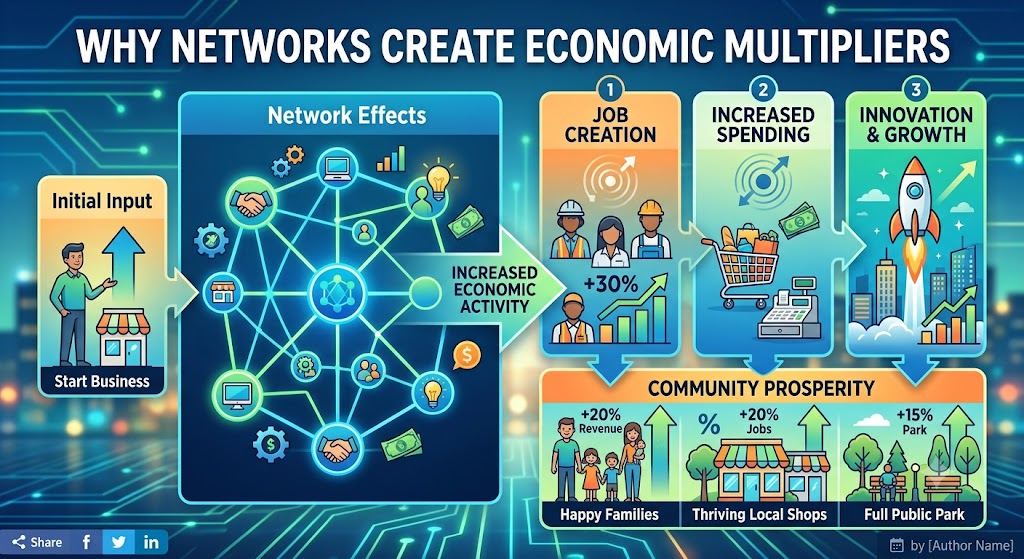
Why Networks Create Economic Multipliers
In every economy, whether digital or physical, value rarely moves in isolation. What most people see as individual success is often the visible outcome of something much larger working quietly in the background. That hidden force is networks. Networks are not just groups of people connected by chance. They are living systems of trust, exchange, information flow, and opportunity distribution. When these systems become strong, they create what can only be described as economic multipliers, where one connection leads to several opportunities, and one opportunity leads to many more.
To understand why networks create economic multipliers, it is important to first understand how most people traditionally think about income and value. Many assume that income is strictly tied to effort or time. Work more hours, earn more money. Improve a skill, increase your pay. While this is partly true, it is incomplete. In reality, income is also shaped by access. Access to people, access to information, and access to opportunities. Networks determine how much access you have, and access determines how far your efforts can go.
A network acts like an amplifier for human capability. On your own, your knowledge, skills, and time are limited. You can only do so much in a day. However, when you are connected to a network of people who think, build, buy, sell, and share information, your reach expands beyond your personal limits. A single idea can move through a network and become a business opportunity, a partnership, or a new source of income. This amplification effect is what makes networks economically powerful.
One of the clearest ways networks create economic multipliers is through information flow. Information is one of the most valuable resources in any economy, but it is not evenly distributed. Some people know where opportunities are forming long before others. Some people hear about changes in markets before they become obvious. In strong networks, information travels faster and more efficiently. This means that individuals within the network are more likely to act early, position themselves correctly, and benefit from opportunities before they become widely known.
Trust is another critical factor. In weak or disconnected environments, people spend a lot of time proving themselves. They struggle to get access, struggle to be believed, and struggle to be recommended. In strong networks, trust is often transferred. If one trusted person introduces you, that trust extends to you. This reduces the cost of entry into opportunities. It also increases the speed at which deals are made, partnerships are formed, and value is exchanged. Trust inside networks becomes a form of invisible currency that multiplies economic activity.
Networks also create multipliers through opportunity stacking. One connection rarely leads to only one result. For example, meeting one person in a professional network might lead to a job opportunity. That job might then lead to meeting additional people, which leads to a business idea, which leads to a partnership, which leads to investment opportunities. Each layer builds on the previous one. This stacking effect is what transforms small advantages into large outcomes over time.
Another important dimension is collaboration. When individuals operate alone, their output is limited by their personal capacity. However, in a network, collaboration allows people to combine strengths. One person may have technical skill, another may have marketing ability, and another may have capital. When these resources come together, the result is far greater than what any single person could achieve alone. This is not just addition, it is multiplication. The combined output becomes larger than the sum of individual efforts.
Networks also shape perception, and perception influences economic value. In many cases, what something is worth is not only determined by its intrinsic value but also by how widely it is recognized and discussed. When a person is embedded in a strong network, their work is more likely to be seen, shared, and recommended. This increases demand for their skills or products. As demand increases, value increases. This creates a feedback loop where visibility leads to opportunity, and opportunity leads to higher income.
Another way networks create economic multipliers is through repeated exposure to opportunities. Most people miss opportunities not because they are unavailable, but because they are not present at the right moments. In a networked environment, opportunities are constantly circulating. Someone is always sharing a lead, suggesting a partnership, or introducing a new idea. The more connected you are, the more frequently you are exposed to potential value. Over time, this repeated exposure increases the probability of success significantly.
Networks also reduce friction in economic activity. Friction refers to the barriers that slow down transactions, communication, or execution. Without networks, every interaction requires starting from zero trust, zero context, and zero understanding. Within networks, much of this groundwork already exists. People understand each other faster, agree more easily, and execute more efficiently. This reduction in friction speeds up economic activity and increases overall productivity within the system.
There is also a psychological dimension to networks. Being surrounded by people who are actively building, creating, and improving their economic situation influences behavior. People tend to adopt the standards of the environment they are in. In strong networks, there is often a culture of ambition, learning, and execution. This environment pushes individuals to improve themselves, which increases their economic potential. In this way, networks do not just provide opportunities, they also shape the mindset required to take advantage of them.
One of the most underestimated aspects of networks is their role in risk distribution. In isolated situations, individuals bear the full weight of their decisions. In networks, risk can be shared, reduced, or redistributed. For example, partnerships allow multiple people to contribute resources, which reduces the burden on any single participant. Advice from experienced members of a network can also prevent costly mistakes. This shared intelligence reduces failure rates and increases overall success rates within the group.
Networks also create compounding effects over time. The longer you remain connected to a strong network, the more value you accumulate from it. Early connections may seem small or insignificant, but over time they evolve into deeper relationships, stronger trust, and more valuable opportunities. This compounding effect is similar to financial compounding, but instead of money growing, relationships and access grow. Eventually, the network itself becomes a form of capital that continuously generates returns.
At a deeper level, networks are powerful because they connect individual goals to collective systems. When individuals pursue success alone, their growth is linear. When they are embedded in networks, their growth becomes interconnected with the growth of others. This interconnectedness creates ecosystems where success is shared, reinforced, and expanded. In such systems, one person’s achievement can open doors for many others, and those others in turn contribute back into the network.
It is also important to understand that not all networks are equal. The quality of a network matters more than its size. A large network with weak connections produces limited value. A smaller network with strong trust, active engagement, and meaningful exchange can produce far greater economic multipliers. What matters is not just who you know, but how well you are connected to them and how actively value flows between you.
Ultimately, networks create economic multipliers because they expand access, accelerate information flow, strengthen trust, reduce friction, and increase exposure to opportunity. They transform isolated effort into collective advantage. In a world where information and opportunity move faster than ever before, the ability to build and maintain strong networks is no longer optional. It is one of the most powerful drivers of long term economic success.
Those who understand this principle begin to see relationships differently. They no longer view connections as random or social only. They see them as pathways through which value moves. And over time, as these pathways grow and strengthen, they discover a simple truth. Wealth is not only built by what you do alone, but also by how effectively you are connected to the world around you.

EarnSmartOnline.com.ng is dedicated to helping readers make smarter financial decisions through practical guides on online income, personal finance, technology, digital business, and wealth creation. Our goal is to provide reliable, easy-to-understand, and actionable content that empowers individuals to earn smarter, build sustainable income streams and achieve long-term financial success.
Recommended: Start Earning Online
- Ultimate Affiliate Marketing Program — learn affiliate marketing with a done-for-you sales system ($15). Check it out
- The Newbie Affiliate Guide — the beginner-friendly starter guide (~$6.68). Check it out
- Easy Dollar Maker — earn in dollars uploading AI images and videos from your phone ($17). Check it out
Disclosure: These are affiliate links. If you buy through them, I may earn a commission at no extra cost to you.



