
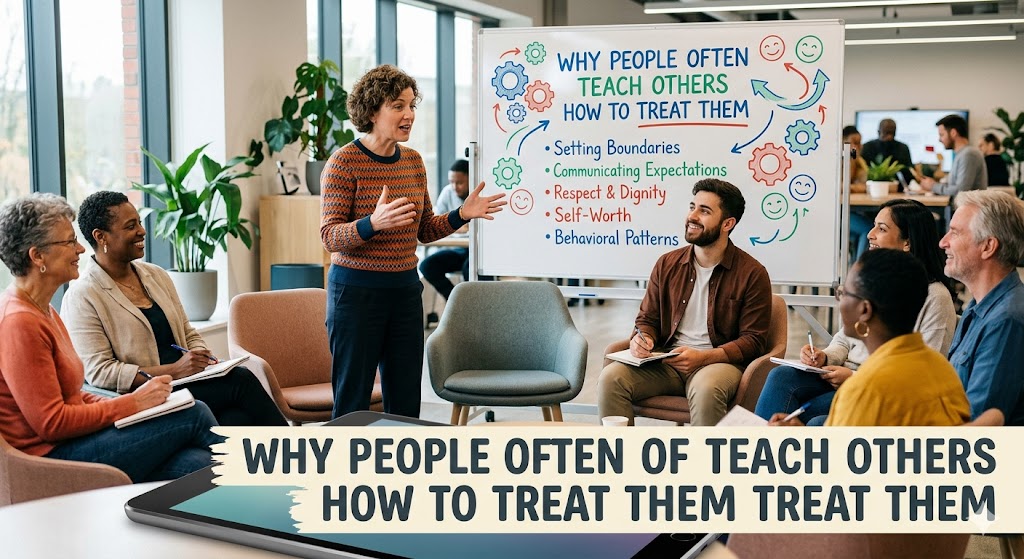
Why People Often Teach Others How to Treat Them
One of the most overlooked truths in human behavior is that people constantly participate in shaping how others interact with them. In many cases, this is not done through direct instruction or conscious effort, but through repeated patterns of response, tolerance, and emotional reaction. Over time, these patterns become signals. They quietly communicate what is acceptable, what is not, and what will be rewarded or ignored. This is why relationships of all kinds, whether romantic, familial, social, or professional, often settle into stable patterns that reflect not just personality, but established behavioral boundaries created by both sides.
At the core of this idea is the principle of reinforcement. Human beings are highly adaptive. When someone behaves in a certain way and receives no resistance or consequence, the behavior tends to continue. When that same behavior is met with correction or withdrawal of attention, it is more likely to change. Without realizing it, people teach others how to treat them by reinforcing what they tolerate. Every time a boundary is ignored and nothing is said, the silence becomes part of the lesson. Every time disrespect is met with acceptance, it becomes normalized.
This process is often subtle because it does not always involve dramatic moments. Instead, it is built from small repeated interactions. A person who constantly answers messages late at night despite feeling uncomfortable is communicating availability without limits. Someone who allows interruptions during important conversations without addressing it is signaling that their focus can be disregarded. Over time, these micro decisions accumulate into a clear pattern that others learn to rely on, even if it was never verbally expressed.
Another important factor is emotional conditioning. People are not only rational beings, they are deeply emotional ones. Many individuals avoid setting boundaries because they fear conflict, rejection, or loss of connection. This fear leads them to accept behaviors that do not align with their preferences or self respect. However, in doing so, they unintentionally condition others to continue those behaviors. The emotional discomfort they try to avoid in the short term often becomes a long term structure that defines how they are treated.
It is also important to understand that most people are not intentionally disrespectful or manipulative. In many cases, they are simply responding to the environment presented to them. Human behavior is highly responsive to feedback. If someone is consistently met with acceptance regardless of their actions, they will naturally assume those actions are acceptable. This does not make them malicious. It simply makes them adaptive. The responsibility, therefore, is shared between how someone behaves and what is consistently allowed.
Self perception also plays a major role in this dynamic. The way a person sees their own worth influences what they believe they deserve from others. Individuals with low self regard are more likely to tolerate behaviors that undermine their value, not because they enjoy it, but because it aligns with their internal narrative. When someone believes they are not worthy of respect, they often do not challenge disrespect when it appears. Over time, this belief becomes visible in how others treat them.
On the other hand, people who have strong self awareness and self respect tend to naturally set clearer boundaries. This does not mean they are aggressive or controlling. Instead, they are consistent. They communicate expectations clearly and respond when those expectations are not met. This consistency teaches others how to engage with them. As a result, their relationships tend to stabilize around mutual respect rather than confusion or imbalance.
An often ignored element in this process is the role of silence. Silence can be interpreted in many ways, but in behavioral terms, it often signals acceptance. When harmful or uncomfortable behavior is not addressed, it creates ambiguity. Over time, ambiguity is resolved through repetition. The behavior continues, and the lack of correction becomes interpreted as permission. This is how many people unintentionally allow patterns they dislike to become permanent features of their relationships.
Another dimension is emotional labor. People frequently invest energy into maintaining harmony even at the expense of their own comfort. They avoid difficult conversations, downplay their feelings, or convince themselves that certain behaviors are not a big deal. While this may reduce short term tension, it often leads to long term imbalance. Others learn that there is no need to adjust their behavior, because there are no meaningful consequences or feedback signals being communicated.
It is also worth noting that teaching others how to treat you is not a one time action, but an ongoing process. Boundaries are not established once and then forgotten. They are maintained through consistent behavior. If a boundary is set verbally but not reinforced through action, it loses meaning. Consistency is what gives boundaries their strength. Without it, people naturally revert to interpreting behavior based on what is repeatedly demonstrated rather than what is occasionally said.
In healthy relationships, this teaching process becomes mutual and balanced. Both individuals adjust their behavior in response to feedback, communication, and shared understanding. There is clarity about expectations and respect for limits. In unhealthy dynamics, however, this process becomes one sided. One person continuously adapts while the other remains unchanged, not because of superiority, but because the system allows it. Over time, imbalance becomes the default state.
Understanding this concept is powerful because it shifts responsibility back to where it belongs. Instead of only asking why others behave a certain way, it also encourages reflection on what signals are being sent. It highlights the importance of alignment between internal standards and external behavior. When someone’s actions consistently reflect their self respect, others naturally adjust. When there is a mismatch between what is tolerated and what is desired, confusion and imbalance emerge.
Ultimately, people often teach others how to treat them through patterns rather than words. It is not a single decision but a collection of repeated responses that shape expectations over time. The good news is that patterns can be changed. When someone begins to act in alignment with their true standards, even if it feels uncomfortable at first, the system around them begins to adjust. New expectations are formed. Old patterns weaken. And over time, relationships recalibrate to reflect clearer boundaries and healthier interaction.
The most important realization is that respect is not only requested, it is demonstrated. It is communicated through consistency, clarity, and self awareness. When these elements are present, they naturally guide others toward more respectful behavior. When they are absent, people tend to fill the gap with assumptions shaped by experience. In this way, everyone is constantly involved in teaching others how to treat them, whether they are aware of it or not.

EarnSmartOnline.com.ng is dedicated to helping readers make smarter financial decisions through practical guides on online income, personal finance, technology, digital business, and wealth creation. Our goal is to provide reliable, easy-to-understand, and actionable content that empowers individuals to earn smarter, build sustainable income streams and achieve long-term financial success.
Recommended: Start Earning Online
- Ultimate Affiliate Marketing Program — learn affiliate marketing with a done-for-you sales system ($15). Check it out
- The Newbie Affiliate Guide — the beginner-friendly starter guide (~$6.68). Check it out
- Easy Dollar Maker — earn in dollars uploading AI images and videos from your phone ($17). Check it out
Disclosure: These are affiliate links. If you buy through them, I may earn a commission at no extra cost to you.



