
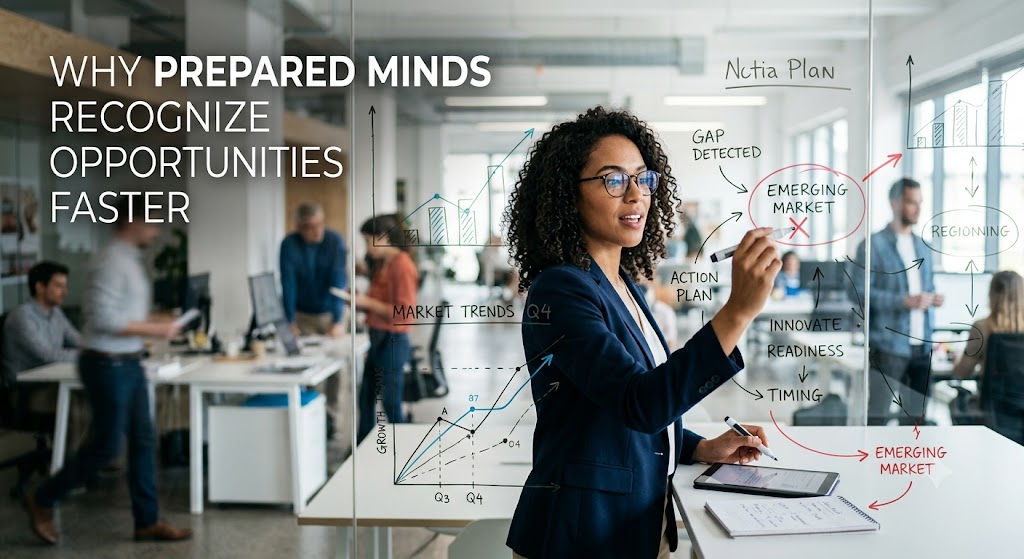
Why Prepared Minds Recognize Opportunities Faster
Success is often described as being in the right place at the right time, but this explanation leaves out one of the most important parts of the story. Two people can stand in the same place, witness the same event, receive the same information, and still walk away with completely different outcomes. One person sees a problem, while the other sees a profitable opportunity. One person hesitates until the moment passes, while the other takes action with confidence. The difference is rarely luck alone. More often than not, the difference is preparation. Prepared minds recognize opportunities faster because they have already invested in knowledge, experience, awareness, and the ability to connect ideas before the opportunity ever arrives.
Many people spend years waiting for the perfect opportunity without realizing that opportunities rarely introduce themselves with bright lights and clear instructions. They usually arrive disguised as uncertainty, change, inconvenience, or even failure. Those who are mentally prepared have developed the ability to see beyond the obvious. They understand that every major breakthrough begins as something ordinary that most people overlook.
Preparation is not merely collecting information. It is the deliberate process of training your mind to think critically, observe carefully, and respond intelligently. A prepared mind does not panic when circumstances change because it has already built the habit of learning continuously. This kind of preparation creates confidence, not because the future is predictable, but because the individual knows how to adapt regardless of what happens.
History repeatedly demonstrates this principle. Every generation celebrates successful entrepreneurs, innovators, investors, and leaders, but few people pay attention to the years of preparation that preceded their success. Overnight success is usually the final chapter of a much longer story filled with learning, mistakes, experimentation, and personal growth. What appears to be sudden achievement is often the visible reward for invisible preparation.
The modern world changes faster than ever before. New technologies emerge, industries evolve, consumer preferences shift, and entirely new markets appear within a few years. These rapid changes create opportunities almost daily, yet many people fail to recognize them because they are focused only on what they already know. Prepared minds remain curious. They constantly update their understanding of the world instead of assuming yesterday’s knowledge will solve tomorrow’s problems.
One of the greatest advantages of preparation is pattern recognition. Human beings naturally recognize patterns based on previous experiences. Someone who studies business regularly can identify emerging market trends before others notice them. A skilled investor notices economic signals that the average person ignores. An experienced programmer recognizes technological shifts that suggest future demand. A prepared individual does not rely on guessing. Their preparation allows them to see relationships between events that seem unrelated to everyone else.
This explains why two people can read the same news article yet reach completely different conclusions. One simply consumes information, while the other analyses its long-term implications. The prepared mind asks deeper questions. What does this mean for businesses? Which industries will benefit? What problems will this create? Who will need solutions? Every answer creates another opportunity to think ahead.
Preparation also improves decision-making speed. Opportunities rarely remain available forever. Sometimes the difference between success and failure is measured in hours, days, or even minutes. Those who spend years building knowledge and skills do not need excessive time to decide because they already possess a strong foundation for evaluating situations. Their preparation reduces uncertainty.
Many people confuse fast decision-making with impulsiveness, but they are not the same. Impulsive people act without thinking. Prepared people think long before the opportunity appears, allowing them to act quickly when it finally does. Their speed comes from previous preparation rather than emotional excitement.
Education plays a significant role in developing prepared minds, but education extends far beyond classrooms. Books, podcasts, documentaries, online courses, conversations with experienced people, practical projects, and personal experimentation all contribute to intellectual preparation. Every piece of useful knowledge becomes another tool that may prove valuable when unexpected opportunities arise.
Reading remains one of the simplest ways to prepare the mind. Books expose readers to ideas, experiences, strategies, failures, and successes accumulated over centuries. A single book can save years of costly mistakes by teaching lessons learned through someone else’s experience. Those who develop a consistent reading habit gradually build a broader perspective that helps them identify possibilities others overlook.
Curiosity is another defining characteristic of prepared minds. Curious people constantly ask questions. They wonder why industries operate the way they do. They explore unfamiliar topics. They investigate trends instead of dismissing them. This curiosity gradually expands their understanding, allowing them to connect information from different fields into innovative solutions.
The ability to combine knowledge from multiple disciplines has become increasingly valuable in today’s economy. Innovation often occurs when ideas from one industry solve problems in another. Someone who understands both technology and healthcare may identify opportunities neither industry recognizes independently. Likewise, combining finance with psychology, education with artificial intelligence, or agriculture with data science creates possibilities that would otherwise remain hidden.
Prepared minds also possess emotional discipline. Opportunities frequently involve uncertainty, and uncertainty naturally creates fear. Those who have prepared mentally understand that calculated risks are unavoidable. They evaluate facts instead of reacting emotionally. This emotional stability allows them to remain objective while others become overwhelmed by anxiety or excitement.
Fear itself is not the enemy. Every successful individual experiences fear before making significant decisions. The difference is that preparation reduces unnecessary fear by replacing ignorance with understanding. When people know their subject thoroughly, they approach uncertainty with greater confidence because they understand both the risks and the potential rewards.
Experience remains one of the most effective forms of preparation. Practical experience transforms theoretical knowledge into usable wisdom. Every completed project, every customer served, every problem solved, and every failure analysed contributes valuable insights that improve future decisions. Experience teaches lessons impossible to obtain through reading alone.
Failure deserves particular attention because it often provides the greatest preparation for future opportunities. Society frequently treats failure as something to avoid, yet many successful people credit their failures for developing resilience, humility, creativity, and improved judgment. Every mistake contains information that strengthens future performance if properly examined.
Prepared minds treat setbacks differently. Instead of asking, “Why did this happen to me?” they ask, “What can this teach me?” This simple shift in perspective transforms disappointing experiences into valuable preparation for future success. Every obstacle becomes part of the education process.
Networking also contributes significantly to preparation. Opportunities often travel through relationships before appearing publicly. Individuals who build genuine professional relationships gain access to ideas, advice, partnerships, mentorship, and information unavailable elsewhere. A prepared network expands a prepared mind because it introduces diverse perspectives and specialised expertise.
Building strong relationships requires authenticity rather than manipulation. People naturally prefer helping individuals who demonstrate integrity, reliability, and generosity. Over time, trustworthy individuals become magnets for opportunities because others confidently recommend, partner with, and invest in them.
Digital technology has dramatically increased access to preparation resources. Anyone with an internet connection can study world-class universities, learn professional skills, analyse global markets, follow industry experts, and participate in international communities. The barrier to acquiring knowledge has never been lower. The greatest challenge today is no longer access to information but the willingness to consistently learn and apply it.
Unfortunately, abundant information also creates distraction. Many people consume endless content without developing practical expertise. Preparation requires intentional learning rather than passive entertainment. Watching motivational videos alone rarely creates preparedness. Applying lessons through disciplined action does.
Time management also influences preparation. Those who consistently invest small amounts of time in personal development eventually accumulate substantial advantages. Reading twenty pages daily, practising valuable skills consistently, studying market trends weekly, and reflecting on lessons regularly may seem insignificant initially. However, these habits compound over years, producing remarkable expertise.
Compounding applies to knowledge just as it applies to money. Each new concept builds upon previous understanding, making future learning faster and more effective. Eventually, experienced individuals recognise patterns almost instinctively because thousands of previous observations have strengthened their judgment.
Prepared minds rarely stop learning simply because they achieve success. Continuous learning protects relevance in rapidly changing industries. Technologies become outdated, consumer behaviour evolves, regulations change, and competitors innovate. Remaining successful requires ongoing preparation rather than relying on past achievements.
Humility supports continuous learning because humble individuals recognise the limits of their knowledge. Arrogance, on the other hand, convinces people they already know enough. History repeatedly shows that industries often collapse when leaders refuse to adapt to changing circumstances.
Opportunity recognition also depends heavily on observation. Prepared minds notice details others ignore. They pay attention to customer complaints, technological improvements, demographic changes, economic indicators, policy developments, and cultural shifts. These observations often reveal unmet needs before they become obvious to the wider market.
Every successful business exists because someone recognised an unmet need and developed a solution. The greater the problem solved, the greater the potential value created. Prepared individuals train themselves to observe problems rather than complain about them. Every complaint represents a possible business idea. Every inefficiency suggests room for improvement.
Critical thinking strengthens opportunity recognition by encouraging independent analysis. Instead of accepting popular opinions automatically, prepared minds evaluate evidence carefully. They distinguish temporary trends from lasting changes and separate emotional excitement from genuine potential.
Decision quality improves significantly when preparation meets critical thinking. Instead of reacting impulsively to headlines or social media trends, prepared individuals gather relevant information, analyse possible outcomes, consider risks, and act according to rational judgment.
Discipline remains essential throughout this entire process. Knowledge without discipline rarely produces meaningful results. Preparation requires consistent effort long before visible rewards appear. Many people abandon learning because immediate benefits seem limited, yet long-term success depends precisely on these invisible investments.
Self-confidence naturally grows through preparation. Genuine confidence differs from arrogance because it rests upon demonstrated competence rather than empty optimism. People who consistently prepare trust themselves because they have repeatedly proven their ability to learn, adapt, and solve problems.
Prepared minds also understand that not every opportunity deserves pursuit. Wisdom involves recognising which opportunities align with personal strengths, long-term goals, available resources, and core values. Saying yes to every possibility often creates distraction rather than progress. Strategic preparation includes learning when to decline attractive but unsuitable opportunities.
Economic conditions constantly generate both challenges and possibilities. Inflation, technological disruption, demographic shifts, environmental concerns, changing regulations, and evolving consumer preferences all create winners and losers. Prepared individuals recognise that every major change produces new demands requiring innovative solutions. Rather than fearing change, they study it carefully.
Entrepreneurs especially benefit from preparedness because entrepreneurship fundamentally involves recognising opportunities others overlook. Successful entrepreneurs spend significant time understanding customer behaviour, industry trends, operational systems, financial management, marketing psychology, and technological developments. Their businesses succeed because preparation enables better decisions under uncertainty.
Employees benefit equally from preparation. Organisations consistently reward individuals who demonstrate initiative, adaptability, problem-solving ability, and continuous learning. Prepared employees become indispensable because they anticipate challenges, contribute valuable ideas, and require less supervision.
Students should also understand that preparation extends beyond academic grades. Communication skills, emotional intelligence, financial literacy, technological competence, teamwork, leadership, adaptability, and ethical judgment all contribute to recognising future opportunities. Employers increasingly value these practical capabilities alongside formal qualifications.
Parents play an important role by encouraging curiosity rather than merely rewarding correct answers. Children who learn to ask thoughtful questions develop stronger analytical abilities throughout life. Encouraging reading, experimentation, creativity, and responsible independence prepares young minds to recognise opportunities long before adulthood.
Ultimately, opportunity is rarely invisible. More often, it is simply unrecognised by those who have not prepared themselves to see it. The world continuously presents new problems, emerging needs, changing technologies, shifting markets, and evolving human behaviour. Within every one of these changes lies potential value waiting for someone capable of recognising it.
The saying that “luck is when preparation meets opportunity” remains remarkably accurate because preparation transforms ordinary moments into extraordinary possibilities. While no one controls when opportunities appear, everyone controls how prepared they choose to become before those moments arrive.
The future will continue rewarding individuals who invest in learning, cultivate disciplined habits, remain intellectually curious, embrace calculated risks, build meaningful relationships, strengthen practical skills, and continuously expand their understanding of the world. These investments may seem invisible today, but they gradually transform the way people think, observe, decide, and act.
Why prepared minds recognize opportunities faster is ultimately a question of perspective. Preparation changes the lens through which people view reality. Instead of seeing obstacles alone, they see possibilities. Instead of seeing uncertainty alone, they see potential. Instead of waiting for perfect circumstances, they become ready long before circumstances become perfect.
In a world filled with constant change, preparation remains one of the few advantages entirely within human control. Those who prepare consistently position themselves to recognise possibilities that others overlook, respond intelligently while others hesitate, and create lasting value where others see only ordinary events. Opportunities rarely wait for anyone, but they almost always favour those who have already done the work before the moment arrives.

EarnSmartOnline.com.ng is dedicated to helping readers make smarter financial decisions through practical guides on online income, personal finance, technology, digital business, and wealth creation. Our goal is to provide reliable, easy-to-understand, and actionable content that empowers individuals to earn smarter, build sustainable income streams and achieve long-term financial success.
Recommended: Start Earning Online
- Ultimate Affiliate Marketing Program — learn affiliate marketing with a done-for-you sales system ($15). Check it out
- The Newbie Affiliate Guide — the beginner-friendly starter guide (~$6.68). Check it out
- Easy Dollar Maker — earn in dollars uploading AI images and videos from your phone ($17). Check it out
Disclosure: These are affiliate links. If you buy through them, I may earn a commission at no extra cost to you.



