
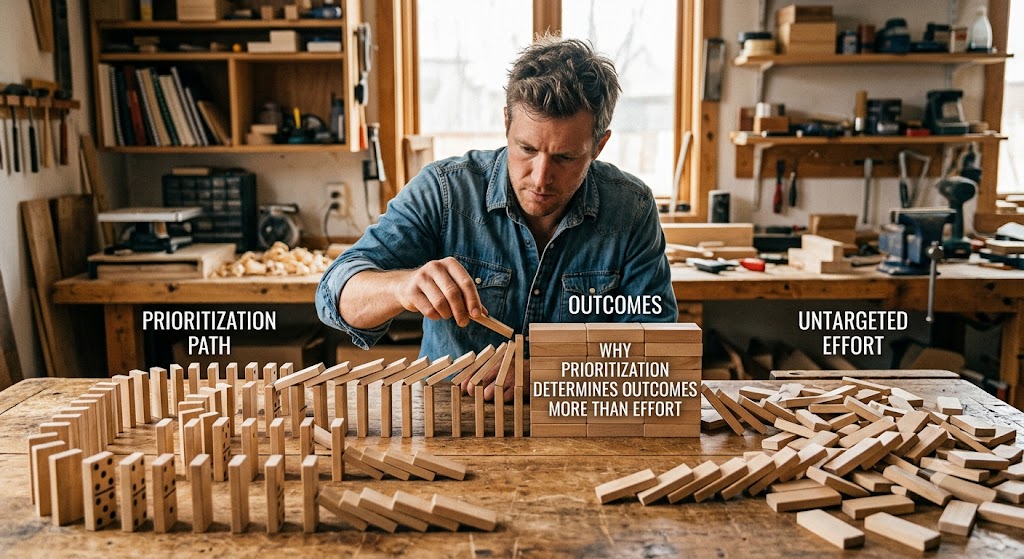
Why Prioritization Determines Outcomes More Than Effort
Many people believe that success belongs to those who work the hardest. While hard work is undoubtedly valuable, effort alone does not guarantee meaningful results. Every day, countless individuals wake up early, work long hours, and exhaust themselves, yet they struggle to make significant progress. At the same time, others appear to accomplish more with less effort because they have mastered one critical skill: prioritization.
Why prioritization determines outcomes more than effort is a lesson that applies to business, careers, finances, education, relationships, and personal development. It is not about working less. It is about directing your energy toward the activities that create the greatest impact. Success is rarely determined by how much you do. It is determined by whether you are doing the right things at the right time.
Time is the only resource that every person receives equally. Every day offers twenty-four hours, yet the difference between highly successful individuals and those who remain stagnant often comes down to how those hours are allocated. A person who spends twelve hours doing low-value activities may achieve less than someone who spends four focused hours on high-impact tasks.
Many people confuse being busy with being productive. They fill their schedules with meetings, emails, phone calls, social media updates, errands, and countless minor responsibilities. At the end of the day, they feel tired but cannot point to any meaningful achievement. Busyness creates the illusion of progress, but activity without direction rarely leads to significant results.
Prioritization forces you to distinguish between what is urgent and what is important. Urgent tasks demand immediate attention, but important tasks determine your future. Responding to every notification, answering every message instantly, or attending every meeting may feel productive, but these activities often prevent you from working on projects that truly move your life forward.
One of the greatest mistakes people make is treating every task as equally important. In reality, not all activities produce equal outcomes. Some actions create extraordinary results while others contribute very little. This principle is often observed in business, where a small percentage of customers generate the majority of revenue, or in personal productivity, where a few key habits produce most long-term success.
Effort without prioritization is like pouring water into a bucket full of holes. You continue investing energy without retaining meaningful progress. On the other hand, strategic prioritization allows every unit of effort to produce greater value.
Successful entrepreneurs understand this concept well. They do not attempt to solve every problem personally. Instead, they identify the few decisions that have the greatest influence on business growth. They delegate routine tasks, automate repetitive processes, and focus their attention on areas where their unique abilities generate the highest returns.
Students often experience the same challenge. Some study for ten hours every day but perform poorly because they focus on memorizing unimportant details. Others study fewer hours but concentrate on understanding key concepts, practicing difficult questions, and reviewing high-priority topics. Their results are often far superior because they prioritize effectively.
The workplace offers another clear example. Employees who constantly respond to emails, attend unnecessary meetings, and multitask throughout the day often appear hardworking. However, the employees who identify critical projects, solve important problems, and consistently deliver measurable value usually advance faster in their careers.
Financial success also depends heavily on prioritization. Many people spend years trying to increase income while ignoring spending habits, investment opportunities, or financial education. Others prioritize learning how money works, building emergency savings, developing valuable skills, and investing consistently. Over time, these priorities produce dramatically different financial outcomes.
Prioritization is closely connected to opportunity cost. Every decision carries a hidden cost because choosing one activity means sacrificing another. Spending three hours scrolling through social media is not merely losing three hours. It is losing the opportunity to learn a new skill, strengthen relationships, exercise, build a business, or create something valuable.
Many people underestimate the cumulative effect of poor priorities. Small daily choices rarely seem significant in isolation, but over months and years they shape careers, finances, health, and relationships. Reading ten pages of a valuable book every day appears insignificant until it results in dozens of completed books over several years. Exercising consistently may seem like a minor priority today, but it can determine health decades later.
Decision fatigue makes prioritization even more important. Every decision consumes mental energy. When people spend excessive time deciding what to do next, they reduce their ability to make high-quality decisions later in the day. Establishing clear priorities minimizes unnecessary choices and preserves mental focus for what truly matters.
Technology has made prioritization more challenging than ever before. Notifications, messages, advertisements, breaking news, and endless entertainment compete constantly for attention. Every interruption carries a hidden cost because regaining focus requires additional time and mental effort. Those who learn to protect their attention gain a significant advantage in both personal and professional life.
Successful people are often misunderstood as being exceptionally disciplined. While discipline certainly matters, much of their success comes from eliminating distractions before they become problems. They create environments where important work naturally receives priority while unnecessary interruptions are minimized.
Prioritization also requires the courage to say no. Every commitment consumes time, energy, and attention. Accepting every invitation, opportunity, or request leaves little room for meaningful progress. Saying no to low-value activities creates space for high-value work.
Many individuals fear missing opportunities, leading them to pursue multiple goals simultaneously. They start businesses while changing careers, enrolling in numerous courses, launching side projects, and chasing every emerging trend. Instead of making rapid progress in one area, their attention becomes fragmented across many directions.
Focus amplifies effort. Concentrated attention allows deeper thinking, faster learning, and higher-quality execution. When priorities remain clear, momentum builds naturally because each completed task supports larger objectives instead of competing against them.
Prioritization is equally valuable in relationships. Strong relationships are rarely built through occasional grand gestures. They grow through consistently prioritizing quality time, honest communication, trust, and shared experiences. People who continually prioritize work, entertainment, or convenience over relationships often discover too late that neglected connections become difficult to restore.
Health provides another powerful example. Many people postpone exercise, healthy eating, adequate sleep, and preventive care because other responsibilities appear more urgent. Eventually, neglected health begins affecting productivity, finances, and overall quality of life. Prioritizing wellness early often prevents far greater challenges later.
Leaders distinguish themselves through prioritization. Organizations constantly face competing demands, limited budgets, and finite resources. Effective leaders identify initiatives that align with long-term objectives rather than reacting emotionally to every short-term challenge. Their ability to prioritize creates clarity for entire teams.
Innovation itself depends on prioritization. Companies that attempt to develop every possible product often spread themselves too thin. Those that concentrate resources on solving one meaningful problem exceptionally well frequently become market leaders.
Personal growth follows the same principle. Reading hundreds of motivational quotes rarely changes lives. Consistently applying one valuable lesson does. Many people consume endless information but fail to prioritize implementation. Knowledge becomes valuable only when transformed into action.
One reason prioritization is difficult is that important work often lacks immediate rewards. Watching television, checking social media, or responding to trivial messages provides instant satisfaction. Building skills, saving money, exercising, or writing a book produces results gradually. Long-term priorities require patience because their rewards compound over time.
The ability to distinguish between temporary pleasure and lasting value separates those who make continuous progress from those who remain trapped in cycles of busyness. Every day presents opportunities to invest in a better future or merely maintain the present.
Successful prioritization begins with clear goals. Without knowing what truly matters, everything appears equally important. Defining long-term objectives allows daily decisions to become simpler because each activity can be evaluated according to whether it supports those goals.
Reviewing priorities regularly is equally essential. Circumstances change, industries evolve, technologies advance, and personal responsibilities shift. Effective prioritization is not a one-time decision but an ongoing process of aligning actions with current objectives.
Many people admire successful individuals without recognizing the countless opportunities they intentionally declined. Every meaningful accomplishment is built not only by choosing what to pursue but also by choosing what to ignore. The invisible power of success often lies in disciplined exclusion rather than endless addition.
Ultimately, effort remains important, but effort applied in the wrong direction produces disappointing results. A person climbing the wrong ladder with extraordinary determination still reaches the wrong destination. Prioritization ensures that every step moves closer to meaningful goals rather than simply consuming energy.
The quality of your life is shaped less by how hard you work and more by what you consistently choose to work on. Every decision either strengthens your future or distracts from it. By identifying what matters most, protecting your attention, and investing your effort where it generates the highest return, you dramatically increase the likelihood of achieving lasting success. In the end, prioritization is not about doing more. It is about making sure that what you do matters most.

EarnSmartOnline.com.ng is dedicated to helping readers make smarter financial decisions through practical guides on online income, personal finance, technology, digital business, and wealth creation. Our goal is to provide reliable, easy-to-understand, and actionable content that empowers individuals to earn smarter, build sustainable income streams and achieve long-term financial success.
Recommended: Start Earning Online
- Ultimate Affiliate Marketing Program — learn affiliate marketing with a done-for-you sales system ($15). Check it out
- The Newbie Affiliate Guide — the beginner-friendly starter guide (~$6.68). Check it out
- Easy Dollar Maker — earn in dollars uploading AI images and videos from your phone ($17). Check it out
Disclosure: These are affiliate links. If you buy through them, I may earn a commission at no extra cost to you.



