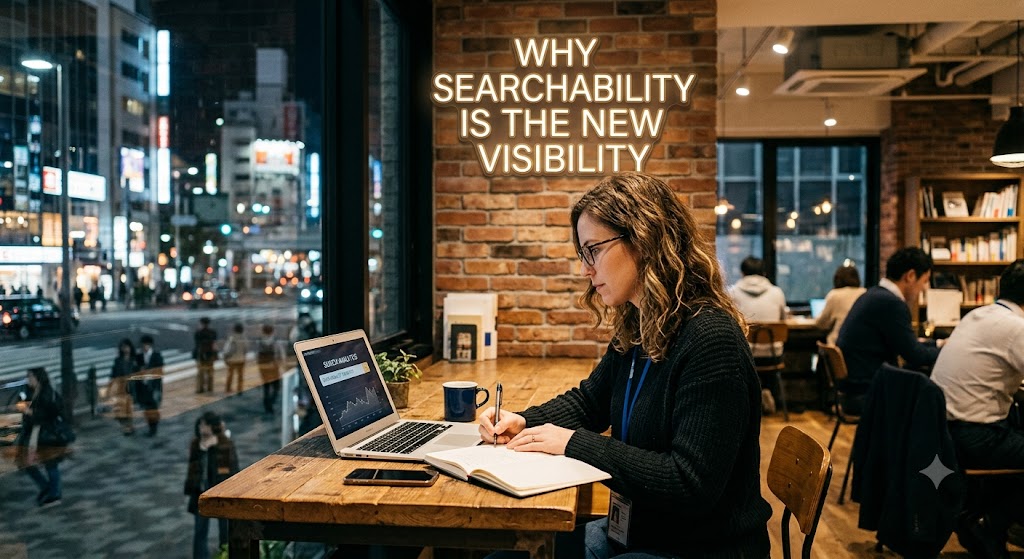
Why Searchability Is the New Visibility
There was a time when visibility alone was enough to build a successful brand, business, or career. If people saw your billboard on a busy road, watched your television commercial, heard your radio advertisement, or passed by your physical store every day, you had a good chance of attracting customers. The digital age has completely transformed that reality. Today, simply being visible is no longer enough. Millions of people and businesses compete for attention every second across websites, social media platforms, search engines, online marketplaces, podcasts, video platforms, and messaging apps. In this crowded digital environment, the biggest advantage no longer belongs to the loudest voice. It belongs to the easiest one to find. This is why searchability has become the new visibility.
Searchability refers to how easily people can discover you, your content, your products, your services, or your expertise whenever they actively search for information online. Visibility is passive because people may happen to see you while scrolling through social media or walking past your business. Searchability is intentional because it connects you with people who are already looking for exactly what you offer. This single difference changes everything.
Imagine two businesses selling the same product. One posts entertaining videos on social media every day and occasionally goes viral. The other invests time creating useful blog articles, optimising product pages, answering common customer questions, improving website speed, and publishing educational videos that appear in search results. The first business enjoys bursts of attention whenever an algorithm favours its content. The second business receives consistent visitors every day because people continue finding its content through search engines months or even years after it was published. One relies on temporary visibility. The other benefits from long-term searchability.
The internet has changed how people make decisions. Before buying a product, hiring a professional, booking a hotel, choosing a restaurant, enrolling in a course, or investing money, people search. They search on Google. They search on YouTube. They search inside TikTok, Instagram, Facebook, LinkedIn, Amazon, Reddit, and countless other platforms. Every search represents intent. It represents curiosity mixed with the possibility of taking action. If your business cannot be found during that moment, your competitors will receive the attention instead.
Searchability is powerful because it aligns perfectly with human behaviour. People rarely buy something simply because they accidentally saw it once. Most purchasing decisions involve research. Consumers compare prices, read reviews, evaluate alternatives, and seek trustworthy information before making commitments. Businesses that understand this behaviour position themselves where those searches happen.
This shift affects everyone, not just companies. Job seekers are searched online before interviews. Freelancers are searched before receiving contracts. Speakers are searched before invitations. Authors are searched before readers buy books. Musicians are searched before people stream songs. Even individuals seeking personal relationships often have some form of online presence that influences first impressions. Whether you realise it or not, someone is probably searching your name right now.
Being searchable also builds credibility. Imagine someone recommends your services to a friend. The first thing that friend does is search your name. What appears? If they find a professional website, useful articles, customer testimonials, social media profiles, interviews, videos, and consistent information, confidence immediately increases. If they find almost nothing, uncertainty begins to replace trust. Search results often become your first digital handshake.
This explains why websites remain valuable despite the popularity of social media. Social platforms are important for engagement, but websites provide ownership. Algorithms change constantly. Accounts can be suspended. Platforms rise and disappear. Your website serves as your permanent digital headquarters where search engines can continuously index your content and introduce it to new audiences. Every useful article becomes another doorway leading potential customers to your business.
Search engine optimisation, commonly called SEO, exists because searchability matters. SEO is not about tricking search engines or manipulating rankings. Modern SEO focuses on making content genuinely useful, organised, relevant, fast, accessible, and trustworthy. Search engines aim to deliver the best answers to users. When your content consistently provides those answers, it naturally becomes easier to discover.
Keywords play an important role in this process because they reflect the language people actually use when searching. A business owner might describe a product using technical industry terms, while customers search using simple everyday language. Understanding this difference allows businesses to communicate more effectively. The goal is not stuffing articles with repeated keywords but understanding search intent and creating content that genuinely satisfies it.
Searchability extends beyond websites. YouTube functions as one of the world’s largest search engines. Millions of people search for tutorials, product reviews, educational lessons, entertainment, and solutions every single day. Videos with descriptive titles, accurate descriptions, helpful content, and clear organisation remain discoverable long after publication. Unlike social media posts that disappear beneath newer updates, searchable videos continue attracting viewers for years.
The same principle applies to podcasts. People increasingly search podcast directories for discussions about entrepreneurship, health, technology, finance, productivity, relationships, and personal development. Podcasts with clear titles, detailed descriptions, transcripts, and searchable websites dramatically increase their chances of reaching new listeners.
Social media itself is evolving into a search platform. Younger generations increasingly use TikTok and Instagram to search for restaurants, travel destinations, recipes, product recommendations, fashion inspiration, and educational content. This means captions, hashtags, profile descriptions, and video titles matter more than ever before. Social platforms no longer reward only entertaining content. They increasingly reward discoverable content.
Businesses often underestimate the long-term value of educational content. Answering frequently asked questions may seem simple, but every answer creates another opportunity for search engines to connect your expertise with someone seeking information. Imagine publishing one helpful article every week for five years. You would have over two hundred pieces of searchable content working around the clock without demanding additional salaries or advertising budgets.
Searchability also reduces dependence on paid advertising. Advertising remains valuable, but every click costs money. Organic search traffic continues arriving long after the original content has been created. While developing strong search presence requires patience, the long-term return often exceeds short-term advertising campaigns. Businesses with strong organic visibility enjoy sustainable growth because their customer acquisition costs gradually decrease.
Trust plays a significant role in searchability. Search engines increasingly prioritise reliable sources demonstrating expertise, experience, authority, and trustworthiness. Businesses that publish accurate information, maintain transparent policies, update outdated content, and earn genuine customer reviews naturally strengthen their search presence. This creates a positive cycle where credibility improves discoverability, and discoverability reinforces credibility.
Another overlooked aspect of searchability involves local businesses. Someone searching for a nearby electrician, restaurant, hotel, pharmacy, mechanic, or dentist usually intends to make a purchase quickly. Businesses with accurate addresses, contact information, operating hours, customer reviews, photographs, and optimised local listings significantly improve their chances of appearing in local search results. Many small businesses lose customers simply because their information is incomplete or inconsistent across different platforms.
Mobile technology has accelerated this trend even further. Smartphones have placed search engines inside everyone’s pocket. Questions that once remained unanswered now receive immediate responses. Consumers compare products while standing inside physical stores. Travellers search for nearby hotels while already driving through unfamiliar cities. Students search educational resources during lectures. Employees search solutions while working. Search has become woven into everyday life.
Artificial intelligence is also changing search behaviour. People increasingly ask complete questions rather than typing isolated keywords. Instead of searching “best laptop,” users ask, “What is the best laptop for graphic design under one thousand dollars?” This shift rewards detailed, conversational, comprehensive content that directly addresses real human questions. Businesses creating valuable educational resources position themselves for success within both traditional search engines and AI-powered assistants.
Content quality remains the foundation of searchability. Publishing hundreds of low-quality articles rarely produces sustainable results. One comprehensive, accurate, engaging resource often outperforms dozens of shallow posts. Readers stay longer, share valuable content with others, bookmark useful resources, and return repeatedly. These positive user signals reinforce search performance over time.
Consistency matters just as much as quality. Search engines favour active websites that continue providing fresh information. Consistent publishing demonstrates commitment, expertise, and relevance. This does not require daily posting. Even one outstanding article every week builds impressive authority over several years. The key lies in maintaining quality while remaining dependable.
Many creators become discouraged because searchability develops slowly. Unlike viral social media content that produces immediate attention, search optimisation resembles planting trees. Results appear gradually but continue producing value long after the initial effort. Articles written today may become your most valuable traffic sources next year. Videos uploaded this month may still generate viewers five years from now. Patience becomes a competitive advantage because many people quit before momentum begins.
Searchability also improves customer experience. Well-organised websites help visitors locate information quickly. Clear navigation, fast loading speeds, readable formatting, descriptive headings, and logical page structures reduce frustration. Search engines recognise these positive experiences and often reward them with better rankings. Optimising for users usually aligns naturally with optimising for search engines.
Personal branding increasingly depends on searchability as well. Professionals who regularly publish thoughtful insights, case studies, interviews, presentations, and educational resources become easier to discover within their industries. Their names gradually become associated with expertise. Opportunities begin arriving through inbound discovery rather than constant self-promotion. Searchability transforms reputation into opportunity.
The future belongs to businesses that answer questions before competitors do. Every customer question represents potential content. Every industry challenge represents another educational opportunity. Every problem solved publicly becomes another searchable asset attracting future customers. Businesses that consistently educate rather than merely advertise establish stronger relationships with audiences while improving search performance simultaneously.
Voice search continues expanding through smart speakers, smartphones, and virtual assistants. People increasingly ask natural questions aloud rather than typing abbreviated keywords. This reinforces the importance of conversational writing that mirrors everyday language. Content written for humans generally performs better than content written solely for algorithms.
Images also contribute to searchability. Properly named image files, descriptive alternative text, relevant captions, and optimised sizes improve accessibility while creating additional opportunities for appearing in image search results. Visual search technology continues advancing, making image optimisation increasingly valuable.
Video transcripts represent another overlooked opportunity. Search engines cannot fully understand spoken words without supporting text. Accurate transcripts help search engines interpret video content while improving accessibility for viewers. They also create additional keyword relevance naturally without forcing repetition.
Searchability should influence every stage of content creation. Instead of asking, “What do I want to publish today?” successful creators ask, “What questions are my audience searching for today?” This subtle shift transforms content from self-centred communication into audience-centred problem solving. Businesses that consistently answer genuine questions naturally become trusted resources.
Analytics provide valuable insights into search performance. Monitoring which pages attract visitors, which keywords generate traffic, how long readers remain on pages, and where users exit helps businesses refine future strategies. Data replaces assumptions, allowing continuous improvement based on real behaviour rather than guesswork.
Building searchability requires collaboration across multiple disciplines. Excellent writing, strong technical website performance, compelling visuals, user-friendly design, credible information, and consistent branding all contribute toward discoverability. No single factor guarantees success. Instead, long-term search visibility emerges from many small improvements working together.
The businesses dominating tomorrow’s digital economy may not necessarily have the largest advertising budgets. They will likely be the organisations most easily found whenever customers need trustworthy answers. Searchability compounds over time, creating durable competitive advantages that become increasingly difficult for competitors to replicate quickly.
Ultimately, visibility attracts attention, but searchability captures intention. Attention can disappear within seconds as users continue scrolling. Intent signals readiness to learn, compare, subscribe, enquire, purchase, or build relationships. Meeting people precisely when they seek solutions creates far greater value than simply appearing before them by chance.
The digital landscape will continue evolving. New platforms will emerge, algorithms will change, technologies will advance, and consumer habits will shift. Yet one principle will remain remarkably consistent. People will always search for answers, opportunities, products, services, experts, and solutions. Those who invest in becoming genuinely discoverable position themselves for sustainable success regardless of changing trends.
The future of digital growth belongs to organisations and individuals who understand that success is no longer measured only by how many people accidentally see them. It is measured by how easily the right people can intentionally find them at exactly the moment they need them. That is the true meaning of modern digital influence. Searchability is no longer simply another marketing strategy. It has become the foundation of online relevance, credibility, trust, and long-term growth. In a world overflowing with content and competition, the winners will not necessarily be those who shout the loudest. They will be those who are found first when it matters most.

EarnSmartOnline.com.ng is dedicated to helping readers make smarter financial decisions through practical guides on online income, personal finance, technology, digital business, and wealth creation. Our goal is to provide reliable, easy-to-understand, and actionable content that empowers individuals to earn smarter, build sustainable income streams and achieve long-term financial success.
Recommended: Start Earning Online
- Ultimate Affiliate Marketing Program — learn affiliate marketing with a done-for-you sales system ($15). Check it out
- The Newbie Affiliate Guide — the beginner-friendly starter guide (~$6.68). Check it out
- Easy Dollar Maker — earn in dollars uploading AI images and videos from your phone ($17). Check it out
Disclosure: These are affiliate links. If you buy through them, I may earn a commission at no extra cost to you.