
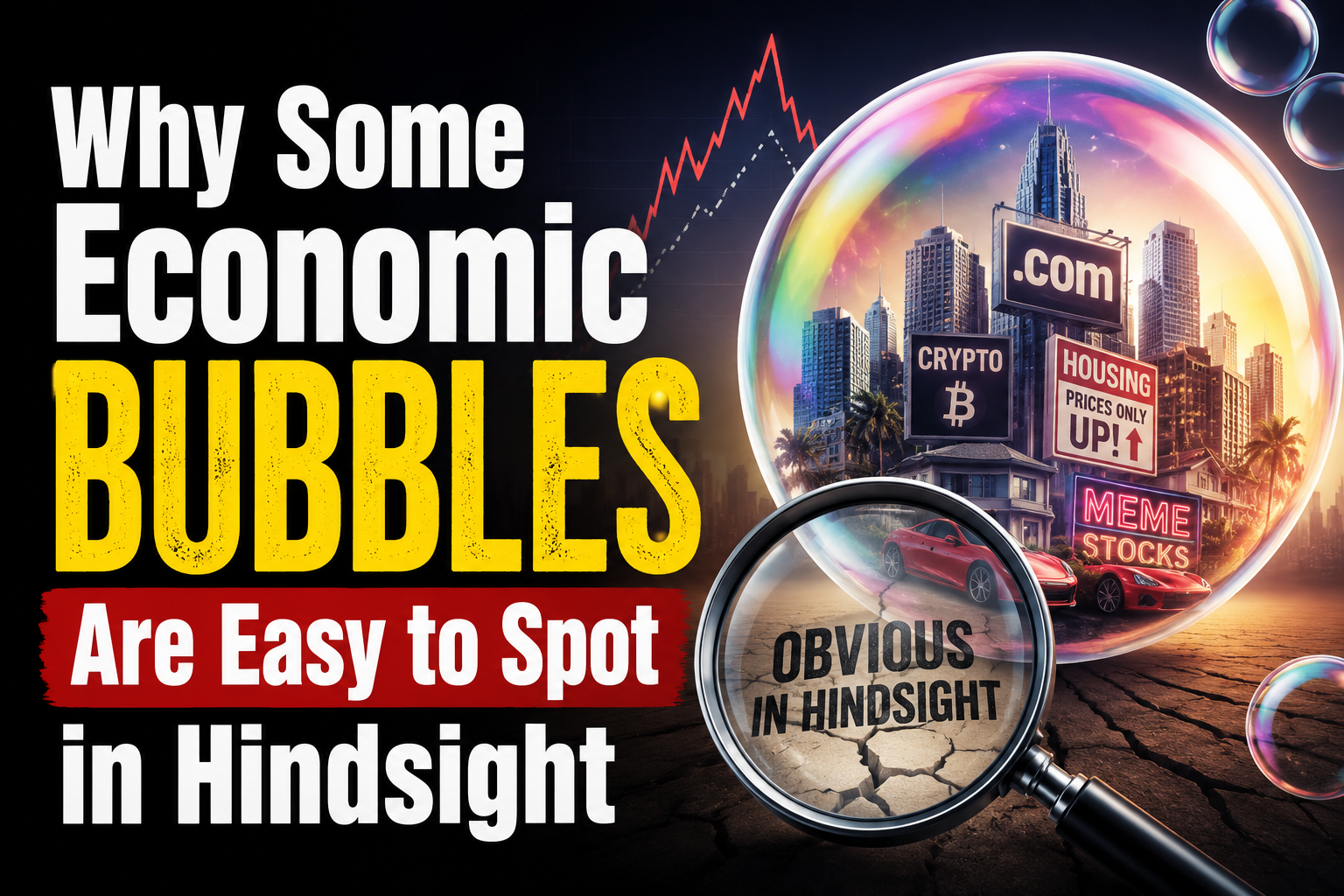
Why Some Economic Bubbles Are Easy to Spot in Hindsight
The reason many economic bubbles look obvious after they burst but feel confusing while they are growing is not because people suddenly become smarter in hindsight. It is because during the growth phase, emotions, incentives, and incomplete information distort perception. When prices are rising, when stories of sudden wealth spread, and when everyone around seems to be benefiting, the human brain naturally assumes that what is happening is normal and sustainable. Only after collapse, when data becomes complete and consequences are visible, does the pattern look simple and predictable.
One major reason bubbles become clear in hindsight is that human beings struggle to recognize gradual exaggeration. In the early stages of a bubble, nothing looks extreme. Prices rise a little faster than usual, interest increases, and attention grows. Each step feels justified by a new explanation. Over time, these small justifications stack up until the system becomes completely disconnected from real value. However, because the change is gradual, people adapt slowly. By the time the situation becomes clearly irrational, many participants are already deeply involved and emotionally committed.
Historical examples such as the Dot com bubble show this pattern clearly. During the rise of internet companies in the late nineteen nineties, many businesses were valued not on profit but on future potential that had no clear timeline. The excitement around technology made it difficult for investors to separate real innovation from exaggerated expectations. When the bubble burst, many companies disappeared, but during the rise, it felt like a new economic era was being born. In hindsight, it is easy to see that valuations were disconnected from reality, but at the time, optimism felt rational.
Another reason bubbles are easier to understand after they end is that information becomes complete only after collapse. While a bubble is forming, data is incomplete and constantly changing. People rely on recent success stories instead of full historical context. Once the bubble collapses, however, analysts can study the entire timeline, including entry points, peak behavior, and failure signals. This complete picture creates the illusion that the warning signs were obvious all along, even though those signals were mixed with strong opposing narratives at the time.
Emotional influence plays a huge role in why bubbles are not easily recognized in real time. When people see others gaining wealth quickly, fear of missing out becomes stronger than rational analysis. This emotional pressure leads individuals to ignore warning signs that would otherwise seem important. The belief that one might miss a once in a lifetime opportunity pushes people to participate even when doubts exist. After the collapse, when emotional pressure disappears, it becomes easier to judge the situation logically.
The housing market collapse that contributed to the 2008 financial crisis is another example that appears predictable in hindsight but was widely misunderstood during its growth phase. Easy access to credit, rising property prices, and widespread belief in continuous growth created an environment where risk felt minimal. Many financial instruments were built on assumptions that seemed reasonable at the time. When the system eventually failed, it became clear that risk had been underestimated across the board. However, during the expansion phase, optimism and confidence dominated decision making.
Another important factor is incentive structure. During bubbles, many participants benefit directly from continued growth. Investors, companies, media platforms, and even analysts often gain more by supporting positive narratives than by warning about risk. This creates an environment where optimistic views are amplified while cautious voices are ignored or dismissed. After the collapse, incentives change. At that point, explaining what went wrong becomes valuable, and previously ignored warnings gain attention.
Social reinforcement also makes bubbles difficult to identify early. When everyone around appears to be benefiting from a trend, disagreement feels risky. People tend to trust group behavior more than individual judgment. If a person questions a rising market while others are profiting, that person may be seen as lacking understanding rather than offering insight. This social pressure suppresses critical thinking during the growth phase. Once the bubble bursts, however, group confidence disappears and individual skepticism becomes acceptable.
Another reason hindsight makes bubbles appear obvious is the illusion of inevitability. After an event has already happened, the human brain reconstructs the timeline in a way that feels logical and structured. This is known as narrative thinking. Instead of remembering uncertainty, people remember a simplified story with a clear beginning, peak, and collapse. This reconstructed narrative removes confusion and makes the outcome appear predictable, even though real time experience was far more chaotic.
The rise and fall of cryptocurrency markets, including Bitcoin, provides a modern example of how speculative cycles can appear obvious after major corrections. During rapid growth phases, excitement about new technology and financial independence often drives strong price increases. Discussions focus on potential future value rather than present limitations. After corrections, critics highlight overvaluation and speculative behavior. Both perspectives exist during the cycle, but one becomes dominant depending on market conditions.
Another factor that explains hindsight clarity is selective memory. People tend to remember signals that support the final outcome and forget signals that contradict it. During a bubble, there are always both warning signs and positive indicators. After the collapse, attention shifts only to the warning signs, making them appear more obvious than they felt at the time. This selective memory strengthens the belief that the collapse was predictable.
Technological enthusiasm also contributes to bubble formation and later clarity. When new technologies emerge, they often create real value at the same time as exaggerated expectations. This combination makes evaluation difficult. It becomes challenging to separate genuine innovation from speculative excitement. As a result, some participants overestimate future growth while others underestimate it. Only after time passes can the real impact of the technology be measured accurately.
Another important concept is liquidity availability. When money is easily accessible, more capital flows into speculative assets. Low interest environments and abundant credit encourage risk taking. During such periods, rising prices are often interpreted as evidence of strong fundamentals. In reality, they may simply reflect excess liquidity. After conditions tighten, prices adjust, revealing the underlying weakness that was previously hidden.
Media amplification also plays a strong role. During bubbles, media coverage tends to increase as public interest grows. Success stories are widely shared because they attract attention. This creates a feedback loop where rising coverage increases participation, which further increases prices and coverage again. After the bubble ends, media narratives shift toward analysis of failure, reinforcing the perception that warning signs were obvious from the start.
It is also important to understand that intelligence alone does not prevent participation in bubbles. Many highly educated and experienced individuals participate in speculative cycles because uncertainty makes it difficult to distinguish between innovation and overvaluation. When future outcomes are unknown, even experts rely on assumptions. If those assumptions are widely shared, they become difficult to challenge.
Time horizon differences also contribute to misunderstanding. Some participants focus on short term gains while others focus on long term value. During bubbles, short term perspectives often dominate because they produce immediate results. Long term concerns are discounted because they feel distant. After the collapse, long term consequences become visible, making earlier decisions appear irrational.
Another reason bubbles appear obvious in hindsight is the clarity of failure. Success has many possible explanations, but failure often has a single defining moment. When a collapse occurs, it concentrates attention and creates a clear reference point. This makes it easier to trace backward and identify contributing factors. However, during growth, there is no single moment that signals danger clearly enough to override optimism.
The psychology of belief reinforcement also plays a role. Once people commit to a financial belief or investment, they tend to seek information that confirms their decision. This confirmation bias strengthens conviction during the growth phase. Only after significant losses or external validation of failure do people reconsider their assumptions.
In conclusion, economic bubbles appear easy to spot in hindsight because human perception changes when emotion, information, and incentives shift over time. During growth, uncertainty, social pressure, and optimism dominate decision making. After collapse, complete information, emotional distance, and simplified narratives create clarity. Understanding this difference is important because it helps explain why rational people repeatedly participate in irrational cycles. Recognizing that clarity is often a product of hindsight rather than foresight is essential for better financial judgment in the future.

EarnSmartOnline.com.ng is dedicated to helping readers make smarter financial decisions through practical guides on online income, personal finance, technology, digital business, and wealth creation. Our goal is to provide reliable, easy-to-understand, and actionable content that empowers individuals to earn smarter, build sustainable income streams and achieve long-term financial success.
Recommended: Start Earning Online
- Ultimate Affiliate Marketing Program — learn affiliate marketing with a done-for-you sales system ($15). Check it out
- The Newbie Affiliate Guide — the beginner-friendly starter guide (~$6.68). Check it out
- Easy Dollar Maker — earn in dollars uploading AI images and videos from your phone ($17). Check it out
Disclosure: These are affiliate links. If you buy through them, I may earn a commission at no extra cost to you.



