
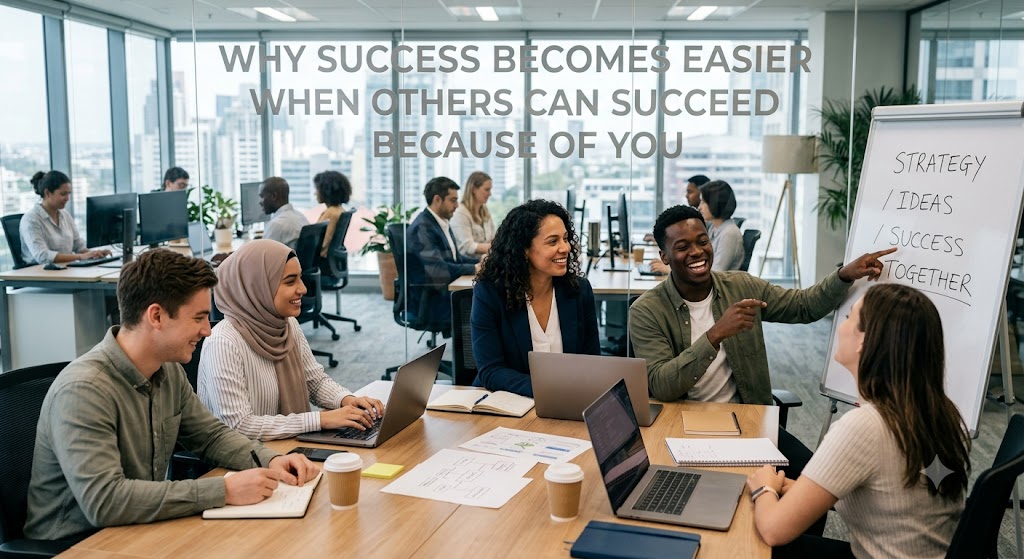
Why Success Becomes Easier When Others Can Succeed Because of You
Success is often described as a personal journey. Many people picture it as climbing a mountain alone, fighting through obstacles, overcoming challenges, and finally standing at the top with nobody else around. While determination, discipline, and hard work are certainly important, this picture leaves out one of the most powerful truths about long term success. The people who experience the greatest and most sustainable success are usually those who create opportunities for others to succeed as well. The moment your success begins to multiply the success of other people, your own growth accelerates in ways that are almost impossible to achieve alone.
Many people spend years asking themselves one question. They ask, “How can I become successful?” It is not a bad question, but it is incomplete. A far more powerful question is, “How can my success help other people become successful too?” That single shift in thinking changes everything. It transforms success from something temporary into something that keeps expanding. It changes success from a personal achievement into a lasting legacy.
Every thriving business, every respected leader, every influential entrepreneur, every successful teacher, and every impactful organisation shares one common characteristic. They make other people better. They solve problems, create opportunities, develop talent, provide employment, share knowledge, or inspire confidence. Their success becomes valuable because it is connected to the success of others.
This is why truly successful people rarely have to chase opportunities forever. Eventually opportunities begin chasing them. People naturally want to work with individuals who improve their lives. Customers remain loyal to businesses that help them grow. Employees remain committed to leaders who develop them. Communities celebrate people who create opportunities instead of simply accumulating wealth.
One of the biggest mistakes people make is believing success is a limited resource. They think if someone else wins, they somehow lose. This scarcity mindset creates competition where collaboration would produce greater results. It encourages jealousy instead of partnership. It makes people hide information instead of sharing it. It causes individuals to build walls when they should be building bridges.
Reality works differently. Success expands when it is shared wisely. Knowledge multiplies when it is taught. Opportunities increase when they are created for others. Businesses grow when customers succeed. Leaders become stronger when their teams become stronger. Families flourish when every member is encouraged to reach their potential.
Imagine two business owners. The first only cares about making as much money as possible. Every decision is centred on personal profit. Employees are viewed merely as expenses. Customers are treated as transactions. Partners are valued only while they remain useful. Eventually people notice the selfish approach. Trust begins to disappear. Relationships weaken. Growth slows because nobody genuinely wants to contribute to someone who only serves themselves.
The second business owner focuses on creating value. Employees receive training that improves their careers. Customers receive products that genuinely solve problems. Partners receive fair treatment. Suppliers are respected. Communities benefit from the business. As time passes, this business owner develops something much more valuable than profit. They develop trust. Trust attracts opportunities that money alone can never buy.
People often underestimate the economic value of helping others succeed. Every successful relationship is built on mutual benefit. Every strong business partnership survives because everyone involved gains something valuable. Every lasting friendship grows because both people add value to each other’s lives. Every healthy community exists because individuals contribute instead of merely consuming.
Consider how the world’s largest companies became successful. They did not simply ask how to earn more money. They focused on solving bigger problems for more people. Their profits became the natural consequence of the value they created. Customers willingly returned because their lives became easier, safer, faster, healthier, or more enjoyable.
The same principle applies whether someone runs a multinational company or a small neighbourhood business. The size may differ, but the foundation remains the same. The more people benefit from what you do, the more sustainable your success becomes.
Many entrepreneurs struggle because they concentrate entirely on selling rather than serving. They constantly search for ways to convince people to buy. Meanwhile the businesses that dominate industries spend enormous energy understanding customer problems before creating solutions. People gladly pay for solutions that genuinely improve their lives.
This principle extends beyond business into every area of life. A teacher becomes respected because students become knowledgeable. A doctor becomes trusted because patients become healthier. A coach becomes valuable because athletes improve. A mentor becomes influential because younger people achieve greater success. Their own reputation rises because other people are rising through their guidance.
Ironically, some people avoid helping others because they fear becoming replaceable. They believe teaching someone everything they know will reduce their own importance. History repeatedly proves the opposite. People who freely develop others usually become even more valuable because they establish themselves as sources of wisdom rather than protectors of information.
Knowledge hidden eventually loses relevance. Knowledge shared creates influence.
One candle loses nothing by lighting another candle. Instead the entire room becomes brighter. Success operates in much the same way. Helping others grow rarely diminishes your own opportunities. More often it creates entirely new opportunities that never existed before.
Think about the people who have influenced your own life. Perhaps someone encouraged you when you doubted yourself. Maybe someone taught you a valuable skill. Maybe someone introduced you to an important opportunity. Perhaps someone believed in you before you believed in yourself. Those individuals probably did not become less successful because they helped you. If anything, they likely expanded their influence through your achievements.
This explains why mentoring has remained valuable across generations. Successful individuals understand that their greatest contribution is not simply what they accomplish personally. Their greatest contribution is what continues growing through the people they influence.
Every parent experiences this principle. Good parents do not measure success only by their own achievements. They also celebrate the achievements of their children. Watching someone else succeed because of your guidance often brings deeper satisfaction than accomplishing something alone.
Business leadership follows the same pattern. Great managers are remembered because they develop great employees. Outstanding executives create future executives. Exceptional entrepreneurs inspire future entrepreneurs. The strongest organisations intentionally prepare people to become leaders rather than permanent followers.
Unfortunately, many workplaces reward short term performance more than long term development. Employees are pressured to produce immediate results without receiving the support necessary for sustained growth. These organisations often struggle with high turnover because people naturally seek environments where they can continue improving.
Organisations that invest in people experience something remarkable. Employees become more loyal. Innovation increases. Productivity improves. Reputation strengthens. Customers notice the positive culture. Recruitment becomes easier because talented individuals are attracted to places where growth is encouraged.
Helping others succeed is not merely an act of generosity. It is also intelligent strategy.
There is an important difference between giving people everything and giving them the ability to achieve things themselves. Real success is not about creating dependence. It is about creating capability. Someone who constantly solves everyone’s problems eventually becomes overwhelmed. Someone who teaches people how to solve problems creates independence.
This distinction separates temporary help from lasting impact.
Imagine giving someone food every day. Their immediate need is addressed. Now imagine teaching them valuable skills that allow them to earn a living for decades. The second approach requires greater effort initially but creates far greater long term results. The individual becomes capable of succeeding independently while also helping others in the future.
This multiplication effect explains why education remains one of humanity’s greatest investments. Every educated individual has the potential to educate countless others. Every skilled professional can train future professionals. Every ethical leader can influence future leaders.
Success becomes easier because responsibility becomes shared. Instead of carrying every burden alone, capable people contribute meaningful solutions. Strong teams replace isolated individuals. Collective intelligence replaces limited perspective.
Many people unknowingly limit themselves because they refuse to delegate. They believe nobody else can perform tasks as effectively as they can. While this may sometimes be true initially, it remains true only because they never invest time developing others. Training requires patience, but it eventually creates freedom.
Successful business owners understand they cannot personally perform every task forever. Successful organisations build systems and develop people who can maintain excellence even when the founder is absent. This allows growth beyond individual limitations.
Leadership is less about being the smartest person in the room and more about making everyone in the room smarter.
People naturally remember those who opened doors for them. Gratitude creates relationships that often last decades. Many careers have advanced because someone recommended a deserving individual for an opportunity. Those recommendations often return in unexpected ways years later.
Networking becomes much more powerful when it is built on genuine contribution rather than self interest. Individuals who constantly ask, “What can I gain?” often struggle to build meaningful relationships. Those who consistently ask, “How can I help?” usually attract lasting trust.
Trust remains one of the most valuable forms of capital in any economy. Money can disappear. Markets can change. Technology can become outdated. Trust, however, continues creating opportunities across changing circumstances.
People prefer doing business with those they trust. Investors fund trustworthy founders. Customers recommend trustworthy brands. Employers promote trustworthy employees. Communities support trustworthy leaders.
Trust grows whenever people repeatedly experience value through someone else’s actions.
Helping others succeed also develops personal character. It cultivates patience because growth takes time. It strengthens empathy because understanding others becomes necessary. It encourages humility because genuine service places people before ego. It develops communication skills because teaching requires clarity. It improves leadership because influence depends on relationships rather than authority.
Ironically, many of the qualities required to help others succeed are the same qualities necessary for personal success.
This creates a positive cycle. The more someone helps others, the stronger their own abilities become. Those improved abilities allow them to help even more people. Greater impact produces greater opportunities. Greater opportunities enable even wider influence.
Social media has made visibility easier than ever before, but visibility alone is not influence. Millions of people can gain attention without creating lasting value. True influence emerges when people’s lives genuinely improve because of your presence.
Someone may have millions of followers yet contribute very little to their audience’s growth. Another individual with a much smaller audience may profoundly transform thousands of lives through consistent wisdom and practical guidance. Numbers alone never determine significance.
Businesses experience something similar. Some companies spend enormous budgets attracting customers while neglecting customer satisfaction. Others invest heavily in customer success. The second group often enjoys stronger referrals because satisfied customers become enthusiastic advocates.
Word of mouth remains one of the most effective forms of marketing because people trust genuine recommendations more than advertisements.
When your success helps others succeed, marketing gradually becomes easier. Customers recommend you voluntarily. Former employees speak positively about working with you. Partners introduce new opportunities. Communities celebrate your contributions. Your reputation begins working even while you are asleep.
This is why reputation deserves careful protection. Years of integrity can open doors that money cannot purchase. Likewise, selfish decisions can destroy trust built over decades.
Long term thinking consistently rewards those who invest in people.
Many successful individuals eventually realise that wealth alone provides limited satisfaction. Acquiring more possessions eventually reaches a point of diminishing emotional returns. However, witnessing someone else’s life improve because of your investment continues providing deep meaning.
This explains why many accomplished entrepreneurs become mentors, philanthropists, educators, or investors later in life. They recognise that significance often produces greater fulfilment than personal accumulation.
Leaving a legacy is not reserved for billionaires. Every individual influences someone. Parents influence children. Teachers influence students. Friends influence one another. Colleagues influence workplace culture. Community members influence neighbourhoods.
The question is not whether you influence people. The question is whether your influence makes success more accessible for those around you.
Even small acts can create remarkable ripple effects. A kind conversation may restore someone’s confidence. Honest feedback may improve someone’s career. Sharing useful knowledge may inspire someone to start a business. Recommending a deserving person may change an entire family’s future.
Most people never fully realise how far their positive influence travels.
A single opportunity can create generations of change. Someone receives education, builds a career, supports a family, educates children, contributes to society, and mentors others. The original person who opened the first door may never witness the full chain of impact.
That is the extraordinary nature of helping others succeed. The results often extend far beyond what anyone can measure.
Success built solely on personal achievement remains vulnerable. Illness, economic downturns, changing industries, or unexpected setbacks can quickly reduce individual accomplishments. Success supported by strong relationships, loyal communities, and developed people possesses far greater resilience.
When challenges arise, people willingly support those who have consistently supported others.
This principle appears repeatedly throughout history. Communities protect generous leaders. Customers remain loyal during difficult seasons. Employees work harder for leaders who invested in them. Friends stand beside people who previously stood beside them.
Generosity creates resilience.
None of this suggests ignoring personal ambition. Personal excellence remains essential. You cannot effectively help others if you refuse to develop yourself. The healthiest approach combines continuous self improvement with intentional service. As your knowledge increases, share it. As your resources grow, create opportunities. As your influence expands, lift others with you.
Success should never become a destination where the journey ends. It should become a platform from which greater impact begins.
Every achievement increases responsibility. Every promotion creates opportunities to develop others. Every business expansion creates opportunities for employment. Every financial breakthrough creates opportunities for generosity. Every lesson learned creates opportunities for teaching.
The most respected individuals understand this responsibility. They recognise that success carries influence, and influence carries obligation.
Imagine what families would look like if every successful family member intentionally helped younger relatives build valuable skills instead of merely offering occasional financial assistance. Imagine workplaces where experienced employees genuinely mentored newcomers instead of viewing them as competition. Imagine communities where successful entrepreneurs regularly encouraged young innovators. Imagine educational systems where graduates returned to inspire future students.
Entire societies become stronger when success circulates rather than accumulates.
This does not mean every act of kindness receives immediate reward. Some people will disappoint you. Some opportunities will fail. Some individuals will misuse your trust. Yet these experiences should not become excuses for abandoning generosity altogether. Wisdom simply teaches discernment. Help responsibly, invest thoughtfully, and encourage accountability while continuing to believe in people’s potential.
Every meaningful investment carries some degree of risk. The possibility of disappointment should never eliminate the possibility of extraordinary impact.
If your definition of success includes only personal comfort, your motivation will eventually weaken. Once basic goals are achieved, purpose begins fading. However, if your definition of success includes improving other people’s lives, your motivation continually renews itself because opportunities to serve never disappear.
Purpose creates endurance.
Many people work harder when someone else depends on them. Parents sacrifice for children. Teachers prepare lessons for students. Doctors remain committed because patients need them. Entrepreneurs persist because employees rely on the business. Responsibility often unlocks levels of determination that self interest alone cannot sustain.
This explains why service frequently strengthens perseverance. Knowing that your efforts create opportunities for others makes difficult seasons easier to endure.
The greatest measure of success is not simply how high you climb but how many people climb higher because you were there. Wealth can be inherited. Buildings can eventually disappear. Companies may close. Technology will continue changing. Markets will evolve. Yet lives transformed through encouragement, education, opportunity, wisdom, integrity, and compassion continue producing results long after individual achievements are forgotten.
Success becomes easier when others can succeed because of you because you stop carrying your dreams alone. You become surrounded by capable people, trusted relationships, grateful communities, loyal supporters, satisfied customers, inspired learners, empowered colleagues, and future leaders whose growth is connected to your own. Instead of constantly fighting for every opportunity, you begin creating opportunities that benefit everyone involved.
The world rarely forgets people who make life better for others. Their names become associated with trust, opportunity, generosity, wisdom, and lasting impact. Their success continues growing because it no longer depends solely on personal effort. It is multiplied through every individual they have encouraged, equipped, inspired, and empowered to succeed. That is the kind of success that endures across generations, and that is why success truly becomes easier when others can succeed because of you.

EarnSmartOnline.com.ng is dedicated to helping readers make smarter financial decisions through practical guides on online income, personal finance, technology, digital business, and wealth creation. Our goal is to provide reliable, easy-to-understand, and actionable content that empowers individuals to earn smarter, build sustainable income streams and achieve long-term financial success.
Recommended: Start Earning Online
- Ultimate Affiliate Marketing Program — learn affiliate marketing with a done-for-you sales system ($15). Check it out
- The Newbie Affiliate Guide — the beginner-friendly starter guide (~$6.68). Check it out
- Easy Dollar Maker — earn in dollars uploading AI images and videos from your phone ($17). Check it out
Disclosure: These are affiliate links. If you buy through them, I may earn a commission at no extra cost to you.



