
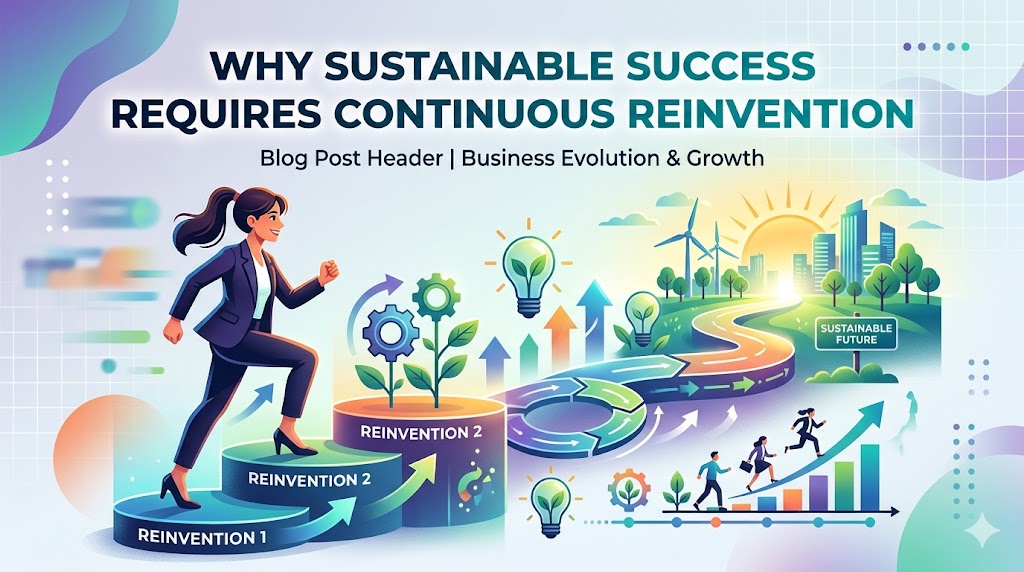
Why Sustainable Success Requires Continuous Reinvention
Most people grow up believing that success is something you achieve once and then keep forever. The idea is simple and comforting. Work hard, reach a certain level, secure a stable job or business, and then enjoy the rest of your life on autopilot. But reality does not follow that pattern. In almost every field, from business to careers to creative work, success is not a fixed destination. It is a moving target. What works today will not necessarily work tomorrow, and what brought you results in the past can slowly become the very thing holding you back. Sustainable success is not about arriving. It is about continuously reinventing yourself in response to changing conditions.
The world is constantly shifting in ways that are often subtle at first but dramatic over time. Technology evolves, industries transform, consumer behavior changes, and even the skills that were once highly valuable can become outdated. People who fail to recognize this early often find themselves struggling later, not because they became less capable, but because the environment moved faster than they did. Continuous reinvention is the ability to stay aligned with change instead of resisting it. It is the decision to keep updating your approach, your mindset, and your skills so that you remain relevant no matter how the landscape shifts.
One of the biggest misconceptions about success is that effort alone guarantees long term stability. While effort is important, it is not enough if it is applied in the wrong direction for too long. Many people work extremely hard doing things that gradually lose value in the market. They assume persistence will eventually pay off, but persistence without adaptation can lead to stagnation. Continuous reinvention is what transforms effort into lasting progress. It ensures that your hard work is always aligned with current realities instead of outdated assumptions.
Reinvention does not necessarily mean starting over from scratch. It often begins with small but intentional adjustments. It could be learning a new skill that complements your existing abilities, adopting a better way of solving problems, or shifting how you position yourself in your industry. Over time, these small adjustments accumulate into a completely new version of yourself. The people who sustain success are not those who change everything at once, but those who are willing to keep evolving in manageable steps.
Another reason continuous reinvention is essential is because competition never stands still. If you become comfortable with your current level of success, there will always be others who are actively improving, learning, and innovating. Even if you are doing well today, someone else is likely studying your field and finding better ways to deliver results. Without reinvention, success becomes temporary because you are gradually overtaken by those who are still evolving. Staying still in a competitive environment is essentially moving backward.
There is also the internal side of reinvention, which is just as important as external change. Over time, people develop habits, routines, and mental models that once helped them succeed but later become limiting. What made you effective at an earlier stage of your journey may not be enough to take you to the next level. Continuous reinvention requires self awareness. It demands that you regularly question your methods, your assumptions, and your comfort zones. This kind of reflection allows you to identify areas where you have outgrown your own approach.
Fear is one of the main reasons people resist reinvention. Change often feels like uncertainty, and uncertainty feels risky. Many people prefer to stick with what is familiar even when it is no longer effective. However, in the long run, the greater risk is refusing to change. The world does not wait for anyone to feel ready. It keeps evolving regardless of comfort levels. Those who learn to embrace change as a natural part of growth are the ones who maintain stability over time, even when everything around them is shifting.
Another important aspect of reinvention is learning agility. It is not just about what you know, but how quickly you can learn what you do not know. People who sustain success are usually fast learners. They are not necessarily the most talented or the most experienced, but they are open to updating their understanding continuously. They treat learning as an ongoing process rather than a phase that ends after formal education. This mindset allows them to adapt to new tools, new systems, and new opportunities without being left behind.
Continuous reinvention also plays a major role in creativity and innovation. When people expose themselves to new ideas and perspectives, they begin to see possibilities that were previously invisible. Many breakthroughs happen not because someone discovered something entirely new, but because they combined existing knowledge in a new way. Reinvention expands mental flexibility, making it easier to connect ideas and solve problems in more effective ways. Without it, thinking becomes rigid and limited.
In business, reinvention is often the difference between growth and decline. Companies that fail to evolve eventually lose relevance, even if they were once industry leaders. Markets reward relevance, not history. This is why some organizations that were once dominant disappear while newer, more adaptable players rise quickly. The same principle applies to individuals. Your past achievements may open doors, but they cannot guarantee future success unless you continue to evolve with the environment.
On a personal level, continuous reinvention builds resilience. Life is unpredictable, and circumstances can change suddenly. People who are flexible in their identity and skills are better able to navigate transitions. If one path closes, they are more capable of creating another. Reinvention gives you options, and options reduce vulnerability. Instead of being dependent on a single way of success, you develop multiple ways to create value.
It is also important to understand that reinvention is not about rejecting your past. Instead, it builds on it. Every stage of growth adds something to your foundation. The goal is not to erase who you were, but to expand who you are. Your past experiences become raw material for your next version. When approached correctly, reinvention feels less like abandoning your identity and more like refining it.
Many people delay reinvention because they believe they need a major trigger such as failure or crisis before making changes. But waiting for a breakdown is not necessary. The most effective reinvention often happens proactively, before circumstances force it. Small, consistent upgrades made over time are more powerful than sudden, reactive changes made under pressure. Proactive reinvention gives you control over your direction instead of forcing you to react to external pressure.
Another key element is awareness of trends without becoming dependent on them. While it is important to understand where the world is heading, successful reinvention is not about chasing every new thing. It is about identifying meaningful shifts and adapting intelligently. Blindly following trends can be just as harmful as ignoring them completely. The goal is to filter change through understanding, not impulse.
Ultimately, sustainable success belongs to those who accept that growth never ends. There is no final version of success where improvement becomes unnecessary. Every level brings new challenges, new expectations, and new standards. Continuous reinvention is what keeps you aligned with those changes instead of being overwhelmed by them. It transforms success from something fragile into something durable.
In the end, the ability to reinvent yourself repeatedly is one of the most valuable skills you can develop. It ensures that you do not become outdated in a world that never stops evolving. It keeps your thinking sharp, your skills relevant, and your opportunities open. Most importantly, it shifts your mindset from trying to “arrive” at success to actively participating in it as an ongoing process. Sustainable success is not a moment. It is a continuous evolution.

EarnSmartOnline.com.ng is dedicated to helping readers make smarter financial decisions through practical guides on online income, personal finance, technology, digital business, and wealth creation. Our goal is to provide reliable, easy-to-understand, and actionable content that empowers individuals to earn smarter, build sustainable income streams and achieve long-term financial success.
Recommended: Start Earning Online
- Ultimate Affiliate Marketing Program — learn affiliate marketing with a done-for-you sales system ($15). Check it out
- The Newbie Affiliate Guide — the beginner-friendly starter guide (~$6.68). Check it out
- Easy Dollar Maker — earn in dollars uploading AI images and videos from your phone ($17). Check it out
Disclosure: These are affiliate links. If you buy through them, I may earn a commission at no extra cost to you.



