
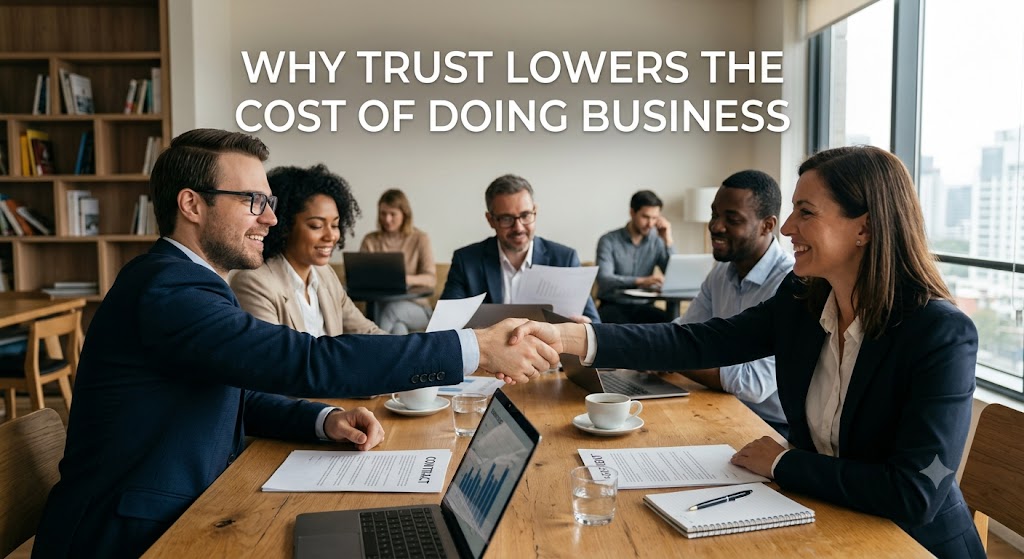
Why Trust Lowers the Cost of Doing Business
Trust is one of the most valuable assets any business can possess, yet it is also one of the most overlooked. While many entrepreneurs spend enormous amounts of money on advertising, legal protection, customer acquisition, employee monitoring, and crisis management, they often fail to realise that a significant portion of these costs exists because trust is missing. Businesses that are trusted by customers, employees, suppliers, investors, and partners naturally spend less money convincing people, defending themselves, fixing misunderstandings, and recovering from damaged relationships. This is why trust is not simply a moral value or a nice personality trait. It is an economic advantage. It reduces friction, speeds up decision making, improves cooperation, and allows businesses to operate more efficiently. The simple truth is that trust lowers the cost of doing business in ways that many companies never fully appreciate until they lose it.
Every business transaction involves some level of uncertainty. Whenever someone buys a product, signs a contract, hires a service provider, or enters into a partnership, there is an element of risk. The customer wonders whether the product will meet expectations. The supplier wonders whether payment will arrive on time. The employee hopes salaries will not be delayed. The investor wants assurance that financial reports are accurate. The business owner expects customers to honour their commitments. Trust exists to reduce these uncertainties. When people trust each other, they spend less time worrying about what could go wrong and more time creating value together.
Imagine two businesses selling the same product at the same price. One company has built a reputation for honesty, reliability, and excellent customer service. The other has a history of complaints, hidden charges, and poor communication. Which company will customers choose? In most cases, they will choose the trusted company even if it is slightly more expensive. People are willing to pay for peace of mind because trust reduces their perceived risk. This means the trusted business spends less money convincing customers to buy. It enjoys repeat purchases, referrals, and stronger customer loyalty without constantly increasing its marketing budget.
Marketing is often one of the biggest expenses for any organisation. Companies spend millions trying to capture attention and persuade strangers to become buyers. However, trust changes the equation completely. When customers genuinely trust a brand, they become voluntary marketers. They recommend products to family members, friends, colleagues, neighbours, and even strangers on social media. Word of mouth remains one of the most powerful forms of marketing because people naturally trust recommendations from people they know more than advertisements created by businesses themselves. Every satisfied customer who recommends your business is reducing your future advertising costs.
Customer acquisition becomes easier when trust is already established. Businesses with strong reputations often receive enquiries before they even begin promoting a product. Potential customers seek them out because someone else has already done the convincing. Compare this with companies that struggle with damaged reputations. They must spend heavily on advertisements, discounts, promotional campaigns, and public relations simply to overcome existing doubts. Instead of investing in innovation or expansion, they are forced to spend resources repairing damaged credibility.
Trust also reduces customer support costs. Businesses that consistently deliver what they promise receive fewer complaints, fewer refund requests, fewer product returns, and fewer angry phone calls. Customer service departments become more efficient because they spend less time resolving conflicts and more time helping customers maximise the value of their purchases. On the other hand, companies that repeatedly disappoint customers often require larger support teams just to handle the constant stream of complaints generated by broken promises.
Legal expenses are another area where trust significantly lowers business costs. Contracts are necessary, but businesses built on mutual trust often negotiate faster and experience fewer legal disputes. Lawyers become involved less frequently because both parties believe agreements will be honoured. This does not eliminate the need for legal protection, but it reduces the frequency of expensive lawsuits, lengthy negotiations, contract enforcement actions, and costly litigation. Every legal dispute avoided represents money that can instead be invested in business growth.
Within organisations, trust dramatically reduces management costs. Employees who trust leadership are generally more engaged, productive, and committed. Managers spend less time micromanaging every task because employees can be relied upon to fulfil their responsibilities without constant supervision. Instead of creating layers of approval processes designed to prevent mistakes or dishonesty, trusted teams work with greater independence. This allows businesses to operate with leaner management structures while maintaining high performance.
Micromanagement is often a hidden cost of low trust. When leaders do not trust employees, every decision requires multiple approvals. Every report is checked repeatedly. Every expense is questioned. Every action requires supervision. While these measures may appear to improve accountability, they also slow productivity, frustrate employees, and increase administrative expenses. High-trust organisations eliminate much of this unnecessary bureaucracy because people are trusted to make responsible decisions within clearly defined boundaries.
Employee retention is another major financial benefit of trust. Recruiting and training new employees is expensive. Every resignation represents the loss of knowledge, relationships, experience, and productivity. Employees who trust their employers are more likely to remain loyal during challenging periods because they believe leadership will act fairly. They are less likely to leave for minor salary differences because trust creates emotional commitment that goes beyond financial compensation. Businesses with high employee trust therefore spend less money replacing talent.
Trust strengthens teamwork in ways that directly affect profitability. When employees trust one another, communication becomes more open and honest. Problems are reported earlier before they become expensive crises. Mistakes are admitted instead of hidden. Ideas are shared more freely without fear of ridicule or punishment. Departments cooperate instead of competing internally. These improvements reduce delays, improve innovation, and increase operational efficiency. Every hour saved through effective collaboration represents reduced operational costs.
Innovation also thrives in environments where trust exists. Employees who trust leadership are more willing to suggest creative ideas because they believe their contributions will be respected rather than stolen or criticised unfairly. They take calculated risks that may lead to improved products, better customer experiences, and more efficient processes. Organisations lacking trust often experience the opposite. Employees keep valuable ideas to themselves because they fear negative consequences. Innovation slows while competitors move ahead.
Supplier relationships provide another clear example of how trust lowers costs. Suppliers who trust a business often offer better payment terms, faster deliveries, priority service, and improved pricing. They become more flexible during temporary financial difficulties because they believe commitments will ultimately be honoured. In contrast, businesses with poor reputations may be required to pay upfront, provide additional guarantees, or accept less favourable terms because suppliers perceive higher risk. These additional requirements increase operating costs and reduce financial flexibility.
Cash flow improves when trust exists throughout the supply chain. Trusted businesses often enjoy longer payment periods while still receiving reliable deliveries. This allows them to manage working capital more effectively without relying heavily on expensive loans or emergency financing. Lower financing costs translate directly into higher profitability.
Investors also place enormous value on trust. Financial performance matters, but credibility often determines whether investors are willing to provide funding. Companies known for transparency, ethical leadership, and honest communication usually attract investment more easily than businesses surrounded by uncertainty or controversy. Investors understand that trustworthy management reduces the risk of fraud, financial manipulation, and poor governance. As a result, trusted businesses may secure funding at better terms, reducing their overall cost of capital.
Banks operate under similar principles. Lending institutions evaluate not only financial statements but also the credibility of borrowers. Businesses with strong reputations often qualify for lower interest rates because lenders believe repayment risk is lower. Over time, even a small reduction in borrowing costs can save substantial amounts of money, particularly for businesses financing expansion projects or large capital investments.
Trust is equally valuable in negotiations. Negotiations between trusted parties usually conclude faster because less time is spent questioning motives or verifying every statement. Agreements become easier to reach because each side believes the other is acting in good faith. Faster negotiations reduce professional fees, minimise delays, and allow businesses to begin generating value sooner.
Time itself is a significant business cost, and trust saves time every day. Meetings become shorter because fewer issues require repeated clarification. Emails become more straightforward because intentions are rarely questioned. Decisions move faster because people believe the information being presented. Projects advance without constant verification or unnecessary approvals. Although these individual time savings may appear small, they accumulate into substantial productivity gains over months and years.
Customer loyalty is perhaps one of the greatest financial rewards of trust. Acquiring a new customer often costs several times more than retaining an existing one. Trusted businesses naturally retain customers for longer periods because customers develop confidence that future experiences will be as positive as previous ones. Loyal customers not only buy repeatedly but often purchase additional products and services over time, increasing their lifetime value. This reduces dependence on expensive customer acquisition campaigns.
Pricing power also increases when trust is established. Customers often focus less on finding the absolute cheapest option when they trust a business to deliver consistent quality and reliable service. They recognise that lower prices sometimes carry hidden costs, disappointments, or risks. Trusted brands therefore avoid destructive price wars because customers value reliability alongside affordability. Higher pricing power contributes directly to healthier profit margins.
Trust becomes even more valuable during difficult economic periods. Recessions, inflation, supply shortages, and market disruptions create uncertainty. Customers naturally become more cautious with their spending. During such times, businesses with established trust often maintain stronger sales because customers feel safer buying from organisations they already know. Trust acts like insurance during economic downturns by preserving customer confidence when uncertainty is high.
The digital economy has made trust more important than ever before. Online shoppers frequently purchase products from businesses they have never visited physically. Since they cannot inspect products personally, trust becomes the deciding factor. Positive reviews, transparent policies, secure payment systems, authentic customer testimonials, and consistent communication all contribute to building digital trust. Businesses lacking credibility online face significantly higher customer acquisition costs because sceptical consumers hesitate before making purchases.
Social media has accelerated both the creation and destruction of trust. A single positive customer experience can reach thousands of potential buyers through shares and recommendations. Unfortunately, one dishonest action can spread just as quickly, damaging years of reputation building. This reality makes trust not only valuable but essential for long-term business sustainability. Every dishonest shortcut may produce temporary gains but often creates far greater future costs.
Transparency plays a central role in building trust. Businesses that openly communicate pricing, policies, product limitations, delivery expectations, and potential challenges create realistic customer expectations. Customers appreciate honesty even when the news is not entirely positive. By contrast, businesses that exaggerate benefits or hide important details often generate disappointment, complaints, refunds, and negative reviews. The short-term gains from misleading communication rarely outweigh the long-term costs of broken trust.
Consistency is equally important. Trust is not built through one impressive advertisement or one excellent customer interaction. It develops gradually through repeated experiences that consistently meet expectations. Every promise kept strengthens credibility. Every deadline honoured reinforces confidence. Every customer treated fairly contributes to a stronger reputation. Over time, this accumulated trust becomes one of the business’s most valuable competitive advantages.
Leadership behaviour strongly influences organisational trust. Employees observe whether leaders practise the values they promote. If executives demand honesty while behaving dishonestly themselves, trust quickly disappears. However, when leaders consistently demonstrate integrity, accountability, fairness, and transparency, employees are more likely to follow their example. Organisational culture becomes stronger because trust flows from leadership throughout every level of the company.
Trust also reduces stress throughout organisations. Employees working in high-trust environments experience greater psychological safety because they do not constantly fear hidden agendas, unfair treatment, or unexpected consequences. Lower stress contributes to higher productivity, better health, reduced absenteeism, and improved creativity. Although these benefits may seem intangible, they eventually produce measurable financial savings.
Businesses frequently underestimate the hidden costs of distrust. Suspicion creates duplicate work because information must be verified repeatedly. Approval processes become increasingly complex. Internal politics consume valuable time. Employees become reluctant to collaborate. Customers hesitate before purchasing. Suppliers demand stricter payment terms. Investors require higher returns. Banks increase interest rates. Lawyers become more involved. Insurance costs may even rise due to perceived operational risks. Collectively, these hidden costs quietly reduce profitability without always appearing on financial statements as “cost of distrust.”
Many successful global brands owe much of their longevity to trust rather than simply superior products. Competitors may eventually copy features, reduce prices, or introduce similar services, but genuine trust is much harder to imitate. It represents years of consistently fulfilling promises. Businesses that focus solely on short-term profits often sacrifice trust through misleading advertising, poor customer service, or unethical behaviour. While they may enjoy temporary financial gains, they frequently face higher long-term costs repairing damaged reputations.
Family businesses provide interesting examples of trust in action. Many survive for generations because customers trust the family’s commitment to maintaining quality and protecting the family name. That reputation becomes a valuable business asset passed from one generation to another. The same principle applies to professional service firms where personal credibility often determines business success more than technical expertise alone.
Trust also influences recruitment. Talented professionals increasingly research company culture before accepting job offers. Organisations known for treating employees fairly receive more applications from qualified candidates. This reduces recruitment costs while increasing the quality of available talent. Companies with poor reputations often struggle to attract skilled professionals without offering significantly higher salaries or additional incentives.
Customer forgiveness represents another overlooked benefit of trust. No business is perfect. Mistakes happen. Deliveries may be delayed. Products occasionally fail. Systems experience technical problems. However, customers who trust a business are generally more patient when genuine mistakes occur because previous positive experiences create confidence that problems will be resolved fairly. Businesses lacking trust rarely receive this benefit. Even minor issues quickly escalate into major conflicts because customers already expect disappointment.
Trust also improves decision quality. In organisations where trust exists, employees share accurate information without fear of punishment. Leaders therefore make decisions based on complete and honest data rather than filtered reports designed to avoid criticism. Better decisions reduce costly mistakes while improving strategic planning and operational performance.
Ethics and profitability are often presented as competing priorities, but in reality they frequently support each other over the long term. Ethical behaviour builds trust. Trust reduces business costs. Lower costs improve profitability. Businesses that consistently act with integrity create sustainable financial advantages that dishonest competitors struggle to replicate. Although unethical shortcuts may occasionally produce immediate profits, they usually create future expenses through lawsuits, regulatory penalties, damaged reputations, customer loss, and employee disengagement.
Small businesses often benefit from trust even more than large corporations because personal relationships play a greater role in their success. A local business owner who consistently treats customers honestly can build an extremely loyal customer base without spending heavily on national advertising campaigns. Community reputation becomes a powerful marketing asset that significantly lowers customer acquisition costs.
Technology continues to change how businesses operate, but it has not changed the importance of trust. Artificial intelligence, automation, digital payments, remote work, and online commerce all depend on people believing that systems, organisations, and individuals will behave responsibly. As technology increases transaction speed, trust becomes even more important because decisions are often made with less personal interaction. Businesses that combine technological efficiency with genuine trustworthiness will likely outperform those relying solely on technology.
Building trust requires patience because credibility develops slowly. Every interaction either strengthens or weakens it. Businesses build trust by keeping promises, communicating honestly, admitting mistakes, correcting problems quickly, respecting customers, paying suppliers on time, treating employees fairly, protecting customer information, delivering consistent quality, and demonstrating integrity even when no one appears to be watching. These actions may seem ordinary individually, but together they create extraordinary long-term financial value.
Once trust is broken, rebuilding it becomes expensive and time consuming. Companies often launch costly public relations campaigns, introduce compensation programmes, hire consultants, redesign policies, replace executives, or spend years repairing damaged reputations. These recovery efforts highlight an important lesson. Maintaining trust is almost always less expensive than rebuilding it after it has been lost.
Business history repeatedly demonstrates that trust compounds over time much like financial investments. Every positive interaction adds another layer of credibility. As trust grows, customers become more loyal, employees become more committed, suppliers become more cooperative, investors become more confident, and partners become more willing to collaborate. These cumulative benefits continuously lower operating costs while creating opportunities for sustainable growth.
Ultimately, trust is far more than an emotional concept or ethical ideal. It is a practical business strategy with measurable financial consequences. It reduces marketing expenses, lowers legal costs, improves employee retention, strengthens supplier relationships, attracts investment, speeds up negotiations, enhances customer loyalty, increases productivity, reduces stress, supports innovation, improves decision making, and creates long-term competitive advantages that competitors cannot easily copy. Every organisation faces a choice between investing in trust today or paying the far greater costs of distrust tomorrow.
The businesses that achieve lasting success rarely do so because they have the cheapest products, the largest advertising budgets, or the most sophisticated technology alone. They succeed because people believe them. Customers trust them enough to buy repeatedly. Employees trust them enough to give their best efforts. Suppliers trust them enough to extend favourable terms. Investors trust them enough to provide capital. Communities trust them enough to support their growth. In every one of these relationships, trust quietly removes barriers, reduces unnecessary expenses, and allows value to flow more freely. That is why trust is not merely good for business. Trust is one of the most powerful economic assets a business can ever build, and one of the surest ways to lower the true cost of doing business while creating a foundation for enduring success.

EarnSmartOnline.com.ng is dedicated to helping readers make smarter financial decisions through practical guides on online income, personal finance, technology, digital business, and wealth creation. Our goal is to provide reliable, easy-to-understand, and actionable content that empowers individuals to earn smarter, build sustainable income streams and achieve long-term financial success.
Recommended: Start Earning Online
- Ultimate Affiliate Marketing Program — learn affiliate marketing with a done-for-you sales system ($15). Check it out
- The Newbie Affiliate Guide — the beginner-friendly starter guide (~$6.68). Check it out
- Easy Dollar Maker — earn in dollars uploading AI images and videos from your phone ($17). Check it out
Disclosure: These are affiliate links. If you buy through them, I may earn a commission at no extra cost to you.



