
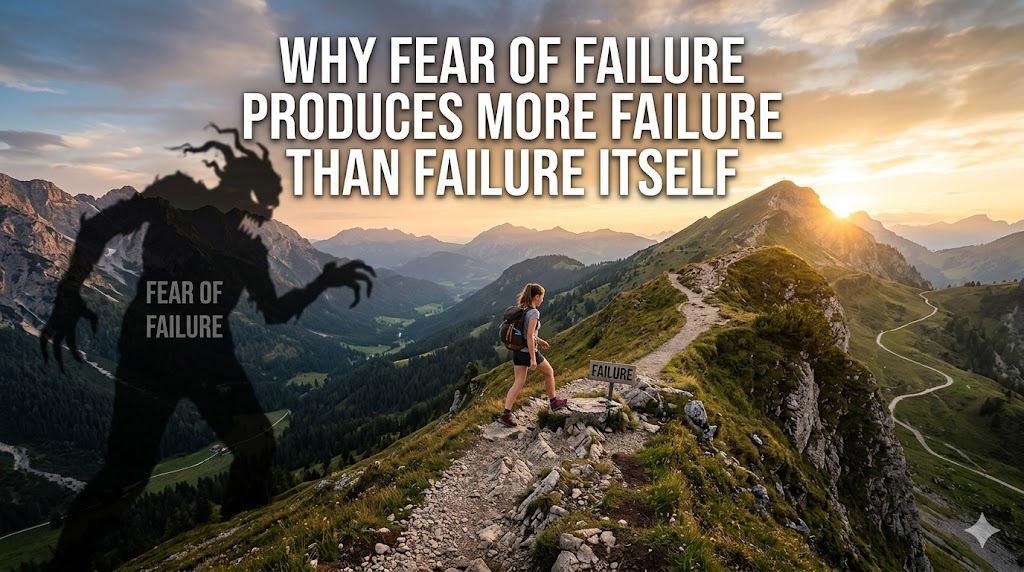
Why Fear of Failure Produces More Failure Than Failure Itself
Fear of failure is often treated like a protective instinct, something that keeps people safe from embarrassment, loss, or regret. In reality, it frequently becomes the very force that blocks progress and creates the outcomes people are trying so hard to avoid. When fear of failure takes control of decision making, it does not reduce mistakes. Instead, it multiplies them in hidden ways that show up as missed opportunities, poor timing, lack of practice, and eventually a life that feels stuck. The strange truth is that failure itself is rarely the biggest threat to success. The fear of failure is.
At its core, fear of failure changes how people behave long before any real failure happens. It influences the willingness to try, the speed of decision making, and the level of effort invested in learning something new. A person who is afraid of failing often avoids situations where they might be judged or corrected. This avoidance feels safe in the moment, but it slowly removes exposure to the exact experiences required for growth. Without repetition, feedback, and adjustment, improvement becomes impossible. Over time, this creates a cycle where the person becomes less skilled, less confident, and more dependent on avoiding risk. That dependency itself becomes a form of failure.
One of the most damaging effects of fear of failure is procrastination. When people are afraid of not getting things right, they delay starting altogether. They convince themselves that they need more preparation, more research, or better conditions before they begin. While preparation is valuable, excessive delay becomes a disguised form of avoidance. Meanwhile, others who are less afraid begin, make mistakes, learn quickly, and adjust in real time. The fearful individual does not fail publicly, but they fail privately through inaction. In many cases, the opportunity simply passes them by, not because they were incapable, but because they were too cautious to engage.
Fear of failure also distorts decision making. Instead of choosing what offers the highest potential for growth or reward, people tend to choose what feels safest. This leads to conservative choices that minimize risk but also minimize progress. For example, someone might avoid starting a business, learning a new skill, or applying for a better job because of the possibility of rejection or embarrassment. On paper, this looks like caution. In practice, it leads to stagnation. Over time, this pattern produces a life filled with unrealized potential. The failure here is not dramatic or visible, but it is persistent and cumulative.
Another hidden consequence of fear of failure is the avoidance of feedback. Feedback is one of the most powerful tools for improvement, yet it often feels threatening to those who are afraid of being wrong. Instead of seeking correction, they avoid situations where their work or ideas might be evaluated. This removes the possibility of refinement. Without feedback, errors go uncorrected and weak skills remain weak. Meanwhile, those who are willing to be corrected grow faster even when they fail more often in the short term. Ironically, failure becomes the pathway to success for them, while avoidance of failure becomes the barrier for others.
Fear of failure also affects consistency. Many people start projects, goals, or habits with enthusiasm, but the moment they encounter difficulty or make a mistake, they interpret it as evidence that they are not good enough. Instead of continuing through the learning phase, they stop. This creates a pattern of starting and quitting, which prevents mastery from developing. True skill requires sustained repetition over time, including repeated failure. When fear interrupts this process, progress becomes fragmented and incomplete. The result is not just failure in one attempt, but failure to build long term capability.
On a deeper level, fear of failure changes identity. People begin to see themselves as someone who should not fail rather than someone who is learning. This identity shift is subtle but powerful. It creates pressure to appear competent instead of becoming competent. As a result, effort is often directed toward maintaining appearances rather than improving ability. This leads to shallow learning, surface level understanding, and avoidance of challenging tasks. In contrast, individuals who accept failure as part of learning focus on improvement rather than image. Over time, they develop stronger skills and greater resilience.
Fear of failure also increases emotional pressure around performance. When too much importance is placed on not failing, every task becomes high stakes. This pressure often leads to anxiety, overthinking, and reduced performance in the moment. Instead of focusing on execution, attention is divided between action and fear of consequences. This reduces clarity and increases mistakes. Ironically, the fear meant to prevent failure becomes a direct contributor to it. Calm, repeated exposure to challenges usually produces better results than high pressure avoidance strategies.
Another overlooked effect is reduced experimentation. Progress in most areas of life depends on trying different approaches, testing ideas, and learning what works through experience. Fear of failure limits experimentation because every attempt is seen as a risk rather than a learning opportunity. Without experimentation, individuals rely on assumptions instead of evidence. This slows growth significantly. Those who experiment freely may fail more often, but they also discover better strategies faster. Over time, they outperform those who avoided failure entirely.
Fear of failure also shapes long term opportunity cost. Every time a person avoids a challenge, they are not just avoiding failure, they are also avoiding potential success. These missed opportunities accumulate over time. Years later, the difference between someone who acted despite fear and someone who avoided action becomes very large. The second group often realizes that their biggest failures were not the mistakes they made, but the chances they never took. This realization is often delayed, but its impact is permanent.
Ultimately, fear of failure produces more failure than failure itself because it blocks the natural learning process that leads to success. Failure, when experienced directly, provides feedback, correction, and growth. Fear of failure removes the person from that process entirely. It creates a situation where mistakes are avoided at the cost of improvement, and safety is prioritized at the cost of progress. The result is a life shaped not by what went wrong, but by what was never attempted.
The most successful individuals are not those who avoid failure, but those who engage with it frequently and learn from it quickly. They understand that failure is temporary information, not a permanent identity. Each attempt provides data that improves the next attempt. Over time, this creates momentum that fear cannot compete with. While fear of failure creates hesitation and delay, acceptance of failure creates movement and growth.
In the end, the real danger is not failure itself but the fear that prevents action. Once this is understood, failure loses its power to control decisions. What remains is the ability to act, learn, and improve continuously. And that is where real success begins, not in avoiding mistakes, but in moving forward despite them.

EarnSmartOnline.com.ng is dedicated to helping readers make smarter financial decisions through practical guides on online income, personal finance, technology, digital business, and wealth creation. Our goal is to provide reliable, easy-to-understand, and actionable content that empowers individuals to earn smarter, build sustainable income streams and achieve long-term financial success.
Recommended: Start Earning Online
- Ultimate Affiliate Marketing Program — learn affiliate marketing with a done-for-you sales system ($15). Check it out
- The Newbie Affiliate Guide — the beginner-friendly starter guide (~$6.68). Check it out
- Easy Dollar Maker — earn in dollars uploading AI images and videos from your phone ($17). Check it out
Disclosure: These are affiliate links. If you buy through them, I may earn a commission at no extra cost to you.



