
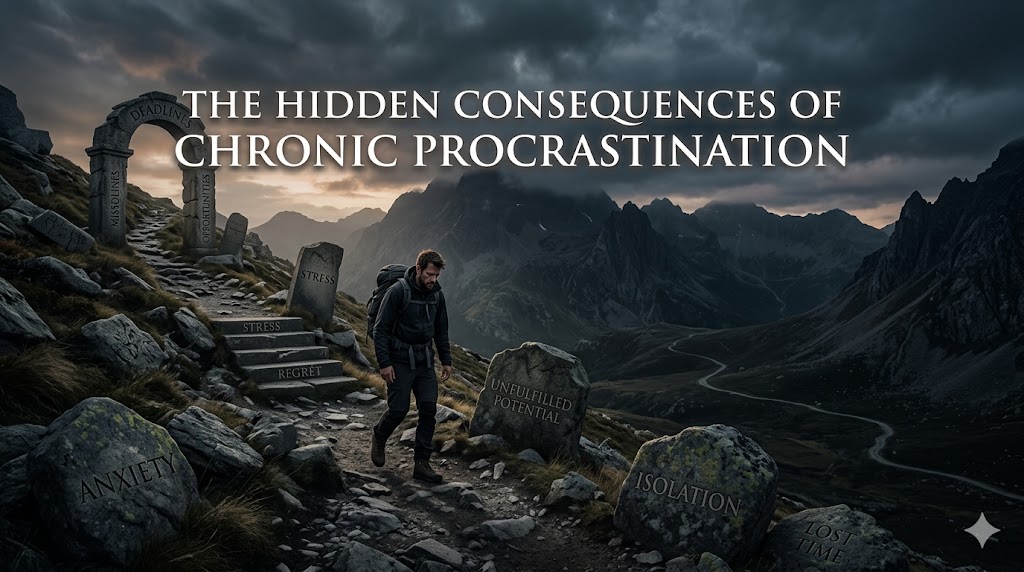
The Hidden Consequences of Chronic Procrastination
Procrastination often looks harmless on the surface. It appears as a simple delay, a small postponement of action, or a momentary choice to do something later instead of now. Many people even treat it as a normal habit, something everyone struggles with occasionally. But when procrastination becomes chronic, it stops being a harmless behavior and starts becoming a silent force that reshapes a person’s life in ways they may not immediately recognize. The most dangerous aspect of chronic procrastination is not the delay itself, but the chain of hidden consequences it creates over time.
One of the earliest effects of chronic procrastination is the distortion of time perception. People who consistently delay tasks begin to underestimate how quickly deadlines approach. This creates a cycle of pressure where tasks are always rushed, and quality is consistently compromised. What begins as “I will do it later” eventually becomes “I don’t have enough time,” even when adequate time was originally available. Over time, this pattern trains the mind to operate under unnecessary stress, making even simple responsibilities feel overwhelming.
Chronic procrastination also quietly erodes self-trust. Every time a person promises themselves that they will start tomorrow and fails to do so, they weaken their internal confidence. Self-trust is built through consistency between intention and action, and procrastination repeatedly breaks this alignment. As self-trust declines, decision-making becomes harder. Individuals begin to doubt their ability to follow through, which leads to even more delay and avoidance. This creates a psychological loop where inaction reinforces more inaction.
Another hidden consequence is the accumulation of mental burden. Unfinished tasks do not simply disappear when ignored. Instead, they linger in the background of the mind as unresolved thoughts. This mental clutter consumes cognitive energy, even when the person is not actively working on the task. As more responsibilities are postponed, the mental load increases, leading to fatigue, reduced focus, and a constant sense of pressure. Many people misinterpret this feeling as laziness or lack of motivation, when in reality it is the weight of unfinished commitments.
Chronic procrastination also affects the quality of opportunities a person can access. Many opportunities in life are time-sensitive. Whether in education, career, or personal development, timing often determines success. When action is delayed, opportunities are either missed entirely or approached too late to be fully beneficial. This does not always show immediate consequences, which is why it is so dangerous. The loss is often invisible, seen only in the comparison between where a person is and where they could have been if action had been taken earlier.
Financial consequences are also deeply tied to chronic procrastination. Delayed decisions around learning skills, applying for opportunities, investing, or building systems often lead to long-term financial limitations. Time is one of the most important factors in wealth-building, especially when it comes to compounding growth. When action is consistently postponed, the potential for compounding is reduced or completely lost. This is why many people work hard later in life but still struggle financially, not because they lack effort, but because they lost critical time earlier.
Relationships are not immune to the effects of procrastination either. Delaying communication, postponing difficult conversations, or failing to show up consistently can slowly weaken trust in personal and professional relationships. People often assume relationships decline due to major conflicts, but in many cases, they deteriorate through small delays in attention, care, and responsiveness. Over time, these delays create emotional distance that becomes difficult to repair.
Chronic procrastination also has a significant impact on personal identity. People tend to form their identity based on repeated behavior. When someone consistently delays action, they begin to see themselves as someone who is not disciplined, not focused, or not reliable. This self-image becomes deeply embedded and influences future behavior. Once a person believes they are “a procrastinator,” they often act in ways that reinforce that identity, even when they want to change.
Another overlooked consequence is reduced performance quality. Tasks completed under pressure, especially last-minute work, rarely reflect a person’s true potential. Rushed execution limits creativity, reduces attention to detail, and increases the likelihood of errors. Over time, this creates a gap between actual ability and demonstrated performance. Many individuals are far more capable than their output suggests, but procrastination prevents their full capability from being visible.
Chronic procrastination also increases emotional instability. The constant cycle of delay, pressure, and rushed completion creates emotional fluctuations that can affect mood, confidence, and motivation. This instability often leads to feelings of guilt and frustration, which further reduce the desire to act. Instead of solving the original problem, individuals become trapped in emotional responses to the problem, deepening the cycle.
In the long term, procrastination can reshape life trajectory. Small delays repeated over months and years accumulate into significant differences in outcomes. Two individuals with similar potential can end up in completely different places simply because one consistently acted earlier while the other consistently delayed. The difference is not always talent or intelligence, but the ability to act in time.
Breaking out of chronic procrastination requires more than motivation. It requires awareness of these hidden consequences and a shift in behavior patterns. Action becomes easier when it is small, immediate, and consistent. The longer a person waits to act, the heavier the psychological resistance becomes. This is why starting is often more important than completing. Once action begins, momentum can carry progress forward.
Ultimately, chronic procrastination is not just about delaying tasks. It is about delaying life itself in small, almost invisible ways. Each delay seems insignificant on its own, but together they shape outcomes, identity, and opportunity. Understanding this hidden cost is the first step toward change. The real power lies in recognizing that time does not pause for indecision, and every moment spent delaying is a moment that could have been used to build, improve, or move forward.

EarnSmartOnline.com.ng is dedicated to helping readers make smarter financial decisions through practical guides on online income, personal finance, technology, digital business, and wealth creation. Our goal is to provide reliable, easy-to-understand, and actionable content that empowers individuals to earn smarter, build sustainable income streams and achieve long-term financial success.
Recommended: Start Earning Online
- Ultimate Affiliate Marketing Program — learn affiliate marketing with a done-for-you sales system ($15). Check it out
- The Newbie Affiliate Guide — the beginner-friendly starter guide (~$6.68). Check it out
- Easy Dollar Maker — earn in dollars uploading AI images and videos from your phone ($17). Check it out
Disclosure: These are affiliate links. If you buy through them, I may earn a commission at no extra cost to you.



