
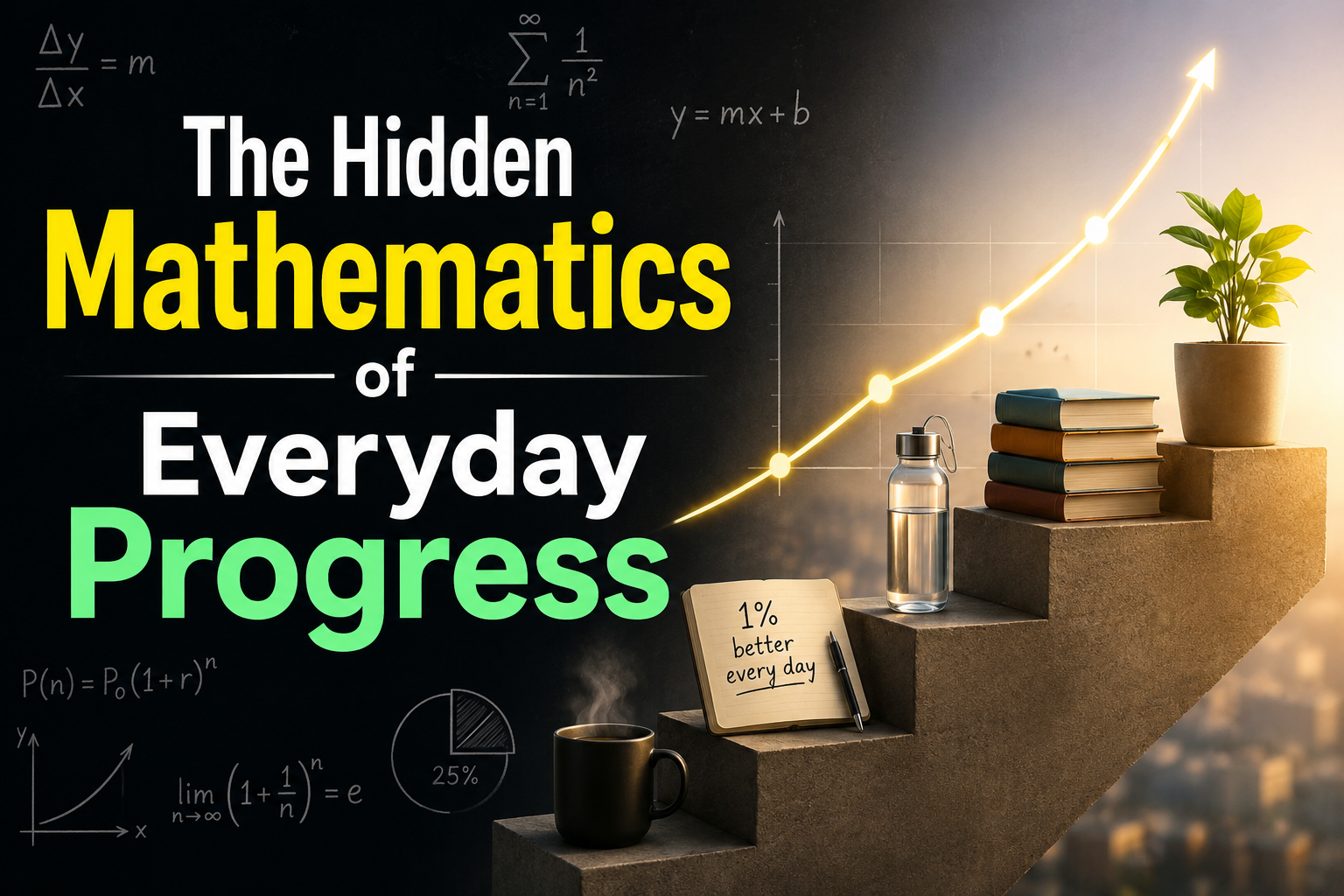
The Hidden Mathematics of Everyday Progress
Most people underestimate the power of small improvements because they focus on visible results instead of invisible growth. Human beings are naturally attracted to dramatic transformations. We celebrate overnight successes, sudden breakthroughs, and rapid achievements. What we rarely notice is the mathematical reality operating quietly beneath every meaningful accomplishment. Whether it is wealth, health, knowledge, relationships, or business success, progress follows patterns that are often hidden from immediate observation. Understanding the hidden mathematics of everyday progress can completely change how you approach your goals and how you interpret your results.
One of the biggest reasons people abandon their goals is because they expect linear growth in a world that often rewards exponential growth. Linear growth is easy to understand. If you improve by one unit every day, your results increase in a straight line. Exponential growth behaves differently. For a long time, it appears insignificant. The early stages seem slow, almost disappointing. Then suddenly, the results begin to accelerate. The challenge is that most people quit during the invisible phase before exponential growth becomes visible.
Consider someone who decides to read ten pages of a book every day. Ten pages may seem insignificant. Missing a day may seem harmless. Yet over a year, that simple habit can amount to several thousand pages of reading. What looked insignificant on a daily basis becomes extraordinary when viewed through the lens of time. The mathematics behind progress is often less about intensity and more about consistency.
The same principle applies to financial growth. A person who saves a small amount regularly may feel as though they are making no real difference in their financial situation. However, the power of accumulation transforms small actions into significant outcomes. Every deposit builds upon previous deposits. Every wise financial decision adds another layer to future security. Progress compounds because today’s actions become the foundation upon which tomorrow’s opportunities are built.
The hidden mathematics of progress also reveals why setbacks are not always as damaging as they appear. Many people believe success requires perfection. In reality, progress is rarely a straight line. There are mistakes, delays, failures, and interruptions. What matters is not avoiding every setback but maintaining a positive overall trajectory. A few bad days cannot destroy years of consistent effort. Likewise, a few good days cannot compensate for years of neglect. Success is usually determined by averages rather than isolated events.
This concept explains why habits are so powerful. Every habit functions as a mathematical equation repeated over time. Positive habits generate positive outcomes while negative habits generate negative outcomes. The effect may be invisible at first because the daily impact is small. Yet the accumulation of repeated actions eventually becomes impossible to ignore. A person who exercises for thirty minutes daily may not notice dramatic changes after one week. After several months, however, the cumulative effect becomes obvious. The mathematics never stopped working. It was simply operating beneath the surface.
Time is perhaps the most important variable in the equation of progress. Most people understand effort but underestimate duration. They are willing to work hard for a short period but become discouraged when results take longer than expected. The reality is that meaningful accomplishments often require far more time than people initially imagine. The hidden mathematics of progress rewards patience because time allows small actions to accumulate into large outcomes.
There is also a psychological aspect to this principle. Human beings tend to evaluate progress based on immediate feedback. We want evidence that our efforts are working. When results are delayed, motivation decreases. This creates a dangerous cycle where people abandon strategies that would have succeeded if given enough time. Understanding the mathematics behind progress helps break this cycle. Instead of focusing solely on outcomes, you begin to value the process that produces outcomes.
Every successful business demonstrates this principle. Businesses rarely become successful overnight. Behind every visible achievement are countless invisible actions. Customer relationships are built one interaction at a time. Brand reputation develops through repeated positive experiences. Expertise grows through continuous learning and practice. Revenue expands as trust accumulates. The final result may appear sudden to outsiders, but the mathematics of accumulation has been operating quietly for years.
Relationships follow similar patterns. Strong friendships, successful marriages, and healthy family connections are rarely built through grand gestures alone. They are often the result of small acts repeated consistently over time. A kind word, a thoughtful action, a moment of support, or a display of respect may seem insignificant individually. Together, however, they create bonds that become remarkably strong. The mathematics of relationships is based on accumulation rather than occasional intensity.
Knowledge also compounds in ways many people fail to appreciate. Learning is not simply the accumulation of facts. Every new piece of information connects with existing knowledge, creating deeper understanding. This means that the value of learning often increases over time. The more you know, the easier it becomes to learn new things. Knowledge creates leverage because previous learning accelerates future learning.
This hidden mathematics explains why successful individuals often appear to gain momentum. Their progress is not necessarily the result of working harder than everyone else. Instead, they benefit from accumulated advantages. Skills reinforce skills. Experience improves judgment. Relationships create opportunities. Reputation generates trust. These factors combine to create accelerating results that may seem mysterious to those observing from the outside.
Momentum itself is one of the most powerful mathematical forces in personal growth. When positive actions are repeated consistently, they create forward movement that becomes easier to sustain. Starting is often difficult because momentum has not yet been established. Once movement begins, however, each action supports the next. This is why consistency is often more important than motivation. Motivation fluctuates while momentum builds through repeated action.
The opposite is also true. Negative behaviors compound just as effectively as positive ones. Small acts of procrastination, poor financial decisions, unhealthy habits, and neglected responsibilities may seem harmless individually. Over time, however, they accumulate into significant problems. The mathematics of decline operates according to the same principles as the mathematics of growth. Small actions repeated consistently eventually produce large outcomes.
One reason people struggle to appreciate this reality is that cause and effect are often separated by time. The decision that creates a future problem may occur months or years before the problem becomes visible. Similarly, the decision that creates future success may not produce immediate rewards. This delay makes it difficult to connect actions with outcomes. Understanding the hidden mathematics of progress helps bridge this gap by recognizing that today’s choices shape tomorrow’s reality.
Another important lesson is that progress rarely occurs at the same rate throughout a journey. Early stages often involve learning, adaptation, and foundation building. These activities may not produce visible results immediately. Yet they are essential because they support future growth. Just as a building requires a strong foundation before additional floors can be added, personal and professional growth often requires invisible preparation before visible success emerges.
This principle applies to virtually every area of life. Athletes build strength through repeated training sessions. Writers improve through consistent practice. Entrepreneurs learn through repeated experimentation. Investors build wealth through disciplined decision making. None of these achievements occur because of a single action. They emerge from the mathematical accumulation of many actions over time.
The hidden mathematics of everyday progress teaches a valuable lesson about expectations. People often overestimate what they can accomplish in a few weeks and underestimate what they can accomplish in several years. This misunderstanding leads to frustration because expectations do not match reality. By focusing on long term accumulation rather than short term outcomes, individuals can maintain motivation even when immediate results are limited.
Ultimately, progress is less about dramatic moments and more about repeated actions. Every day presents opportunities to add another positive number to the equation of your life. The changes may appear insignificant in the moment. They may not attract attention. They may not generate immediate rewards. Yet each action contributes to a larger pattern that unfolds over time.
The hidden mathematics of everyday progress reminds us that success is rarely accidental. It is often the predictable result of small actions repeated consistently, patiently, and deliberately. While others search for shortcuts, breakthroughs, and overnight transformations, those who understand this principle recognize a deeper truth. Great achievements are often built one decision, one habit, one effort, and one day at a time. The mathematics may be hidden, but its results eventually become impossible to ignore. When viewed through this lens, every positive action matters because every action becomes part of a larger equation that shapes the future.

EarnSmartOnline.com.ng is dedicated to helping readers make smarter financial decisions through practical guides on online income, personal finance, technology, digital business, and wealth creation. Our goal is to provide reliable, easy-to-understand, and actionable content that empowers individuals to earn smarter, build sustainable income streams and achieve long-term financial success.
Recommended: Start Earning Online
- Ultimate Affiliate Marketing Program — learn affiliate marketing with a done-for-you sales system ($15). Check it out
- The Newbie Affiliate Guide — the beginner-friendly starter guide (~$6.68). Check it out
- Easy Dollar Maker — earn in dollars uploading AI images and videos from your phone ($17). Check it out
Disclosure: These are affiliate links. If you buy through them, I may earn a commission at no extra cost to you.



