
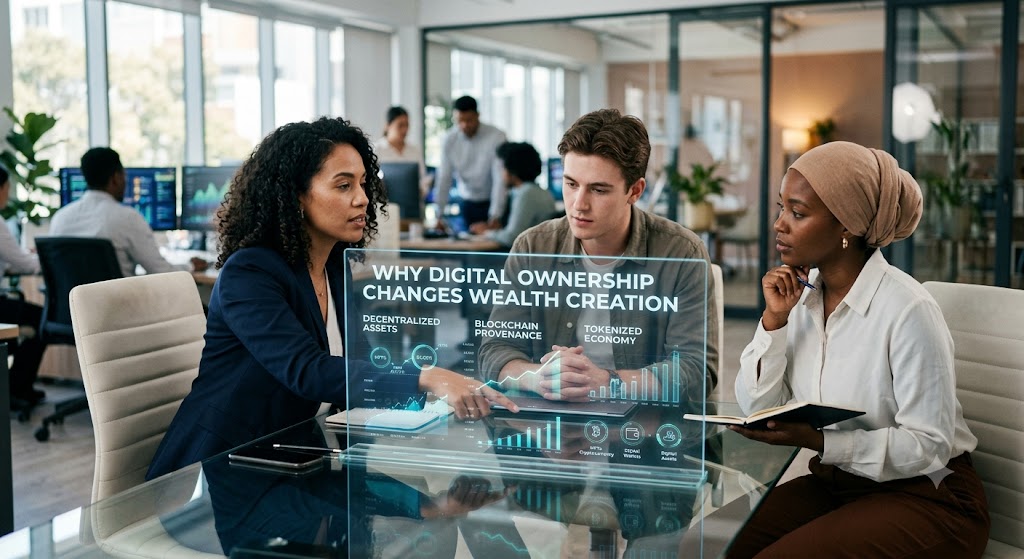
Why Digital Ownership Changes Wealth Creation
The internet has created opportunities that previous generations could never have imagined, yet many people still use it in ways that benefit someone else more than themselves. Every day, billions of people spend hours on social media, streaming platforms, marketplaces, and messaging apps, helping these companies grow richer through their attention, content, and engagement. While there is nothing wrong with using these platforms, there is a growing difference between those who merely participate in the digital economy and those who actually own valuable digital assets. That difference is changing how wealth is created across the world. Understanding why digital ownership changes wealth creation is becoming one of the most important lessons for anyone who wants to build lasting financial security in today’s connected world.
For many years, wealth was closely associated with physical ownership. People invested in land, houses, factories, farms, shops, vehicles, and equipment because these assets could appreciate in value or generate income. While physical assets are still valuable today, the digital revolution has introduced entirely new forms of ownership that can produce income around the clock without the geographical limitations of traditional businesses. A website, a blog, an online course, a software application, a YouTube channel, a digital publication, an online directory, or even a valuable domain name can become income-producing assets that continue generating value long after they are created.
Many people mistakenly believe that making money online simply means finding a remote job or becoming an influencer. Those are only small parts of the digital economy. The real transformation happens when individuals begin to own the platforms, websites, products, intellectual property, and audiences that create continuous opportunities. Instead of working exclusively for someone else’s business, they gradually build digital properties that they control. Ownership shifts the financial equation because it allows the creator to benefit from long-term growth rather than receiving only short-term compensation.
Imagine two individuals who spend five hours every day online. One spends those hours scrolling through videos, commenting on posts, sharing memes, and consuming endless entertainment. The other spends the same amount of time writing useful articles, improving a website, creating educational videos, developing digital products, or growing an email list. Both individuals are active online, but only one is building an asset. Years later, the first person has memories of thousands of posts viewed, while the second owns a valuable online business that continues attracting visitors from search engines and generating income even while sleeping. The difference is not simply hard work. It is ownership.
One of the greatest advantages of digital ownership is scalability. A traditional shop often serves customers who live nearby. A physical teacher can only teach a limited number of students at one time. A consultant may only have enough hours to work with a handful of clients each week. Digital assets operate differently. A well-written article can be read by thousands or even millions of people without requiring additional effort from its creator. A digital course can be sold repeatedly without being recreated every time a customer makes a purchase. Software can serve users in multiple countries simultaneously. This ability to reach unlimited audiences dramatically changes income potential.
Digital ownership also removes many of the barriers that previously prevented ordinary people from creating wealth. In the past, starting a business often required expensive buildings, inventory, equipment, employees, and significant capital. Today, someone with a laptop, an internet connection, useful knowledge, and consistent effort can create digital assets that compete with much larger organisations. While success still requires patience and dedication, the cost of entry has become dramatically lower than it was only a few decades ago.
One of the most overlooked digital assets is a website. Many people see websites as simple online brochures, but in reality they function as digital real estate. Every article published, every page indexed by search engines, every visitor acquired, and every backlink earned increases the overall value of that property. A website that consistently attracts visitors from search engines becomes an asset capable of generating advertising revenue, affiliate commissions, product sales, memberships, sponsorships, consulting opportunities, and countless other income streams. Unlike social media accounts, where algorithms frequently change without warning, a website offers far greater control over how content is presented and monetised.
Domain names themselves have also become valuable investments. Just as prime land in a growing city increases in value, memorable and relevant domain names often appreciate as businesses compete for online visibility. Some domain names purchased for modest amounts have later been sold for thousands or even millions of pounds because of their branding potential and market demand. Although not every domain will become extremely valuable, understanding digital property helps people recognise opportunities that many others overlook.
Content creation represents another powerful form of digital ownership. Every helpful article, educational video, podcast episode, infographic, eBook, or tutorial becomes intellectual property that can continue attracting audiences for years. Unlike temporary social media posts that disappear from attention within hours or days, evergreen content can remain discoverable through search engines for many years. A single well-optimised article written today may still be bringing visitors and generating income five or even ten years from now.
Search engine optimisation plays an essential role in digital ownership because it allows owned assets to become discoverable without depending entirely on paid advertising. Every time someone searches for information and finds your website, they become part of your audience rather than someone else’s. Organic traffic is particularly valuable because it often continues arriving without continuous advertising expenditure. While SEO requires patience, consistency, and quality content, it transforms digital assets into long-term income generators.
Another reason digital ownership changes wealth creation is the ability to build multiple income streams from the same asset. A single website can display advertisements, promote affiliate products, sell digital downloads, offer online courses, provide consulting services, collect email subscribers, generate sponsorship opportunities, and even become valuable enough to sell entirely. Instead of relying on one source of income, digital owners often diversify revenue using the same audience they have patiently built.
Email lists represent another frequently underestimated digital asset. Social media followers belong to the platforms where they are hosted. Algorithms change, accounts get suspended, and audience reach fluctuates unpredictably. An email list, however, gives creators direct communication with people who have voluntarily chosen to receive updates. This relationship becomes increasingly valuable over time because it allows businesses to announce new products, share useful information, and maintain customer relationships independently of changing social media trends.
Digital ownership also encourages long-term thinking. Employees are often paid for hours worked. Freelancers are generally paid for completed projects. Digital owners invest time into creating assets that may continue producing value indefinitely. This changes the mindset from constantly exchanging time for money to building systems that generate ongoing returns. Although creating these assets often requires significant effort upfront, the long-term rewards can greatly exceed the initial investment.
The rise of artificial intelligence has made digital ownership even more important. Many repetitive tasks are becoming automated, and competition in traditional employment continues evolving. People who own valuable digital assets are generally better positioned to adapt because their income depends less on performing routine tasks and more on controlling platforms, audiences, brands, and intellectual property. Technology may change how work is performed, but ownership remains valuable regardless of technological shifts.
Personal branding has also become a powerful form of digital ownership. Individuals who consistently share expertise, solve problems, educate audiences, and establish trust gradually create reputations that open countless opportunities. Companies seek partnerships with respected creators. Customers prefer purchasing from trusted experts. Publishers invite recognised voices to contribute. Speaking engagements, consulting opportunities, collaborations, and business ventures often emerge naturally from a strong digital presence built over time.
One of the biggest misconceptions surrounding wealth creation is the belief that income alone determines financial success. In reality, ownership frequently matters far more than earnings. Someone earning a high salary but owning no appreciating assets may struggle financially if employment ends unexpectedly. Meanwhile, another individual with modest monthly income but ownership of several growing digital assets may experience increasing wealth as those assets appreciate and produce recurring revenue.
Digital ownership also creates opportunities for global business. Unlike traditional businesses limited by local geography, digital assets can reach customers in different countries without opening physical branches. An educational course created in Nigeria may be purchased by students in Canada, Australia, the United Kingdom, India, South Africa, or the United States. A blog can attract readers from virtually every continent. Software applications can serve international users instantly. This worldwide reach dramatically expands market potential compared to many conventional businesses.
The beauty of digital ownership lies in compounding growth. Every article strengthens a website. Every satisfied customer increases credibility. Every backlink improves search visibility. Every subscriber expands future marketing opportunities. Every product launched benefits from previous audience growth. Small consistent actions accumulate into increasingly valuable digital ecosystems. This compounding effect often remains invisible during the early stages, causing many people to quit before meaningful results appear.
Patience therefore becomes one of the greatest competitive advantages in digital entrepreneurship. Many people expect immediate income after launching a website or publishing their first videos. When instant success fails to appear, they abandon their projects. Those who understand digital ownership recognise that valuable assets require time to mature. Just as trees need years before producing abundant fruit, digital properties often experience gradual growth before reaching significant momentum.
The ownership mindset also changes daily decision making. Instead of asking how to earn money today, digital owners ask what assets they can create that will continue producing value years from now. Instead of chasing every short-term trend, they focus on building lasting resources. Instead of relying entirely on external platforms, they establish websites, email lists, products, and brands that remain under their control.
Education itself has become a valuable digital asset. People who package their knowledge into courses, membership communities, downloadable resources, coaching programmes, or educational newsletters transform expertise into scalable businesses. Every skill learned has the potential to become intellectual property capable of serving thousands of people rather than remaining useful only during individual employment.
The creator economy has further demonstrated how ownership transforms financial opportunities. Writers publish newsletters instead of relying solely on newspaper salaries. Musicians distribute music independently. Designers sell templates globally. Developers create software subscriptions. Teachers build online academies. Photographers license digital images repeatedly. Each example reflects individuals moving beyond selling only labour towards owning the products generated from their skills.
Many successful entrepreneurs began with remarkably simple digital assets. Some started with blogs documenting personal experiences. Others launched niche websites answering frequently asked questions. Some built online communities around hobbies. Others created software solving everyday problems. What united them was not extraordinary resources but a commitment to owning something valuable rather than contributing exclusively to platforms owned by others.
Digital ownership also encourages continuous learning because technology evolves rapidly. Owners remain motivated to improve search engine optimisation, user experience, marketing strategies, customer service, automation, analytics, and product development. Every new skill acquired increases the value of their digital properties. Unlike many traditional careers where knowledge may become obsolete quickly, digital owners continually adapt while strengthening their existing assets.
Another powerful aspect of digital ownership is flexibility. Digital businesses often allow owners to work from different locations, adjust schedules, automate repetitive tasks, and expand without proportionally increasing operating costs. While running any business requires commitment, digital assets provide lifestyle flexibility that many conventional businesses cannot easily match.
Risk management also improves through diversified digital ownership. Instead of relying entirely on one employer or one client, owners may operate multiple websites, offer several digital products, maintain various income streams, and reach audiences across different platforms. If one revenue source declines, others continue supporting the overall business. This diversification strengthens financial resilience during economic uncertainty.
Families also benefit from digital ownership because digital assets can often be transferred, sold, expanded, or inherited. A profitable website may continue generating income under new management. Intellectual property retains value beyond the creator’s active involvement. Digital brands can be acquired by larger companies. Unlike wages that stop when employment ends, owned assets frequently possess ongoing market value.
One reason many people fail to appreciate digital ownership is that its rewards are often delayed. Society celebrates immediate pay cheques but rarely highlights years spent quietly building valuable online assets before they become profitable. Yet behind many successful digital entrepreneurs are countless hours of writing, researching, improving websites, responding to customers, analysing data, and refining products. Ownership rewards persistence more generously than impatience.
The rise of online marketplaces has further increased opportunities for digital owners. Templates, software, artwork, music, photographs, educational resources, printable documents, business tools, and countless other digital products can now be sold globally with relatively low distribution costs. Once created, these products may generate recurring income with minimal additional production expenses.
Building trust remains central to successful digital ownership. Visitors return to websites that consistently provide valuable information. Customers recommend businesses delivering excellent experiences. Subscribers remain loyal when content genuinely helps them solve problems. Wealth created through digital ownership is rarely built on shortcuts. It grows through credibility, usefulness, consistency, and genuine value creation.
One fascinating characteristic of digital assets is their ability to appreciate alongside technological progress. As internet usage expands globally and more businesses move online, valuable digital properties often become increasingly desirable. High-authority websites, recognised brands, specialised communities, and trusted educational resources may become acquisition targets for larger organisations seeking established audiences.
Young people entering today’s economy possess unprecedented opportunities to begin building digital assets early in life. Students can launch blogs, develop educational channels, create useful applications, publish digital books, or establish niche communities before graduating. Years of consistent effort during youth can produce significant assets by adulthood, changing financial trajectories long before traditional career advancement would normally occur.
Even established professionals benefit from embracing digital ownership. Doctors, lawyers, accountants, engineers, teachers, consultants, and skilled tradespeople can create educational websites, publish expert resources, offer online training, or develop specialised digital tools related to their industries. Their professional knowledge becomes significantly more valuable when transformed into scalable digital assets.
Communities also gain from increased digital ownership because local entrepreneurs create employment, share knowledge, stimulate innovation, and strengthen economic resilience. Rather than depending solely on multinational technology companies, communities with many digital creators retain more value locally through independent businesses serving global audiences.
The future increasingly belongs to people who combine knowledge with ownership. Skills remain important because they enable asset creation, but ownership determines who benefits most from the resulting value. The programmer who develops software owns more than coding skills. The writer who builds an educational website owns more than writing ability. The teacher who creates online courses owns more than teaching experience. Their knowledge becomes embedded within assets capable of generating ongoing opportunities.
Many people ask how to begin participating in digital ownership. The answer usually starts with solving real problems. Build a helpful website. Create useful educational content. Develop digital products addressing specific needs. Learn search engine optimisation. Register memorable domain names for genuine business ideas. Grow an email list. Invest consistently in improving owned platforms rather than depending entirely on rented digital spaces controlled by others.
The distinction between using the internet and owning part of the internet becomes increasingly important every year. Consumers spend money online. Employees work online. Freelancers earn online. Owners build online assets that continue creating value regardless of daily activity. This distinction explains why some individuals experience financial freedom while others remain trapped exchanging time for income indefinitely.
Digital ownership does not guarantee overnight wealth, nor does it eliminate the need for discipline, learning, or perseverance. It simply changes the rules of wealth creation by allowing ordinary individuals to build scalable assets with worldwide reach, recurring income potential, and long-term appreciation. The internet rewards those who create value, but it rewards ownership even more.
As technology continues reshaping commerce, education, entertainment, communication, and business, digital ownership will likely become even more valuable than it is today. Those who recognise this shift early position themselves to benefit from decades of technological advancement rather than merely observing it. Every website published, every digital product created, every audience nurtured, every email subscriber gained, and every piece of valuable content produced contributes towards an expanding portfolio of digital assets.
Ultimately, why digital ownership changes wealth creation comes down to one simple truth. Income pays today’s bills, but ownership builds tomorrow’s wealth. Every digital asset represents an opportunity to earn beyond the limits of time, geography, and traditional employment. The individuals who understand this principle are not simply working on the internet. They are steadily building pieces of it, and in doing so, they are creating wealth in ways that previous generations could scarcely imagine.

EarnSmartOnline.com.ng is dedicated to helping readers make smarter financial decisions through practical guides on online income, personal finance, technology, digital business, and wealth creation. Our goal is to provide reliable, easy-to-understand, and actionable content that empowers individuals to earn smarter, build sustainable income streams and achieve long-term financial success.
Recommended: Start Earning Online
- Ultimate Affiliate Marketing Program — learn affiliate marketing with a done-for-you sales system ($15). Check it out
- The Newbie Affiliate Guide — the beginner-friendly starter guide (~$6.68). Check it out
- Easy Dollar Maker — earn in dollars uploading AI images and videos from your phone ($17). Check it out
Disclosure: These are affiliate links. If you buy through them, I may earn a commission at no extra cost to you.



