
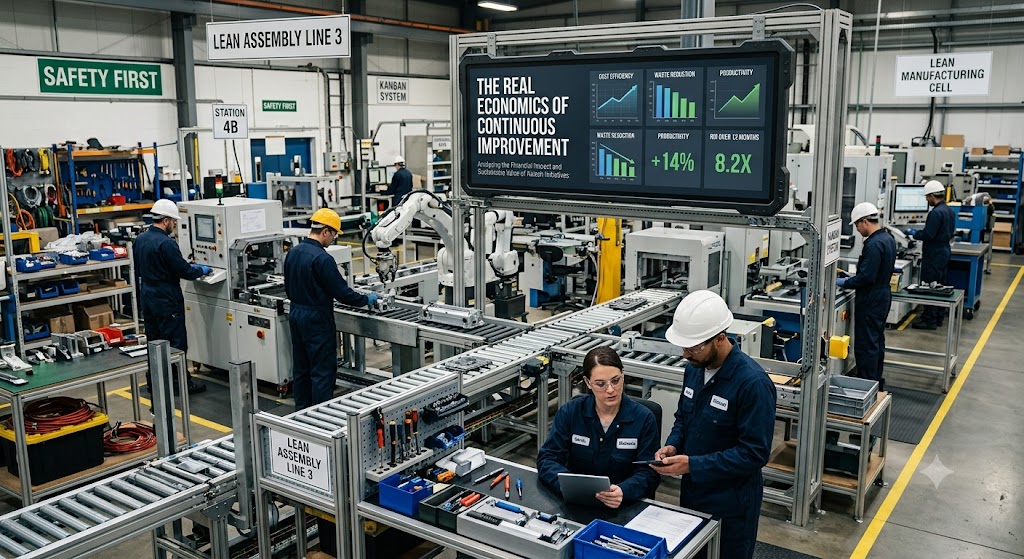
The Real Economics of Continuous Improvement
The Real Economics of Continuous Improvement is one of the most overlooked principles behind lasting success in business, personal development, entrepreneurship, education, and even relationships. Many people spend their lives searching for one revolutionary idea, one magical opportunity, one lucky breakthrough, or one life-changing investment that will instantly transform everything. While dramatic success stories receive the most attention, the reality is that sustainable wealth, influence, knowledge, and competitive advantage are usually the result of countless small improvements made consistently over time.
Modern society often celebrates overnight success without recognising the years of silent refinement that happened behind the scenes. We admire successful companies, influential entrepreneurs, respected professionals, and talented creators, yet we rarely study the tiny improvements they repeated every single day. These small adjustments may appear insignificant in isolation, but together they create extraordinary economic value that compounds year after year.
Continuous improvement is not merely a motivational phrase or a productivity technique. It is an economic principle that governs how value is created, preserved, and multiplied. Every improvement increases efficiency, reduces waste, enhances quality, strengthens customer satisfaction, and ultimately contributes to greater profitability. Whether someone runs a multinational corporation, owns a small online business, manages a local shop, or works as a freelancer, continuous improvement creates measurable financial advantages that accumulate over time.
Many businesses fail not because they lack talent or capital but because they stop improving. The marketplace rewards adaptation while punishing complacency. Consumer expectations evolve, technology advances, competitors innovate, and industries transform. Businesses that refuse to improve gradually become less relevant until customers quietly move elsewhere. This process often happens slowly enough that business owners fail to notice until the damage becomes severe.
The economics behind continuous improvement become easier to understand when viewed through the lens of compound growth. Imagine improving a business process by only one percent every week. One percent may sound trivial, but after many months those improvements begin interacting with one another. Better customer service increases satisfaction. Increased satisfaction generates positive reviews. Positive reviews attract new customers. More customers increase revenue. Higher revenue provides additional resources for further improvements. Each improvement strengthens the next, creating a powerful cycle of growth.
This same principle applies to individuals. Someone who reads only ten pages each day may initially appear no different from everyone else. However, after several years, that individual has consumed hundreds of books while others have barely finished a handful. The accumulated knowledge leads to better decisions, higher earning potential, stronger communication skills, and greater professional opportunities. The economic return on those daily improvements becomes enormous despite the modest daily investment.
Continuous improvement also reduces hidden costs that many people never calculate. Poor communication creates misunderstandings that consume valuable hours. Weak systems generate unnecessary errors requiring expensive corrections. Inefficient workflows waste employee time and increase operational expenses. Low-quality products result in refunds, complaints, and damaged reputations. Every improvement eliminates friction that silently drains profits.
Many entrepreneurs focus heavily on increasing revenue while ignoring operational efficiency. Although increasing sales is important, reducing unnecessary costs through continuous improvement often produces faster and more sustainable profitability. A business that increases efficiency by fifteen percent without raising prices effectively increases its earning power without requiring additional customers. This demonstrates why successful organisations invest heavily in process optimisation rather than relying exclusively on aggressive marketing.
The manufacturing industry has demonstrated the value of continuous improvement for decades. Companies that consistently refine production methods often outperform competitors with larger budgets because they eliminate waste while maintaining quality. Lower production costs allow them to offer competitive prices without sacrificing profit margins. Their ability to improve continuously becomes a long-term competitive advantage that rivals struggle to replicate.
The digital economy has made continuous improvement even more valuable. Websites can now be tested, analysed, and refined based on real user behaviour. Small improvements in page speed, navigation, content quality, search engine optimisation, and user experience can dramatically increase traffic, conversions, and revenue over time. A website that loads one second faster may experience lower bounce rates. Lower bounce rates improve engagement. Better engagement strengthens search rankings. Higher rankings attract additional visitors. More visitors create more sales opportunities. A seemingly minor improvement produces multiple layers of economic benefit.
Search engine optimisation itself illustrates the economics of continuous improvement perfectly. Many website owners expect immediate results after publishing a few articles. In reality, successful websites often grow because they continuously improve existing content, update outdated information, strengthen internal linking, optimise keywords naturally, enhance readability, and respond to changing search trends. Every optimisation increases visibility slightly, and these incremental gains eventually produce significant organic traffic.
Continuous improvement also influences employee productivity. Workers naturally become more efficient as they refine their skills, simplify workflows, and eliminate unnecessary tasks. Organisations that encourage learning, experimentation, and professional development typically experience greater innovation and lower staff turnover. Employees who feel empowered to improve processes often discover solutions that management would never have identified independently.
Training should therefore be viewed as an investment rather than an expense. Some organisations hesitate to spend money developing their workforce because they fear employees might leave. Ironically, failing to develop employees often creates greater losses because undertrained workers generate mistakes, inefficiencies, and missed opportunities. Continuous learning strengthens both individual performance and organisational resilience.
Innovation rarely emerges from isolated moments of inspiration. More often, it develops through continuous experimentation. Every experiment provides feedback. Every piece of feedback reveals opportunities for refinement. Every refinement increases the probability of discovering better products, services, or systems. Businesses that encourage experimentation generally adapt more effectively to changing market conditions than those that insist on preserving outdated practices.
Customer satisfaction also improves through continuous refinement. Listening carefully to customer feedback allows businesses to identify recurring frustrations and unmet needs. Addressing these concerns gradually transforms the customer experience. Satisfied customers become repeat buyers, recommend the business to others, and contribute to a stronger reputation. Since acquiring new customers usually costs more than retaining existing ones, continuous improvement in customer service generates impressive long-term economic returns.
One reason many organisations neglect continuous improvement is that immediate results are often invisible. Human psychology naturally prefers dramatic transformations over gradual progress. People become discouraged when daily improvements fail to produce instant rewards. However, economics teaches that value frequently accumulates long before it becomes visible. Investments compound quietly before reaching noticeable levels. Skills develop gradually before attracting higher-paying opportunities. Businesses improve steadily before experiencing rapid growth.
This delayed gratification separates successful organisations from struggling ones. Leaders who understand compounding continue improving systems even when short-term benefits appear modest. They trust the process because they recognise that cumulative gains eventually become impossible to ignore.
Technology has dramatically accelerated the importance of continuous improvement because competitive advantages disappear more quickly than ever before. A successful business model today may become obsolete within a few years if competitors introduce better technology, superior customer experiences, or more efficient operations. Companies that continuously improve remain flexible enough to respond effectively while others struggle to catch up.
Artificial intelligence, automation, cloud computing, and advanced analytics have made improvement opportunities available to businesses of every size. Small companies can now access sophisticated tools that were once affordable only for large corporations. Those willing to continuously learn and implement new technologies often outperform competitors with significantly larger financial resources.
Continuous improvement also enhances decision-making quality. Better decisions create enormous economic value because every decision influences future opportunities. Leaders who consistently analyse outcomes, review mistakes, and refine their judgement gradually make fewer costly errors. Over decades, improved decision-making compounds into remarkable financial and professional success.
Risk management provides another compelling economic argument for continuous improvement. Every improvement reduces vulnerability to unexpected disruptions. Stronger cybersecurity protects digital assets. Better financial planning improves cash flow stability. More efficient inventory management reduces shortages. Improved communication minimises operational confusion. These refinements reduce the likelihood of expensive crises while strengthening organisational resilience.
Many businesses mistakenly pursue perfection instead of improvement. Perfection often delays progress because organisations hesitate to launch products until every possible flaw disappears. Continuous improvement adopts a different philosophy. Rather than waiting indefinitely for perfection, it encourages releasing valuable solutions, gathering feedback, learning from experience, and improving continuously. This approach accelerates innovation while reducing opportunity costs.
The software industry demonstrates this principle exceptionally well. Applications frequently receive updates that enhance functionality, improve security, eliminate bugs, and introduce new features. Customers generally appreciate ongoing improvements because they receive increasing value without waiting years for entirely new products. Businesses benefit through stronger customer loyalty and sustained relevance.
Financial markets also reward continuous improvement. Investors often favour organisations with cultures of operational excellence because consistent improvement suggests disciplined management and sustainable profitability. Companies capable of adapting efficiently are generally better positioned to survive economic downturns and capitalise on emerging opportunities.
Continuous improvement creates value even in personal finance. Individuals who regularly review spending habits, optimise investments, improve budgeting, and increase financial literacy often accumulate significantly greater wealth than those relying solely on higher incomes. Small financial improvements repeated consistently frequently outperform occasional dramatic financial decisions.
The labour market increasingly rewards adaptability. Employers value professionals who continuously develop new skills because industries evolve rapidly. Workers who embrace lifelong learning remain employable despite technological disruption. Their willingness to improve becomes an economic asset that generates higher salaries, better career opportunities, and greater job security.
Entrepreneurs often underestimate the financial impact of refining communication. Clearer marketing messages increase conversion rates. Better product descriptions reduce customer confusion. Improved negotiation skills secure more favourable agreements. Stronger presentations attract investors and partners. Communication improvements create measurable economic outcomes despite requiring relatively modest financial investment.
Time management represents another overlooked economic resource. Every unnecessary meeting, inefficient workflow, repetitive manual task, or avoidable distraction carries an opportunity cost. Continuous improvement seeks to recover these lost resources by designing better systems rather than expecting people to work harder. Businesses that optimise processes frequently achieve greater productivity without increasing employee workloads.
One fascinating aspect of continuous improvement is its self-reinforcing nature. Improved systems generate better data. Better data supports superior decisions. Better decisions create stronger results. Stronger results provide additional resources for further improvements. Success therefore becomes increasingly sustainable because each improvement strengthens the foundation for future growth.
Competitive industries illustrate this concept vividly. Businesses that consistently improve customer experiences gradually build stronger brands. Stronger brands attract loyal customers willing to pay premium prices. Higher profitability finances additional innovation. Competitors who fail to improve find themselves trapped in price wars while industry leaders continue differentiating themselves through superior value.
Education provides another powerful example. Schools and universities that continuously refine teaching methods, update curricula, integrate technology, and respond to student feedback generally produce better outcomes. Graduates become more employable, institutional reputations improve, and long-term demand increases. Educational improvement therefore produces both social and economic returns.
Healthcare systems similarly benefit from continuous improvement. Refining diagnostic procedures, reducing medical errors, streamlining administrative processes, and adopting evidence-based practices improve patient outcomes while reducing costs. Every improvement benefits both healthcare providers and society by increasing efficiency and preserving valuable resources.
Continuous improvement also strengthens resilience during economic uncertainty. Organisations with efficient operations can withstand declining revenues more effectively because unnecessary costs have already been eliminated. Businesses operating with excessive waste often struggle during downturns because their margins disappear quickly. Continuous improvement creates flexibility that becomes invaluable during challenging periods.
Many people believe improvement requires substantial financial investment. While technology upgrades and infrastructure improvements can certainly help, many valuable improvements require little or no money. Better planning, clearer communication, improved organisation, stronger customer service, more thoughtful decision-making, and enhanced consistency often generate remarkable returns despite minimal financial cost.
Leadership plays a central role in establishing cultures of continuous improvement. Leaders who encourage curiosity, welcome constructive criticism, reward innovation, and support experimentation create environments where improvement becomes part of everyday behaviour rather than an occasional initiative. Employees become active contributors to organisational success instead of merely following instructions.
Psychological safety also influences improvement. Workers who fear punishment for honest mistakes often hide problems instead of solving them. Organisations that encourage open discussion identify inefficiencies earlier and develop solutions more rapidly. Transparency therefore becomes an economic advantage because it accelerates organisational learning.
Continuous improvement encourages better measurement. Businesses cannot improve what they fail to measure accurately. Monitoring customer satisfaction, operational efficiency, employee productivity, conversion rates, quality metrics, and financial performance provides valuable insights that guide future improvements. Reliable data transforms improvement from guesswork into evidence-based decision-making.
The entrepreneurial ecosystem demonstrates that successful founders rarely stop learning after launching their businesses. They analyse customer behaviour, study competitors, refine products, improve marketing strategies, optimise pricing, and strengthen operations continuously. Their companies evolve because their thinking evolves. This adaptability often determines whether a startup survives beyond its early years.
Continuous improvement also increases trust. Customers notice when businesses consistently enhance quality, reliability, and service. Employees appreciate organisations that invest in better working environments. Investors gain confidence in disciplined management teams. Suppliers prefer reliable partners committed to excellence. Trust itself possesses enormous economic value because it reduces transaction costs and strengthens long-term relationships.
Brand reputation develops similarly. Reputations rarely emerge from one exceptional performance. Instead, they result from repeated demonstrations of reliability, quality, and responsiveness. Continuous improvement protects and strengthens reputation because customers experience consistent progress rather than declining standards.
Economic history repeatedly confirms that societies prosper through continuous improvement. Advances in agriculture increased food production. Improvements in transportation expanded trade. Medical innovations extended life expectancy. Educational reforms increased productivity. Technological progress transformed communication and commerce. Each generation inherited accumulated improvements from previous generations, enabling even greater advancements.
Personal habits follow identical economic principles. Someone who exercises consistently, learns regularly, communicates thoughtfully, manages finances wisely, and reflects on daily experiences gradually becomes more capable across multiple areas of life. These improvements reinforce one another, creating opportunities that appear mysterious to observers who notice only the final results.
Continuous improvement also reduces stress because well-designed systems prevent recurring problems. Instead of repeatedly solving identical issues, individuals and organisations address root causes permanently. This frees mental energy for creativity, strategic thinking, and innovation rather than constant crisis management.
The economics of improvement extend beyond financial returns. Better systems improve quality of life, strengthen relationships, increase confidence, and create greater satisfaction. Employees enjoy healthier workplaces. Customers receive better experiences. Communities benefit from stronger businesses. Society gains through increased productivity and innovation. Financial prosperity becomes only one component of a much broader set of positive outcomes.
One of the greatest misconceptions about success is the belief that extraordinary achievements require extraordinary actions. While bold decisions certainly have their place, history repeatedly demonstrates that remarkable outcomes often emerge from ordinary actions performed with extraordinary consistency. Daily improvements accumulate quietly until they produce results that seem astonishing to outsiders.
Businesses seeking sustainable growth should therefore ask different questions. Instead of searching exclusively for the next major breakthrough, they should examine every process, interaction, decision, and customer experience for opportunities to improve slightly. A one percent enhancement repeated hundreds of times often generates greater long-term value than one dramatic change followed by years of stagnation.
The Real Economics of Continuous Improvement ultimately teaches that lasting prosperity is rarely accidental. It emerges from disciplined refinement, thoughtful adaptation, consistent learning, and relentless commitment to becoming slightly better today than yesterday. Markets reward organisations that evolve. Customers reward businesses that improve. Employers reward professionals who develop new capabilities. Investors reward disciplined management. Life itself tends to reward those who never stop growing.
In an increasingly competitive and rapidly changing world, continuous improvement is no longer optional. It is an economic necessity. Every small improvement represents an investment whose returns may not appear immediately but continue compounding far into the future. Those who embrace this philosophy position themselves to create more value, solve bigger problems, serve more people, and achieve greater financial success over time. The true economics of continuous improvement are therefore not measured by isolated victories but by the extraordinary wealth, resilience, influence, and opportunity created through thousands of intentional improvements made consistently throughout a lifetime.

EarnSmartOnline.com.ng is dedicated to helping readers make smarter financial decisions through practical guides on online income, personal finance, technology, digital business, and wealth creation. Our goal is to provide reliable, easy-to-understand, and actionable content that empowers individuals to earn smarter, build sustainable income streams and achieve long-term financial success.
Recommended: Start Earning Online
- Ultimate Affiliate Marketing Program — learn affiliate marketing with a done-for-you sales system ($15). Check it out
- The Newbie Affiliate Guide — the beginner-friendly starter guide (~$6.68). Check it out
- Easy Dollar Maker — earn in dollars uploading AI images and videos from your phone ($17). Check it out
Disclosure: These are affiliate links. If you buy through them, I may earn a commission at no extra cost to you.



