
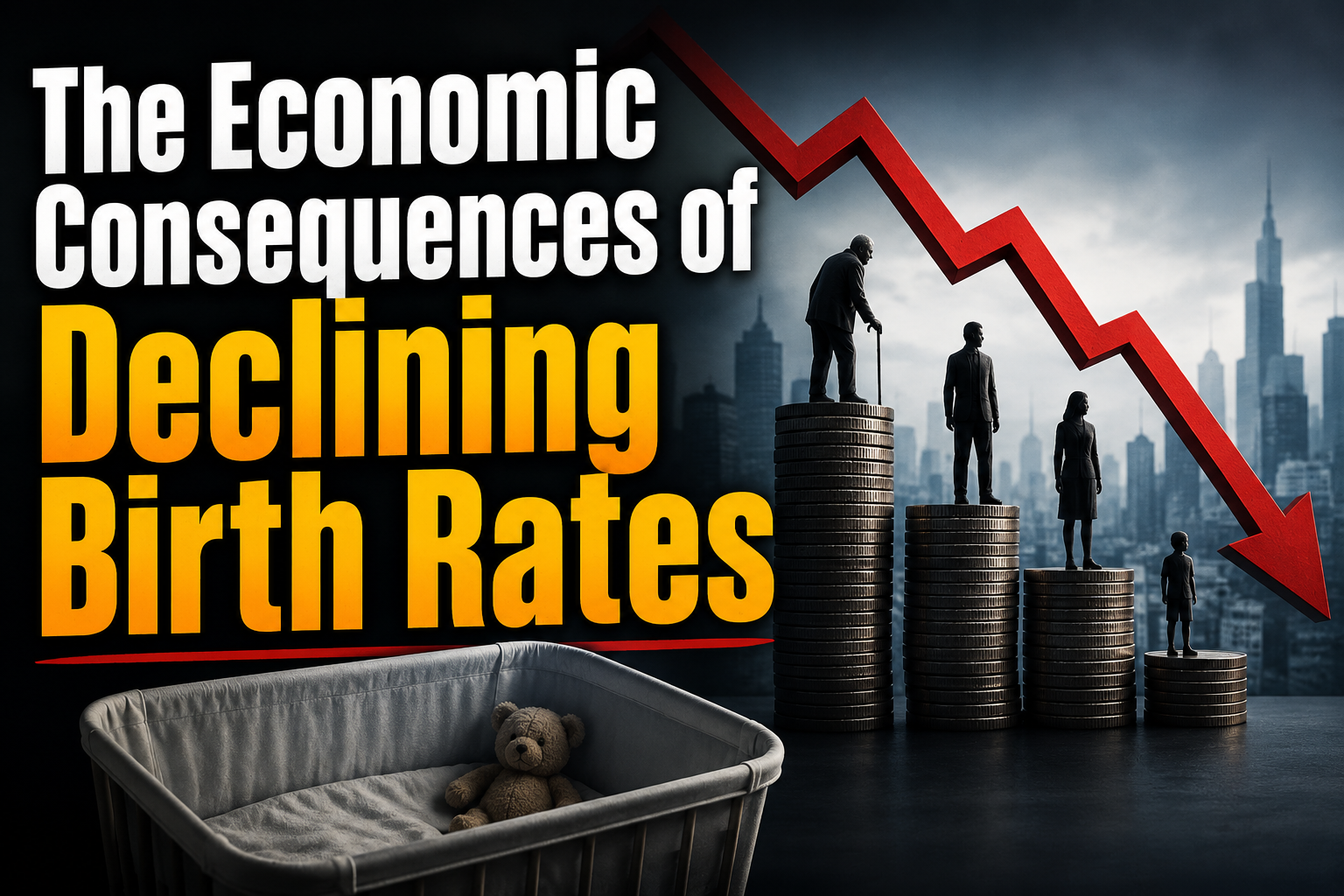
The Economic Consequences of Declining Birth Rates
Across many parts of the world, birth rates are falling at a pace that is reshaping the structure of economies in ways that are only beginning to be fully understood. What once seemed like a distant demographic concern has now become a central economic issue affecting productivity, labor markets, public finances, and long-term growth potential. A declining birth rate does not just mean fewer babies being born, it means a gradual reduction in the number of future workers, consumers, innovators, and taxpayers who sustain the economic engine of a nation. Over time, this shift creates ripple effects that touch almost every aspect of economic life, often in ways that are subtle at first but deeply structural in the long run.
One of the most immediate consequences of declining birth rates is the shrinking of the labor force. Economies depend heavily on a steady supply of working age individuals to maintain productivity levels and support industries. When fewer children are born, the future workforce naturally contracts. This leads to labor shortages in critical sectors such as healthcare, agriculture, manufacturing, education, and technology. As the supply of workers decreases, employers are forced to compete more aggressively for talent, often resulting in higher wages. While higher wages may sound beneficial at first glance, they can also increase production costs, which eventually leads to higher prices for goods and services. This creates inflationary pressure that affects the overall cost of living.
As the workforce shrinks, economic growth begins to slow down. Most modern economies rely on both productivity and labor expansion to drive GDP growth. When population growth stagnates or declines, one of the key engines of economic expansion is weakened. Even if productivity improves through technology or better processes, it often struggles to fully compensate for the loss of labor input. This means that countries with declining birth rates may experience slower GDP growth over time, making it harder to maintain previous levels of economic momentum.
Another major consequence appears in the structure of public finance. Governments rely heavily on taxes collected from working individuals to fund essential services such as healthcare, infrastructure, education, and social welfare programs. When there are fewer working-age people, the tax base shrinks. At the same time, an aging population increases demand for public spending, especially in healthcare and pensions. This creates a financial imbalance where fewer workers are supporting a growing number of retirees. Over time, this can lead to budget deficits, increased borrowing, and rising national debt. Governments may be forced to either increase taxes on the shrinking workforce or reduce public services, both of which have significant economic and social implications.
The aging population that results from declining birth rates also changes consumption patterns within the economy. Younger populations tend to spend more on housing, education, entertainment, technology, and consumer goods. Older populations, on the other hand, typically spend less and focus more on healthcare and essential services. This shift in consumption behavior reduces overall demand in certain sectors, especially those driven by younger consumers. Industries that rely on rapid consumption and lifestyle spending may experience stagnation or decline, while healthcare and elderly services grow in importance. This structural shift forces businesses to adapt or risk becoming obsolete.
Real estate markets are also affected by declining birth rates. Fewer young people entering adulthood means reduced demand for housing in the long term. In many regions, this can lead to stagnating property prices or even long-term declines, especially in areas experiencing population shrinkage. Cities and towns that once thrived on population growth may find themselves with excess housing supply, declining property values, and reduced investment appeal. This can further weaken local economies as real estate often plays a central role in wealth creation and financial stability for individuals and governments alike.
Innovation and entrepreneurship are also influenced by demographic trends. Younger populations are generally more likely to start businesses, adopt new technologies, and take financial risks. When the proportion of young people declines, the rate of innovation can slow down. This does not mean innovation stops, but it may become more concentrated in specific regions or industries rather than being widespread across the economy. Over time, this can reduce the dynamism of an economy and make it less adaptable to global changes.
Another often overlooked consequence is the impact on pension systems. Most pension systems are designed on the assumption that there will always be enough young workers contributing to support retirees. Declining birth rates disrupt this balance. As fewer workers enter the system and more people retire, the sustainability of pension funds becomes increasingly strained. Governments may be forced to raise retirement ages, reduce pension benefits, or increase contributions from workers. Each of these solutions carries political and economic challenges, and none fully resolves the underlying demographic imbalance.
Healthcare systems also come under pressure, but in a different way. An aging population requires more frequent and more expensive medical care. Chronic illnesses, long term care, and age related conditions increase significantly as populations grow older. This leads to rising healthcare costs, which place additional strain on both public and private healthcare systems. At the same time, a shrinking workforce makes it more difficult to train and retain enough healthcare professionals, creating a double pressure of higher demand and limited supply.
On a broader scale, declining birth rates can also affect a country’s global competitiveness. Nations with younger and growing populations often have a natural advantage in terms of labor availability, innovation capacity, and market expansion. Countries with shrinking populations may find it harder to attract foreign investment, especially in labor intensive industries. Over time, economic power can gradually shift toward regions with more favorable demographic trends, altering global economic balances.
Immigration often becomes a key policy tool in response to declining birth rates. By attracting workers from other countries, governments attempt to fill labor shortages and stabilize population decline. While immigration can help mitigate some of the economic effects, it is not always a complete solution. Integration challenges, cultural differences, and political resistance can limit the effectiveness of immigration policies. Additionally, if multiple countries experience declining birth rates simultaneously, global competition for skilled migrants can intensify.
Consumer driven economies are particularly sensitive to demographic shifts. When population growth slows, businesses that depend on expanding customer bases face limitations in their long term growth potential. Companies must then shift their strategies from expansion to retention, focusing more on increasing value per customer rather than simply increasing the number of customers. This fundamentally changes how businesses operate and compete.
Financial markets also respond to demographic changes. Long term investors often adjust their strategies based on population trends, since demographics influence growth potential across entire economies. Slower population growth can lead to lower long term returns in certain markets, prompting capital to flow toward regions with stronger demographic outlooks. This can further widen economic disparities between different parts of the world.
At the household level, declining birth rates reflect deeper social and economic shifts. Rising living costs, housing affordability issues, career priorities, and lifestyle preferences all contribute to decisions to have fewer children. While these choices are often rational from an individual perspective, their collective impact creates long term structural changes in the economy. In this way, personal decisions aggregate into macroeconomic outcomes that shape entire nations.
Ultimately, the economic consequences of declining birth rates are complex and interconnected. They affect labor supply, economic growth, public finance, consumption patterns, healthcare systems, innovation, and global competitiveness. What makes this issue particularly significant is its slow and cumulative nature. Unlike economic crises that appear suddenly, demographic change unfolds gradually, making it easy to underestimate its long term impact.
Addressing the challenges of declining birth rates requires a combination of policy innovation, economic adaptation, and long term planning. Governments may explore family friendly policies, improved childcare support, housing affordability initiatives, and labor market reforms. However, there is no simple or immediate solution. The effects of demographic change take decades to fully manifest, and similarly, any corrective measures also take time to show results.
In the end, declining birth rates represent one of the most important structural shifts in the modern global economy. Understanding their consequences is essential not just for policymakers, but for businesses, investors, and individuals who want to navigate the future with clarity. The economies that adapt most effectively to this new demographic reality will be better positioned to maintain stability, resilience, and long term prosperity in a changing world.

EarnSmartOnline.com.ng is dedicated to helping readers make smarter financial decisions through practical guides on online income, personal finance, technology, digital business, and wealth creation. Our goal is to provide reliable, easy-to-understand, and actionable content that empowers individuals to earn smarter, build sustainable income streams and achieve long-term financial success.
Recommended: Start Earning Online
- Ultimate Affiliate Marketing Program — learn affiliate marketing with a done-for-you sales system ($15). Check it out
- The Newbie Affiliate Guide — the beginner-friendly starter guide (~$6.68). Check it out
- Easy Dollar Maker — earn in dollars uploading AI images and videos from your phone ($17). Check it out
Disclosure: These are affiliate links. If you buy through them, I may earn a commission at no extra cost to you.



