
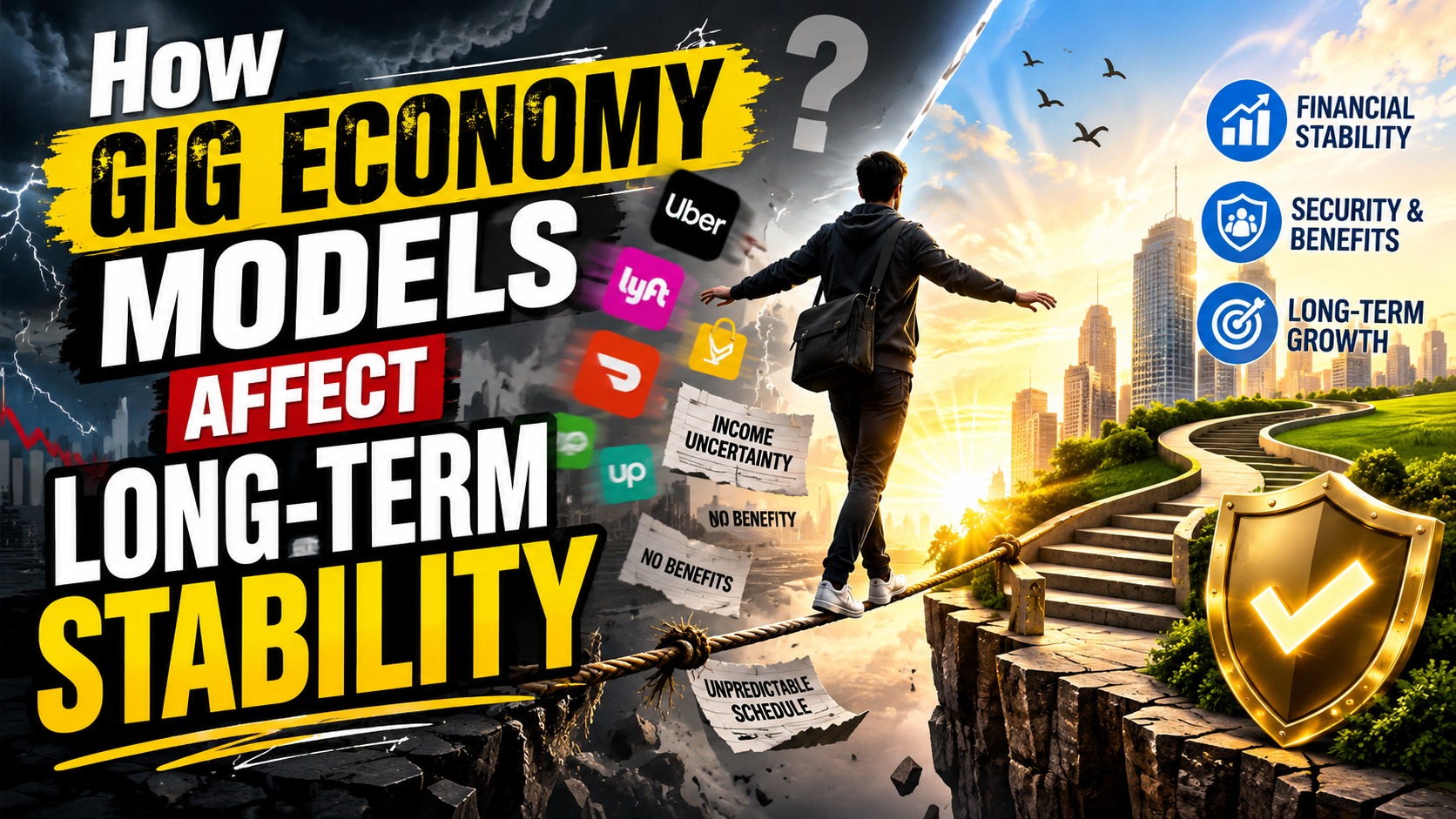
How Gig Economy Models Affect Long-Term Stability
The gig economy has quietly transformed how people think about work, income, and career stability. At first glance, it appears to offer freedom, flexibility, and endless opportunity. You can log in when you want, work from anywhere, and earn based on effort rather than traditional office constraints. For many people struggling with unemployment or low wages, this model feels like a breakthrough. But beneath that surface lies a more complicated reality that directly affects long term financial stability in ways most people do not fully consider.
The gig economy is built on short term contracts, task based work, and platform mediated labor. Instead of long term employment with predictable salaries, workers earn per task, per ride, per delivery, or per project. This structure removes many of the traditional protections associated with stable employment. There are often no pensions, no guaranteed health benefits, no paid leave, and limited job security. While this might seem acceptable in the short term, the long term implications become clearer as years pass.
One of the biggest effects of gig economy models is income unpredictability. Unlike a fixed salary that arrives monthly, gig workers experience fluctuating earnings depending on demand, competition, season, and algorithm changes. A week of high earnings can easily be followed by a week of decline without warning. This inconsistency makes financial planning difficult. It becomes harder to commit to rent, savings goals, debt repayment schedules, or long term investments when income is not stable. Over time, this unpredictability creates a cycle where individuals remain in a reactive financial state rather than a strategic one.
Another important factor is the lack of long term career progression. In traditional employment structures, workers often move through defined paths such as junior roles, mid level positions, and senior roles with increasing pay and responsibility. The gig economy does not always offer this structure. A delivery rider or freelance worker may remain in the same earning category for years unless they actively transition into a different skill set or platform. This limits upward mobility and can create stagnation where effort increases but financial progress plateaus.
The absence of institutional support also plays a major role in long term instability. Traditional jobs often include systems that support workers through training, mentorship, health coverage, and retirement contributions. Gig workers are typically responsible for all of this themselves. While independence sounds empowering, it also means that every financial risk is carried individually. A health emergency, vehicle breakdown, or sudden drop in demand can instantly disrupt income flow without a safety net.
Another subtle but powerful effect is the psychological impact of constant competition. Gig platforms often rank workers based on ratings, speed, or customer feedback. This creates a performance driven environment where individuals feel pressured to constantly optimize their output. While this can increase productivity in the short term, it can also lead to burnout. Over time, the feeling of being replaceable or constantly evaluated can reduce job satisfaction and mental stability, which indirectly affects long term consistency in income generation.
Gig economy models also reshape how people value their time. When income is tied directly to tasks or hours worked, every moment becomes a transactional calculation. This can discourage long term thinking and encourage short term survival behavior. Instead of investing time in skill development or strategic planning, individuals may focus on immediate earning opportunities. While this may solve short term financial needs, it often delays long term growth and skill accumulation that could lead to higher income levels.
Another challenge is the absence of compounding career benefits. In traditional careers, experience builds reputation, seniority, and negotiation power over time. In gig systems, each task is often isolated. A driver or freelancer may complete thousands of tasks without necessarily building leverage that significantly increases long term earnings. Without compounding benefits, financial progress becomes linear rather than exponential, making it harder to achieve significant wealth accumulation.
Access to benefits such as loans, mortgages, and long term financial products is also more difficult for gig workers. Financial institutions often prefer stable income documentation, which gig work does not always provide in consistent form. This limits access to credit systems that could otherwise support asset building, such as buying a home or investing in business opportunities. As a result, many gig workers remain in a cycle of renting and short term financial planning rather than long term wealth creation.
Despite these challenges, it is important to recognize that the gig economy is not entirely negative. It has created opportunities for millions of people who may not have access to traditional employment. It allows students, caregivers, and individuals in underserved regions to earn income in flexible ways. It also opens doors for entrepreneurship and skill discovery. However, the key issue is not the existence of gig work, but the lack of long term structure within it.
The long term stability challenge arises when individuals rely exclusively on gig work without transitioning toward more sustainable income models. Those who succeed in the gig economy over time often treat it as a stepping stone rather than a final destination. They use it to build capital, learn marketable skills, and eventually move into higher leverage opportunities such as business ownership, specialized freelance work, or digital product creation.
Another overlooked factor is inflation and rising living costs. Because gig income does not always grow at the same rate as economic inflation, purchasing power can decline over time. A worker earning the same per task rate for several years may find that their real income decreases even if their nominal earnings remain stable. This creates silent financial pressure that is not immediately visible but becomes significant over long periods.
Technology also plays a role in long term instability within gig systems. As automation and artificial intelligence continue to evolve, many repetitive gig tasks are at risk of being automated. Delivery optimization, ride matching, and basic freelance tasks are increasingly being handled by intelligent systems. This means that some gig opportunities may shrink or become more competitive in the future, further affecting long term income reliability.
However, there is also a path to stability within the gig economy for those who approach it strategically. Diversification of income sources is one key factor. Relying on a single platform or type of gig work increases vulnerability. Combining multiple platforms, building personal client bases, or developing complementary skills can improve financial resilience. Another important factor is reinvesting earnings into skill development. Those who use gig income to upgrade their capabilities often transition into more stable and higher paying roles over time.
Financial discipline also becomes critical. Because income is variable, gig workers who succeed long term tend to adopt strong budgeting habits. They prioritize saving during high income periods to cover low income periods. They also build emergency funds that protect them from sudden disruptions. Without this level of discipline, instability becomes more pronounced and harder to manage.
Ultimately, the gig economy reflects a broader shift in how modern economies function. Stability is no longer automatically built into employment systems. It is something individuals must actively construct through strategy, skill development, and financial planning. While gig work offers flexibility and opportunity, it does not guarantee long term security on its own.
The long term effect of gig economy models is therefore not just economic but behavioral. It changes how people think about work, income, and time. Those who adapt successfully learn to combine flexibility with structure, freedom with planning, and short term earning with long term vision. Those who do not often find themselves trapped in cycles of unstable income without clear progression.
In the end, the gig economy is neither purely good nor purely bad. It is a tool. But like any tool, its impact depends on how it is used. For those who understand its limitations and intentionally build beyond it, it can be a starting point for growth. For those who rely on it without a long term strategy, it can quietly erode financial stability over time.

EarnSmartOnline.com.ng is dedicated to helping readers make smarter financial decisions through practical guides on online income, personal finance, technology, digital business, and wealth creation. Our goal is to provide reliable, easy-to-understand, and actionable content that empowers individuals to earn smarter, build sustainable income streams and achieve long-term financial success.
Recommended: Start Earning Online
- Ultimate Affiliate Marketing Program — learn affiliate marketing with a done-for-you sales system ($15). Check it out
- The Newbie Affiliate Guide — the beginner-friendly starter guide (~$6.68). Check it out
- Easy Dollar Maker — earn in dollars uploading AI images and videos from your phone ($17). Check it out
Disclosure: These are affiliate links. If you buy through them, I may earn a commission at no extra cost to you.



