
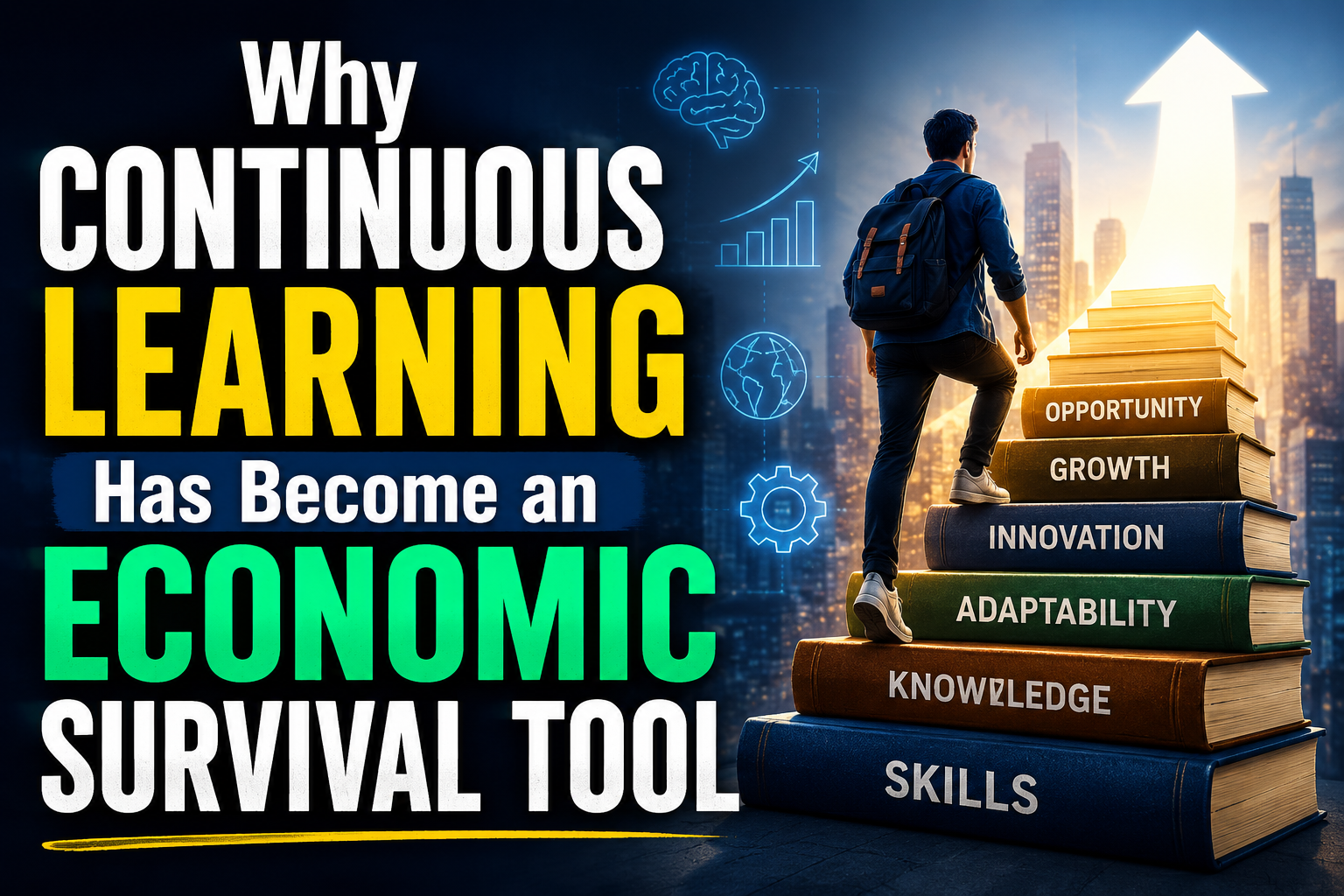
Why Continuous Learning Has Become an Economic Survival Tool
There was a time when earning a degree, learning a trade, or mastering a profession was enough to sustain an individual for decades. A person could acquire a skill in their twenties and rely on it throughout their working life. Those days are rapidly disappearing. In today’s economy, knowledge expires faster than ever, industries evolve constantly, and technological advancements are transforming the way people work, earn, and compete. As a result, continuous learning has shifted from being a personal development choice to becoming an economic survival tool.
The modern economy rewards adaptability. Employers, businesses, and consumers increasingly favor individuals who can adjust to changing circumstances, learn new systems, and acquire new competencies. The ability to continuously learn is no longer an advantage reserved for ambitious professionals. It is now a necessity for anyone who wants to remain relevant, employable, and financially stable.
One of the primary reasons continuous learning has become essential is the rapid pace of technological innovation. Every year, new software, platforms, tools, and systems emerge, changing how work is performed across virtually every industry. Tasks that once required human effort are now being automated. Artificial intelligence is streamlining operations, reducing costs, and replacing repetitive tasks. Workers who refuse to update their knowledge often find themselves competing against machines or individuals who have embraced new technologies.
The impact of technology is not limited to technical professions. Retail workers use digital inventory systems. Healthcare professionals rely on advanced diagnostic technologies. Marketers use data analytics and automation tools. Educators teach through online platforms. Even small business owners must understand digital marketing, online payments, and customer management software. Regardless of industry, continuous learning has become necessary to keep pace with the changing demands of the marketplace.
Another reason continuous learning is vital is the increasing unpredictability of job markets. Economic shifts, global events, and technological disruptions can alter entire industries within a few years. Occupations that once appeared secure can become obsolete. Companies can restructure, automate processes, or relocate operations, leaving workers vulnerable. Individuals who possess the habit of learning can pivot more easily when circumstances change. They can acquire new skills, transition into emerging industries, and create alternative income opportunities.
The rise of the internet has also transformed competition. In previous generations, workers primarily competed with people within their local communities. Today, businesses can hire talent from almost anywhere in the world. Freelancers, consultants, and professionals are competing in a global marketplace. This increased competition means that standing still often leads to falling behind. Continuous learners maintain an edge because they constantly improve their abilities and expand their expertise.
Knowledge has become one of the most valuable economic assets in the modern world. Unlike physical assets, knowledge can appreciate over time when applied effectively. Every new skill acquired increases an individual’s ability to solve problems, create value, and seize opportunities. Employers are not merely paying for labor anymore. They are paying for knowledge, creativity, adaptability, and the ability to navigate complex challenges. Continuous learning strengthens all of these qualities.
The relationship between learning and income has become increasingly direct. Individuals who continuously improve their skills often gain access to better-paying opportunities. They become more valuable to employers, clients, and business partners. New certifications, technical skills, communication abilities, leadership competencies, and industry knowledge can significantly increase earning potential. In contrast, individuals who stop learning may find their market value declining as industry standards evolve.
Continuous learning also improves entrepreneurial success. Running a business today requires far more than simply offering a product or service. Entrepreneurs must understand customer behavior, digital marketing, financial management, data analysis, sales strategies, and emerging market trends. Those who actively learn can adapt their businesses to changing conditions, identify new opportunities, and respond effectively to challenges. Business owners who stop learning often struggle to compete against more informed competitors.
Another important factor is the increasing value of problem-solving skills. The modern economy rewards people who can solve difficult problems efficiently. Continuous learning exposes individuals to new perspectives, methods, and ideas that improve their ability to think critically and make informed decisions. As industries become more complex, employers place greater value on workers who can analyze situations, identify solutions, and adapt quickly to new circumstances.
The concept of job security has also changed dramatically. In the past, many workers believed that loyalty to a single employer guaranteed long-term stability. Today, job security often depends more on skill relevance than organizational loyalty. A person with current, in-demand skills can find opportunities in multiple organizations and industries. Someone relying solely on outdated knowledge may struggle regardless of their experience. Continuous learning creates a form of security that is based on personal capability rather than external circumstances.
Learning also plays a critical role in wealth creation. Most successful investors, entrepreneurs, executives, and professionals are lifelong learners. They understand that financial opportunities often emerge from knowledge. Learning about markets, industries, technologies, consumer behavior, and economic trends allows individuals to identify opportunities before others recognize them. Knowledge often becomes the foundation upon which wealth is built.
The growing importance of artificial intelligence further highlights the need for continuous learning. AI is changing how information is created, analyzed, and distributed. While some fear that AI will eliminate jobs, history suggests that technology often creates new opportunities alongside disruptions. However, benefiting from these opportunities requires learning. Individuals who understand how to use AI tools effectively can increase productivity, improve decision-making, and remain competitive in evolving industries.
Continuous learning also supports career mobility. Many people are no longer following traditional career paths. Workers frequently change industries, pursue side businesses, engage in freelance work, or develop multiple income streams. Learning new skills allows individuals to explore different opportunities without being limited by their original education or profession. The ability to learn quickly has become more valuable than expertise in a single narrow area.
One overlooked aspect of continuous learning is its impact on confidence. Knowledge reduces uncertainty. Individuals who actively learn are often more comfortable navigating change because they trust their ability to acquire new information and adapt. This confidence can improve decision-making, leadership effectiveness, communication skills, and overall career performance. In a rapidly changing world, confidence rooted in learning becomes a significant advantage.
The economic value of learning extends beyond formal education. Continuous learning can take many forms, including reading books, attending workshops, completing online courses, listening to educational podcasts, participating in professional communities, and gaining practical experience. The most successful learners recognize that education does not end with graduation. Instead, learning becomes an ongoing process that continues throughout life.
The future will likely increase the importance of continuous learning even further. Emerging technologies, changing consumer expectations, demographic shifts, environmental challenges, and global economic transformations will create new demands and opportunities. Industries that appear stable today may undergo significant changes tomorrow. Individuals who embrace lifelong learning will be better positioned to adapt and thrive in uncertain environments.
Organizations are increasingly recognizing this reality as well. Many companies now prioritize employees who demonstrate curiosity, adaptability, and a commitment to self-improvement. Employers understand that technical skills can become outdated quickly. Therefore, they often value individuals who possess the ability and willingness to learn continuously. This shift reflects a broader economic trend where learning capacity itself has become a highly valuable skill.
Continuous learning is not merely about acquiring information. It is about maintaining relevance in an economy that rewards adaptation. It is about protecting earning potential in a world where industries evolve rapidly. It is about creating opportunities rather than waiting for them. Most importantly, it is about ensuring that personal growth keeps pace with economic change.
The individuals who thrive in the coming decades will not necessarily be the strongest, the wealthiest, or even the most educated at the beginning of their careers. They will be the ones who remain curious, adaptable, and committed to learning. In a world where change is constant, continuous learning has become one of the most reliable tools for economic survival. Those who embrace it position themselves for greater resilience, stronger opportunities, and long-term prosperity. Those who ignore it risk becoming increasingly vulnerable in an economy that never stops evolving.

EarnSmartOnline.com.ng is dedicated to helping readers make smarter financial decisions through practical guides on online income, personal finance, technology, digital business, and wealth creation. Our goal is to provide reliable, easy-to-understand, and actionable content that empowers individuals to earn smarter, build sustainable income streams and achieve long-term financial success.
Recommended: Start Earning Online
- Ultimate Affiliate Marketing Program — learn affiliate marketing with a done-for-you sales system ($15). Check it out
- The Newbie Affiliate Guide — the beginner-friendly starter guide (~$6.68). Check it out
- Easy Dollar Maker — earn in dollars uploading AI images and videos from your phone ($17). Check it out
Disclosure: These are affiliate links. If you buy through them, I may earn a commission at no extra cost to you.



