
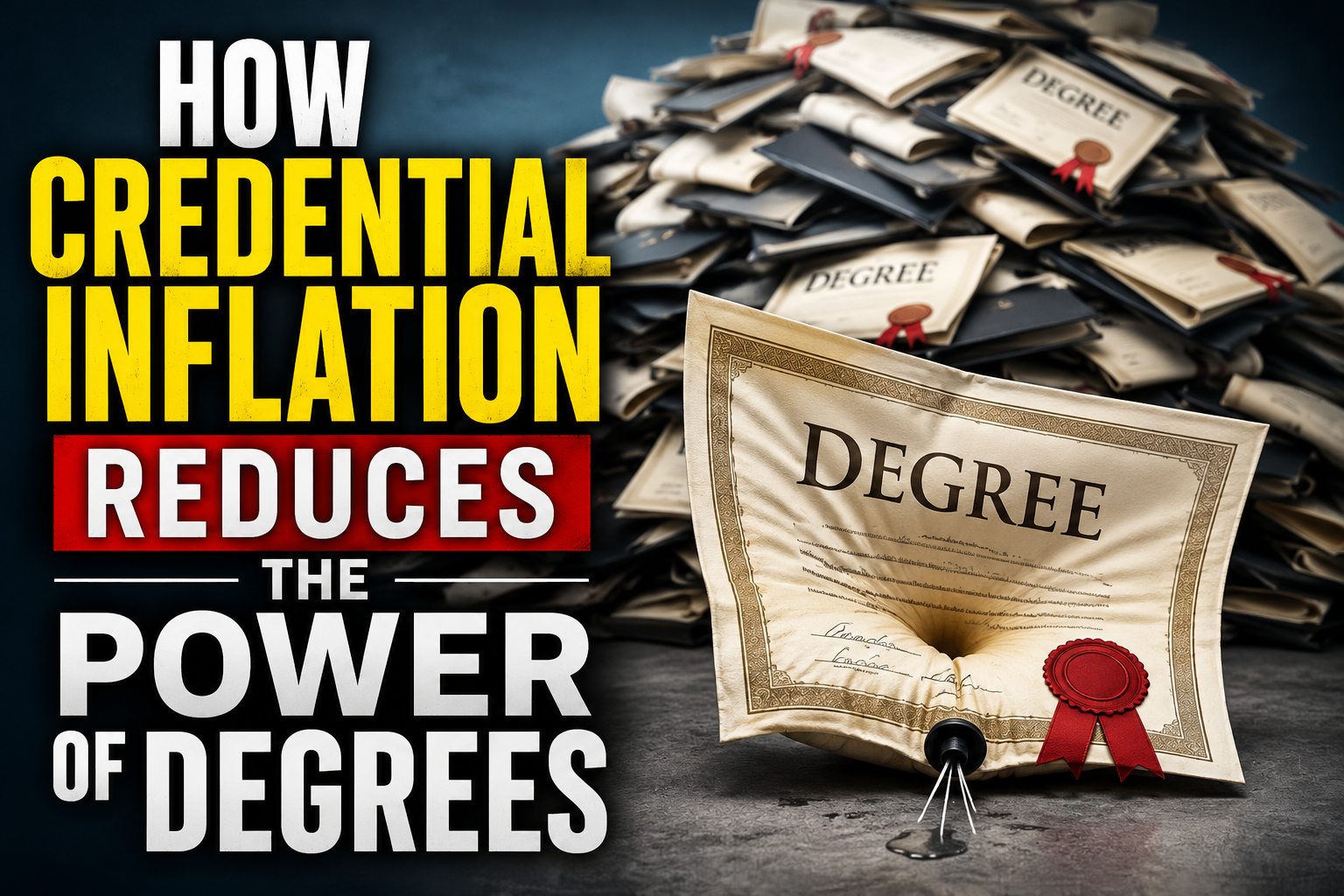
How Credential Inflation Reduces the Power of Degrees
For decades, earning a college degree was considered one of the most reliable paths to career success and financial stability. A degree often served as proof of competence, dedication, and readiness for professional responsibilities. Employers viewed degree holders as qualified candidates, and graduates enjoyed a significant advantage in the job market. However, over time, a growing phenomenon known as credential inflation has begun to change the value of academic qualifications. As more people obtain degrees, employers increasingly demand higher levels of education for positions that previously required less formal training. This trend is gradually reducing the power of degrees and reshaping the relationship between education and employment.
Credential inflation occurs when the educational requirements for jobs increase without a corresponding increase in the skills or knowledge needed to perform those jobs. In simple terms, positions that once required a high school diploma may now require a bachelor’s degree, while roles that once required a bachelor’s degree may now prefer or demand a master’s degree. As educational qualifications become more common, they lose some of their ability to distinguish candidates from one another.
One of the primary reasons credential inflation occurs is the growing number of people pursuing higher education. In many countries, college enrollment has expanded significantly over the past few decades. Governments, educators, and policymakers have encouraged higher education as a solution to economic challenges and unemployment. As a result, millions of individuals have earned degrees, increasing the supply of educated workers in the labor market.
When degrees become widespread, employers often raise educational requirements as a way to filter job applicants. Hiring managers facing hundreds of applications may use degrees as a convenient screening tool, even when the degree itself is not directly relevant to the job. This creates a situation where candidates must obtain higher credentials simply to remain competitive, regardless of whether those credentials improve their ability to perform the role.
The impact of credential inflation can be seen across numerous industries. Administrative positions, sales roles, customer service jobs, and other occupations that previously welcomed candidates with limited formal education increasingly require university degrees. In some cases, employers seek candidates with advanced degrees for positions that involve tasks largely unchanged from previous generations. The result is an educational arms race in which workers continually pursue additional qualifications to stand out from an increasingly credentialed workforce.
One consequence of credential inflation is the rising cost of entering the workforce. Obtaining a degree often requires significant investments of time, money, and effort. Students may spend years pursuing qualifications while accumulating substantial debt. When employers demand degrees for positions that do not truly require them, individuals bear the financial burden of acquiring credentials that offer diminishing returns.
This trend can also delay career development. Young adults who might otherwise enter the workforce and gain practical experience are encouraged to spend additional years in academic institutions. While education can provide valuable knowledge, excessive emphasis on credentials may postpone opportunities for hands on learning and skill development. In some cases, practical experience becomes more valuable than formal qualifications, yet employers continue to prioritize educational credentials during the hiring process.
Credential inflation also affects wage expectations. Historically, earning a degree often led to higher earnings because degree holders possessed skills that were relatively scarce. As degrees become more common, their scarcity decreases, and employers may become less willing to offer premium compensation simply because an applicant holds a qualification. This can reduce the financial advantage that degrees once provided and contribute to frustration among graduates who expected stronger economic returns on their educational investments.
Another significant issue is the mismatch between education and job requirements. Many graduates find themselves working in positions that do not fully utilize their academic training. This phenomenon, often referred to as underemployment, occurs when individuals possess qualifications beyond what their jobs require. A person with a university degree may work in a role that could be performed effectively by someone with less formal education. While employment remains valuable, the mismatch raises questions about the efficiency of requiring degrees for such positions.
Employers are not entirely responsible for credential inflation. Educational institutions also play a role. Universities and colleges benefit from increased enrollment and often market degrees as essential pathways to success. While higher education provides numerous benefits, the message that everyone must pursue advanced credentials can contribute to unrealistic expectations and oversupply in certain fields.
Technological advancements have further complicated the issue. The modern economy increasingly values practical skills, adaptability, and continuous learning. Many employers seek candidates who can solve problems, communicate effectively, collaborate with teams, and learn new technologies quickly. These abilities are not always measured accurately by academic credentials alone. As a result, some organizations are beginning to reconsider traditional hiring practices and place greater emphasis on demonstrated competence.
The rise of online learning platforms, professional certifications, and skill based training programs has created alternatives to traditional degrees. Individuals can now acquire specialized knowledge through shorter, more targeted educational pathways. In fields such as technology, digital marketing, graphic design, and data analysis, employers increasingly recognize portfolios, certifications, and practical achievements as evidence of capability. These developments challenge the assumption that a degree is always the best indicator of professional potential.
Credential inflation can also create social and economic inequalities. Individuals from lower income backgrounds may struggle to afford additional education, placing them at a disadvantage in a labor market that increasingly demands advanced qualifications. When jobs require credentials that exceed actual job needs, barriers to entry become higher, limiting opportunities for talented individuals who possess relevant skills but lack formal educational credentials.
Furthermore, credential inflation may contribute to skill shortages in certain sectors. Some industries face difficulty recruiting workers because educational requirements discourage potential candidates. Positions that could be learned through training and experience remain unfilled because employers insist on credentials that may not be necessary. This can reduce workforce flexibility and slow economic growth.
The psychological impact of credential inflation should not be overlooked. Many individuals feel pressured to pursue additional qualifications to remain competitive. This pressure can lead to stress, anxiety, and uncertainty about career prospects. Graduates who invest heavily in education may become discouraged when they discover that their degrees no longer guarantee the advantages they expected.
Despite these challenges, degrees still hold value. Higher education provides opportunities for intellectual growth, critical thinking, networking, and exposure to diverse perspectives. Certain professions such as medicine, law, engineering, and scientific research require extensive formal education due to the complexity and responsibility involved. The problem is not that degrees have become useless, but rather that their role as a universal measure of employability has weakened in many sectors.
As employers recognize the limitations of credential based hiring, there is growing interest in skill based recruitment. Instead of focusing primarily on academic qualifications, organizations are increasingly evaluating candidates based on demonstrated abilities, work samples, assessments, and practical experience. This approach can help identify talented individuals who may have unconventional educational backgrounds but possess the skills necessary to succeed.
Workers must also adapt to changing realities. In a world affected by credential inflation, lifelong learning has become essential. Rather than relying solely on a degree earned years ago, professionals must continuously develop new skills and remain responsive to industry changes. Adaptability, creativity, communication, and technological literacy are becoming increasingly important assets in the modern economy.
Educational institutions may also need to evolve. Universities can strengthen partnerships with employers, incorporate practical training into academic programs, and focus on developing skills that align with labor market needs. By emphasizing real world application alongside theoretical knowledge, educational institutions can help graduates remain competitive in an increasingly dynamic job market.
Governments and policymakers have a role to play as well. Encouraging diverse educational pathways, supporting vocational training, and promoting apprenticeship programs can create alternatives to traditional degree based routes. These options can help reduce unnecessary credential requirements while ensuring that workers acquire relevant skills.
Ultimately, credential inflation reflects broader changes in the relationship between education, employment, and economic opportunity. As degrees become more common, their ability to serve as exclusive signals of competence diminishes. Employers, educators, workers, and policymakers must recognize this reality and adapt accordingly.
The future of work is likely to place greater emphasis on skills, performance, and adaptability than on credentials alone. While degrees will continue to hold importance in many fields, their value will increasingly depend on the knowledge, abilities, and experiences they help individuals develop. In an era of credential inflation, success belongs not simply to those who collect qualifications, but to those who can demonstrate meaningful value in a rapidly changing world.

EarnSmartOnline.com.ng is dedicated to helping readers make smarter financial decisions through practical guides on online income, personal finance, technology, digital business, and wealth creation. Our goal is to provide reliable, easy-to-understand, and actionable content that empowers individuals to earn smarter, build sustainable income streams and achieve long-term financial success.
Recommended: Start Earning Online
- Ultimate Affiliate Marketing Program — learn affiliate marketing with a done-for-you sales system ($15). Check it out
- The Newbie Affiliate Guide — the beginner-friendly starter guide (~$6.68). Check it out
- Easy Dollar Maker — earn in dollars uploading AI images and videos from your phone ($17). Check it out
Disclosure: These are affiliate links. If you buy through them, I may earn a commission at no extra cost to you.



