
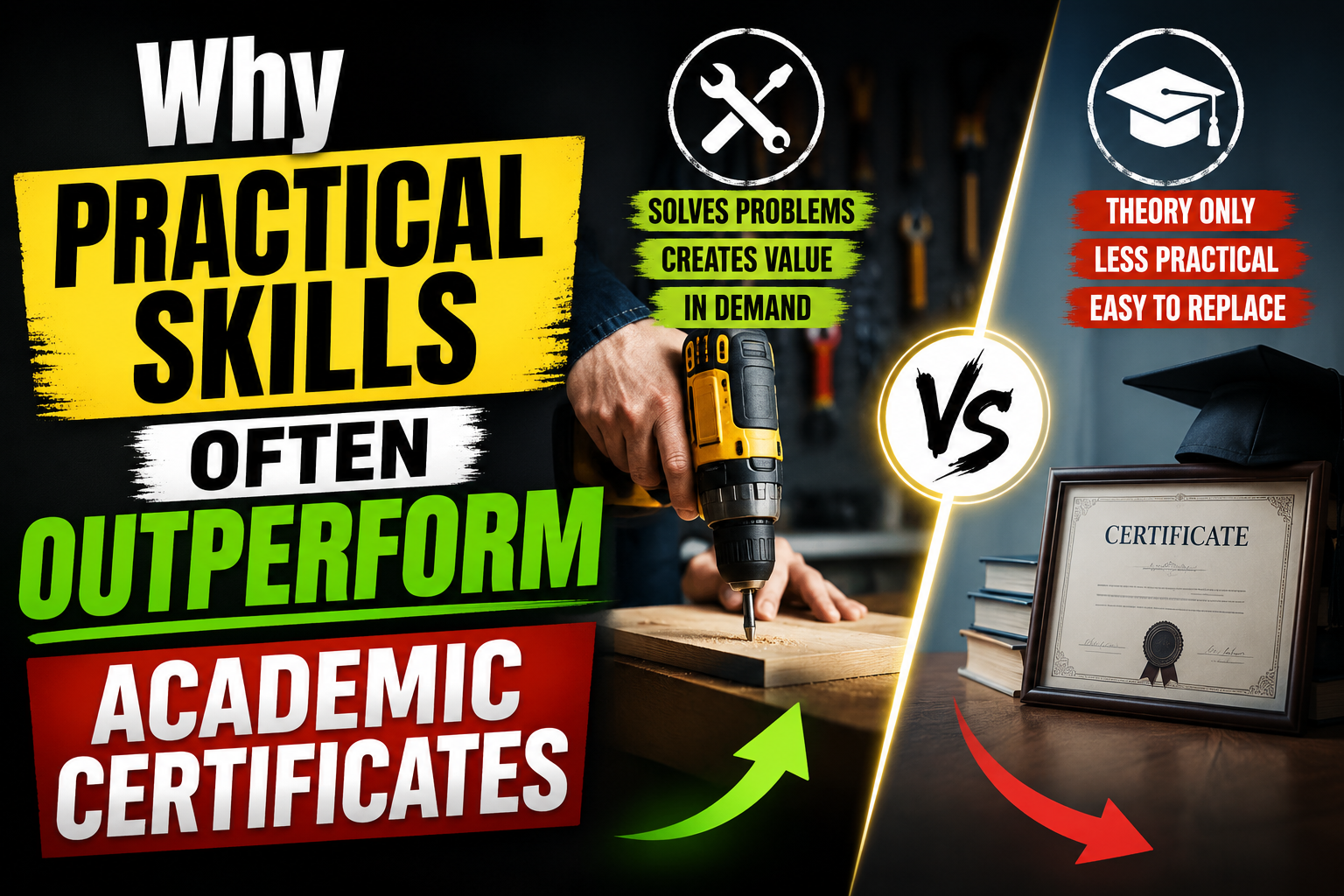
Why Practical Skills Often Outperform Academic Certificates
For decades, academic certificates have been viewed as the ultimate proof of competence and intelligence. Parents encourage their children to earn degrees, employers often list educational qualifications as job requirements, and society generally associates certificates with success. While education remains valuable and important, the modern world is increasingly demonstrating that practical skills often outperform academic certificates in creating opportunities, generating income, solving real problems, and achieving long term success.
The reason is simple. Certificates prove that someone completed a course of study, while practical skills prove that someone can produce results. In today’s highly competitive and rapidly changing environment, results matter more than credentials. Businesses, clients, and employers are primarily interested in what a person can do rather than what they studied years ago.
One of the biggest limitations of academic certificates is that they often focus heavily on theory. Students spend years learning concepts, definitions, principles, and frameworks. While theoretical knowledge provides a foundation, it does not automatically translate into real world competence. Many graduates leave school with impressive certificates but struggle when faced with practical situations that require critical thinking, adaptability, and hands on execution.
Practical skills, on the other hand, are developed through direct experience. Whether it is programming, graphic design, digital marketing, carpentry, sales, content creation, video editing, photography, web development, or entrepreneurship, practical skills are learned by doing. The more a person practices, the more competent they become. This creates individuals who can immediately contribute value in real situations rather than simply discussing theories.
The job market itself has evolved significantly over the last two decades. Employers are increasingly looking beyond academic qualifications when making hiring decisions. Many companies now prioritize portfolios, demonstrations of skill, previous work experience, problem solving ability, and proven achievements. A candidate who can show successful projects often stands out more than a candidate who possesses multiple certificates but lacks practical experience.
Technology has accelerated this shift. The internet has made information accessible to almost everyone. Knowledge that was once confined to classrooms can now be learned through online courses, tutorials, mentorship programs, and hands on experimentation. As a result, practical skills can be acquired faster and often at a lower cost than traditional academic qualifications.
Consider the field of software development. Many successful programmers and technology entrepreneurs built their careers through self learning and practical application rather than formal computer science degrees. Employers frequently hire developers based on coding ability, project portfolios, and technical competence. The ability to solve problems and build functional solutions often carries more weight than the educational institution listed on a resume.
The same trend can be seen in creative industries. Graphic designers, photographers, writers, video editors, social media managers, and digital marketers are often judged primarily by the quality of their work. Clients rarely ask where a designer studied. Instead, they want to see previous projects, measurable results, and evidence of competence. A strong portfolio often speaks louder than a framed certificate hanging on a wall.
Entrepreneurship provides another powerful example. Running a successful business requires practical skills such as communication, negotiation, leadership, sales, financial management, marketing, and customer service. These abilities are typically developed through experience rather than academic study alone. Many highly successful entrepreneurs built thriving businesses despite having little or no formal education because they mastered the practical skills necessary to create value.
Practical skills also provide a greater degree of adaptability. The world changes rapidly. Industries evolve, technologies emerge, and market demands shift continuously. Academic curricula often take years to update, meaning students may learn outdated information. Practical learners, however, can quickly acquire new skills and adjust to changing circumstances. This flexibility creates a significant competitive advantage in uncertain economic environments.
Another reason practical skills outperform academic certificates is their direct connection to value creation. Every economy rewards people who solve problems. Practical skills enable individuals to identify problems and provide solutions. Whether fixing a broken machine, designing a website, managing a marketing campaign, repairing electrical systems, or creating useful content, practical skills generate measurable value that others are willing to pay for.
This value creation often leads to faster income generation. Many people spend years pursuing degrees before entering the workforce. In contrast, individuals who focus on practical skills can begin offering services and earning income much sooner. Freelancers, tradespeople, consultants, and digital professionals frequently start generating revenue while still learning and improving their craft.
The rise of the digital economy has further strengthened the importance of practical skills. Millions of people now earn income online through freelancing, e commerce, affiliate marketing, content creation, software development, and consulting. In many of these fields, success depends almost entirely on practical ability. Clients and customers care about results, not academic transcripts.
Practical skills also foster confidence and independence. When individuals know they can solve problems and create value, they become less dependent on external validation. They understand that their abilities can generate opportunities regardless of economic conditions. This confidence encourages initiative, innovation, and resilience.
Another significant advantage is that practical skills are often easier to demonstrate. A certificate represents past achievement, but a skill can be displayed in real time. A web developer can build a website. A writer can create engaging content. A mechanic can repair a vehicle. A salesperson can close deals. These demonstrations provide tangible evidence of competence that is difficult to dispute.
It is important to recognize that academic certificates are not useless. Education provides structure, foundational knowledge, discipline, and exposure to important concepts. Many professions such as medicine, engineering, law, and certain scientific fields require formal education and certification for good reasons. However, even within these professions, practical competence often distinguishes exceptional performers from average ones.
The most successful individuals often combine education with practical skills. They understand that knowledge becomes valuable only when applied effectively. They do not rely solely on certificates to create opportunities. Instead, they continuously develop their abilities, gain experience, and seek ways to deliver measurable results.
Employers increasingly recognize this reality. Many organizations have begun shifting toward skills based hiring practices. Rather than focusing exclusively on degrees, they evaluate candidates based on demonstrated abilities, project experience, problem solving capacity, and practical achievements. This trend reflects a growing understanding that competence cannot always be measured by academic credentials alone.
Practical skills also encourage lifelong learning. Since skills must be continually refined and updated, individuals become accustomed to constant improvement. They remain curious, adaptable, and open to new information. This mindset is essential in a world where change is accelerating and yesterday’s expertise can quickly become obsolete.
Economic uncertainty further highlights the value of practical skills. During challenging periods, individuals who possess useful abilities can often create alternative income streams, transition into new industries, or start independent ventures. Their skills provide flexibility and resilience that certificates alone may not offer.
The distinction between knowing and doing is crucial. Many people know what should be done, but far fewer can actually do it effectively. Practical skills bridge this gap. They transform information into action and ideas into results. In the real world, execution frequently determines success more than theoretical understanding.
The growing popularity of apprenticeships, vocational training, online learning platforms, and skills based education reflects this shift. More people are recognizing that practical competence can create substantial opportunities without requiring lengthy academic pathways. Skilled professionals in trades, technology, digital services, and entrepreneurship continue to demonstrate that expertise and results often matter more than formal credentials.
Ultimately, the debate should not be framed as practical skills versus academic certificates. The most powerful combination is knowledge supported by action. Certificates can open doors, but practical skills keep those doors open. Certificates may secure an interview, but skills secure performance. Certificates may create initial credibility, but practical competence builds lasting reputation.
In an increasingly competitive and dynamic world, the ability to solve problems, create value, adapt to change, and deliver results has become the true currency of success. While academic certificates still have their place, practical skills often outperform them because they directly address what people, businesses, and societies need most. At the end of the day, the marketplace rewards contribution, and practical skills are one of the most reliable ways to make meaningful contributions that generate opportunities, income, and long term success.

EarnSmartOnline.com.ng is dedicated to helping readers make smarter financial decisions through practical guides on online income, personal finance, technology, digital business, and wealth creation. Our goal is to provide reliable, easy-to-understand, and actionable content that empowers individuals to earn smarter, build sustainable income streams and achieve long-term financial success.
Recommended: Start Earning Online
- Ultimate Affiliate Marketing Program — learn affiliate marketing with a done-for-you sales system ($15). Check it out
- The Newbie Affiliate Guide — the beginner-friendly starter guide (~$6.68). Check it out
- Easy Dollar Maker — earn in dollars uploading AI images and videos from your phone ($17). Check it out
Disclosure: These are affiliate links. If you buy through them, I may earn a commission at no extra cost to you.



