
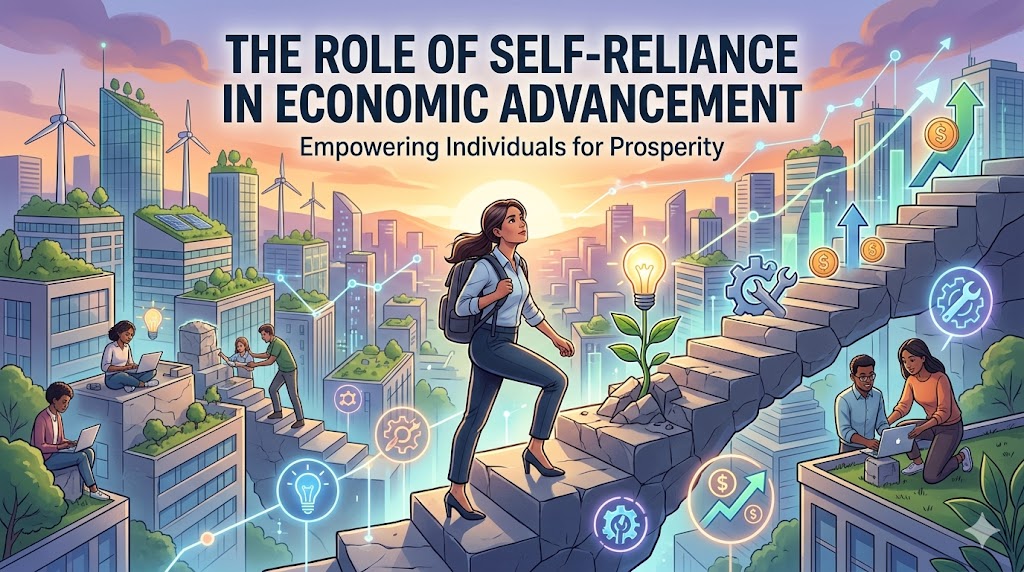
The Role of Self-Reliance in Economic Advancement
Self-reliance is one of the most misunderstood forces behind economic progress. Many people assume that wealth and financial stability come mainly from external support such as government programs, employers, family assistance, or even luck. While external systems can play a role, long term economic advancement is rarely built on dependence. It is built on the ability of individuals to think, act, and sustain themselves without waiting for constant external direction. Self-reliance is not about rejecting help, but about developing the internal capacity to create solutions, generate income, and adapt to changing conditions.
At its core, self-reliance is the practice of taking full responsibility for one’s financial life. It means understanding that your economic outcome is shaped more by your decisions than your circumstances. People who develop this mindset stop outsourcing their survival. Instead of asking what society can do for them, they begin to ask what they can do with what they already have. This shift is subtle but powerful because it transforms a person from a passive participant in the economy into an active contributor.
One of the strongest ways self-reliance drives economic advancement is through skill development. When individuals depend heavily on external systems, there is often less urgency to acquire high value skills. However, when someone understands that their financial future rests on their own ability to produce value, learning becomes a necessity rather than an option. This creates a continuous cycle of improvement where the individual becomes more capable, more adaptable, and more valuable in the marketplace.
Self-reliance also strengthens decision making. People who rely heavily on others for direction often struggle when clear guidance is not available. Economic environments are unpredictable, and opportunities rarely come with complete instructions. Those who are self-reliant develop the ability to analyze situations, weigh options, and take responsibility for outcomes. Even when mistakes happen, they learn quickly and adjust, which is a critical trait in any competitive economic system.
Another important aspect of self-reliance is financial independence. Many individuals remain economically stagnant because they depend on a single source of income or external support systems that limit their flexibility. Self-reliant individuals, on the other hand, actively explore multiple ways to generate income. They may combine skills, side projects, small businesses, or investments to reduce dependency on any single system. This diversification creates stability and allows for growth even in uncertain environments.
Psychologically, self-reliance builds confidence. When people repeatedly solve their own problems, they begin to trust their judgment. This confidence is not arrogance but grounded assurance based on experience. It becomes easier to take calculated risks, pursue opportunities, and step into unfamiliar territory. In contrast, individuals who lack self-reliance often hesitate, waiting for validation or permission before acting. In fast changing economies, hesitation can be more costly than failure.
Self-reliance also influences how people perceive opportunity. Many individuals overlook possibilities because they are conditioned to wait for structured instructions or perfect conditions. Self-reliant individuals tend to see opportunity differently. They recognize that resources are often limited at the beginning and that progress requires creativity. Instead of waiting for ideal circumstances, they work with what is available and gradually expand their capacity over time.
A key component of self-reliance is adaptability. Economic environments change constantly due to technology, market trends, global events, and shifting consumer behavior. Those who rely heavily on fixed systems often struggle when those systems change. Self-reliant individuals are more flexible. They are willing to learn new skills, adjust strategies, and pivot when necessary. This adaptability ensures long term survival and continuous growth.
Self-reliance also reduces vulnerability. When a person depends entirely on one employer, one industry, or one support system, their financial stability becomes fragile. Any disruption in that system can create serious consequences. However, when individuals build their own capacity to generate value independently, they become less vulnerable to external shocks. This does not eliminate risk, but it distributes it more evenly across different sources of income and capability.
Education plays a significant role in developing self-reliance, but not in the traditional sense alone. Formal education provides structure, but self-reliance requires practical learning that extends beyond classrooms. It involves experimenting, solving real problems, and learning from experience. Many economically successful individuals are lifelong learners who continuously upgrade their skills outside formal institutions. This form of learning strengthens independence because it reduces reliance on external validation.
Another major element of self-reliance is initiative. Economic advancement rarely comes to those who wait passively. It comes to those who initiate action without being told. Self-reliant individuals do not wait for perfect timing or perfect resources. They start where they are, with what they have, and improve along the way. This habit of initiation creates momentum, and momentum is one of the strongest drivers of economic progress.
Self-reliance also changes how people relate to failure. In dependent mindsets, failure is often seen as a setback that requires external rescue. In self-reliant mindsets, failure is treated as feedback. Every mistake becomes information that improves future decisions. This perspective removes fear from action and replaces it with learning. Over time, this leads to faster growth and stronger economic positioning.
There is also a strong connection between self-reliance and entrepreneurship. While not every self-reliant individual becomes an entrepreneur, most entrepreneurs are self-reliant by nature. They build systems, solve problems, and create value without waiting for permission. Entrepreneurship is essentially structured self-reliance applied at scale. It transforms individual capability into economic systems that serve others while generating income.
On a broader level, societies with higher levels of self-reliance tend to experience stronger economic development. When individuals are capable of supporting themselves and contributing independently, the overall system becomes more productive. Innovation increases, dependency decreases, and economic resilience improves. This is why self-reliance is not only a personal advantage but also a collective economic strength.
However, self-reliance does not mean isolation. One of the common misunderstandings is that being self-reliant means refusing help or avoiding collaboration. In reality, self-reliant individuals often collaborate more effectively because they are not dependent on others for survival. They engage with systems and people from a position of strength rather than need. This allows for healthier partnerships and more balanced economic relationships.
Developing self-reliance requires intentional practice. It begins with small decisions such as solving personal problems without immediate external assistance, learning basic financial management, and taking responsibility for outcomes. Over time, these small actions build a pattern of independence that extends into larger areas of life. The goal is not perfection but progress in personal capability.
One of the most powerful outcomes of self-reliance is long term economic freedom. Financial freedom is not simply about how much money a person earns, but about how much control they have over their economic survival. Self-reliant individuals are not easily displaced by external changes because they possess adaptable skills, independent thinking, and multiple pathways to income. This freedom creates stability even in uncertain environments.
In conclusion, self-reliance is a foundational element of economic advancement. It influences skill development, decision making, financial independence, adaptability, and long term resilience. Without self-reliance, individuals remain dependent on systems that may not always serve their best interests. With self-reliance, individuals gain the ability to shape their own economic outcomes and navigate uncertainty with confidence. It is not an instant transformation, but a gradual shift in mindset and behavior that compounds over time. Those who embrace it position themselves not just to survive economically, but to grow, adapt, and thrive in any environment.

EarnSmartOnline.com.ng is dedicated to helping readers make smarter financial decisions through practical guides on online income, personal finance, technology, digital business, and wealth creation. Our goal is to provide reliable, easy-to-understand, and actionable content that empowers individuals to earn smarter, build sustainable income streams and achieve long-term financial success.
Recommended: Start Earning Online
- Ultimate Affiliate Marketing Program — learn affiliate marketing with a done-for-you sales system ($15). Check it out
- The Newbie Affiliate Guide — the beginner-friendly starter guide (~$6.68). Check it out
- Easy Dollar Maker — earn in dollars uploading AI images and videos from your phone ($17). Check it out
Disclosure: These are affiliate links. If you buy through them, I may earn a commission at no extra cost to you.



