
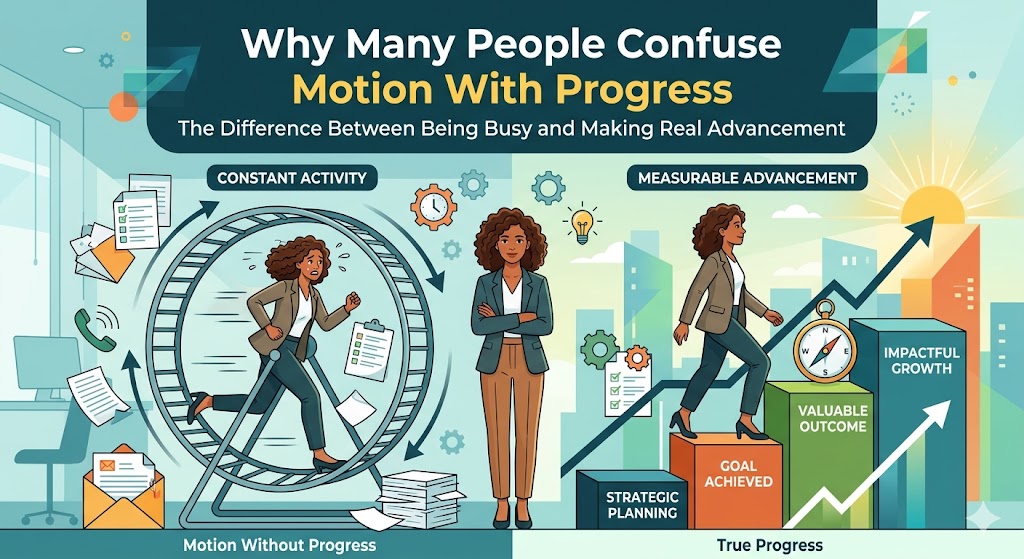
Why Many People Confuse Motion With Progress
Many people move through life with a strong sense of effort, activity, and constant engagement, yet still feel like they are not getting closer to meaningful results. This is because there is a common misunderstanding between motion and progress. Motion is the act of being busy, doing things, responding to tasks, and staying active. Progress is different. Progress is movement toward a defined outcome that actually changes your position in life, whether financially, emotionally, professionally, or personally. The confusion between these two concepts is one of the silent reasons many individuals feel stuck despite being extremely active.
Motion often feels productive because it gives immediate feedback. When a person answers messages, attends meetings, scrolls through information, or switches between tasks, there is a sense of involvement. The brain interprets activity as achievement, even when nothing meaningful is being built. This creates a psychological illusion where effort is mistaken for impact. In reality, motion can increase exhaustion without increasing results. People can end an entire day feeling drained, yet if they look closely at their outcomes, very little has changed compared to the start of the day.
One of the core reasons this confusion happens is the lack of clear direction. When people do not define what progress looks like in measurable terms, they default to staying busy. Without a clear target, any activity feels acceptable. For example, someone trying to grow a business may spend hours designing logos, adjusting social media profiles, or researching competitors, but never actually focus on acquiring customers. The activities feel related to success, but they do not directly produce success. Without clarity, motion fills the gap where progress should be.
Another important factor is emotional comfort. Motion is easier to sustain than progress because it avoids the discomfort of real challenges. Real progress often requires decisions that carry risk, rejection, or uncertainty. It may involve launching an imperfect product, asking for a sale, or confronting personal weaknesses. Motion, on the other hand, allows avoidance while still maintaining the feeling of productivity. People unconsciously choose tasks that keep them safe rather than tasks that move them forward. Over time, this creates a lifestyle of activity without advancement.
Modern technology has also amplified this problem. With constant notifications, endless content, and infinite digital tools, people now have more ways than ever to stay in motion. Checking emails, refreshing feeds, joining online discussions, and consuming information can easily fill an entire day. However, consumption is not creation, and response is not progress. Many individuals confuse being informed with being effective. They believe that knowing more automatically leads to doing more, but without execution, knowledge remains unused potential.
Another layer of confusion comes from social validation. Society often rewards visible activity more than invisible progress. A person who looks busy is often perceived as hardworking, even if their results are minimal. Meetings, updates, and constant communication can create the appearance of importance. Meanwhile, someone who is quietly focusing on deep work may appear inactive, even though they are making real progress. This misalignment between appearance and impact encourages people to prioritize looking productive instead of being productive.
There is also the issue of task multiplication. When individuals feel uncertain about their progress, they often add more tasks to their schedule in an attempt to feel in control. Instead of improving the quality of their actions, they increase the quantity. This creates a cycle where more effort leads to more motion, but not more results. Without evaluation, people rarely ask whether their actions are directly connected to their goals. They assume that all effort contributes equally, which is rarely true in real life.
True progress requires prioritization, and prioritization requires elimination. This is where many people struggle. It is easier to add tasks than to remove them. However, progress is often hidden in what you choose not to do. Every time energy is spent on low value activity, it is taken away from high impact actions. The inability to distinguish between urgent tasks and important tasks leads to constant motion. Urgent tasks keep you active, but important tasks move you forward.
Another important distinction is between input and output. Motion is often focused on input, such as learning, planning, and preparing. Progress is measured by output, such as results, completed work, and real world impact. Many people overinvest in input because it feels safer and more controllable. However, without output, input has no practical value. At some point, learning must turn into doing, and planning must turn into execution. Otherwise, activity remains trapped in preparation without transformation.
The environment also plays a significant role in reinforcing motion over progress. In many workplaces and social circles, people are encouraged to stay constantly engaged. Quick responses, multitasking, and visible busyness are often praised. This creates pressure to remain in motion even when it is not necessary. Over time, individuals internalize this behavior and begin to equate busyness with success. They stop questioning whether their actions are actually producing meaningful change.
Breaking free from this cycle requires a shift in perspective. Instead of asking how busy you are, the more important question becomes what has actually changed because of your effort. Progress always leaves evidence. It either improves a situation, moves a goal forward, or eliminates a problem. Motion, on the other hand, can continue indefinitely without altering anything significant. The difference is not in intensity but in direction.
Ultimately, understanding the difference between motion and progress is about awareness and honesty. It requires the ability to pause and evaluate whether daily actions are aligned with desired outcomes. Many people are not lacking effort, discipline, or intelligence. They are simply misdirecting their energy into activities that feel productive but do not produce meaningful change. Once this realization is made, everything shifts. Effort becomes more intentional, focus becomes sharper, and results begin to reflect actual movement rather than just activity.

EarnSmartOnline.com.ng is dedicated to helping readers make smarter financial decisions through practical guides on online income, personal finance, technology, digital business, and wealth creation. Our goal is to provide reliable, easy-to-understand, and actionable content that empowers individuals to earn smarter, build sustainable income streams and achieve long-term financial success.
Recommended: Start Earning Online
- Ultimate Affiliate Marketing Program — learn affiliate marketing with a done-for-you sales system ($15). Check it out
- The Newbie Affiliate Guide — the beginner-friendly starter guide (~$6.68). Check it out
- Easy Dollar Maker — earn in dollars uploading AI images and videos from your phone ($17). Check it out
Disclosure: These are affiliate links. If you buy through them, I may earn a commission at no extra cost to you.



