
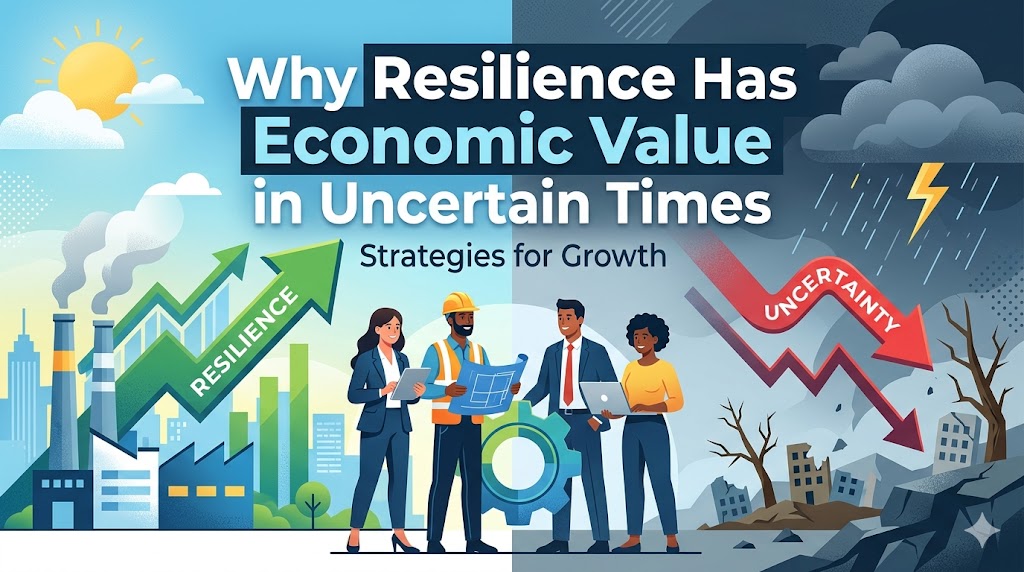
Why Resilience Has Economic Value in Uncertain Times
Economic uncertainty is no longer an occasional event in modern life. It has become a constant background condition that affects how people earn, spend, invest, and plan their future. In such an environment, resilience is not just a personal trait or motivational idea. It becomes a measurable economic advantage. People who can adapt, recover, and remain stable during disruption often end up with stronger financial outcomes than those who depend only on stability or predictability. Understanding why resilience has economic value in uncertain times helps explain why some individuals and businesses continue to grow even when conditions appear unfavorable.
At its core, resilience is the ability to absorb shocks without collapsing and to recover quickly after setbacks. In economic terms, shocks can come in many forms such as job loss, inflation, market downturns, business failure, or sudden changes in demand. People who lack resilience tend to react emotionally and make decisions that worsen their situation, such as panic spending, abandoning plans too quickly, or avoiding future opportunities out of fear. Those who are resilient, however, tend to stabilize first, assess the situation, and then adjust strategically. This difference in response creates very different financial trajectories over time.
One of the clearest ways resilience creates economic value is through income continuity. In uncertain times, income is rarely guaranteed. Industries shift, companies restructure, and entire job roles can become obsolete. A resilient person is more likely to pivot, retrain, or reposition themselves quickly enough to maintain some form of income flow. Even if the income temporarily decreases, they avoid complete financial shutdown. Over time, this ability to stay economically active, even during disruption, compounds into significantly higher lifetime earnings compared to individuals who experience long periods of inactivity.
Resilience also protects against the hidden cost of panic decisions. When uncertainty rises, many people rush into poor financial choices. They may sell assets at a loss, abandon promising ventures prematurely, or take on unnecessary debt out of fear. These reactions often create long lasting damage that is difficult to reverse. A resilient mindset introduces a pause between stimulus and reaction. That pause allows for better analysis, better timing, and better resource allocation. Even if the external situation is negative, the internal decision making process remains stable, which reduces financial losses and preserves long term opportunities.
Another important dimension of resilience is its role in skill development and adaptation. Economic uncertainty often reshapes which skills are valuable. Some skills lose relevance while others become highly demanded. People who are not resilient tend to resist change because it feels uncomfortable or threatening. They may cling to outdated methods or refuse to learn new systems. Resilient individuals, on the other hand, are more willing to learn, experiment, and adjust. This willingness to evolve ensures that their skills remain relevant in changing markets, which directly increases their earning potential over time.
Resilience also has strong effects on entrepreneurship and business survival. In uncertain economies, businesses face fluctuating demand, supply chain issues, and unpredictable costs. Many small businesses fail not because the idea was bad, but because the owners could not withstand the pressure of instability. Resilient entrepreneurs are more likely to redesign their business models, cut unnecessary costs, and explore new markets instead of giving up. This ability to persist through difficult phases often determines whether a business eventually becomes profitable or disappears early.
Another often overlooked aspect of resilience is financial discipline during volatility. When conditions become unstable, spending behavior tends to become emotional. Some people overspend out of anxiety while others completely freeze their financial activity. Both extremes can be harmful. Resilient individuals tend to maintain structured financial habits even when external conditions are unstable. They continue budgeting, saving, and prioritizing essential expenses. This consistency creates a financial buffer that becomes extremely valuable during prolonged uncertainty, allowing them to take advantage of opportunities when others are forced to retreat.
Resilience also increases the ability to recognize opportunity during crisis. Economic downturns are not only periods of loss. They are also periods where new opportunities emerge as markets shift. However, many people are too overwhelmed by uncertainty to notice them. A resilient mindset helps individuals remain observant rather than reactive. They can identify gaps in the market, shifts in consumer behavior, or emerging needs that others overlook. This awareness often leads to strategic positioning that results in financial gain once conditions stabilize.
Another important factor is emotional control. Economic uncertainty triggers stress, fear, and doubt. These emotions often influence financial decisions in negative ways. Resilient individuals are not free from emotion, but they are less controlled by it. They can separate emotional reactions from strategic thinking. This separation is economically valuable because it prevents short term emotional states from dictating long term financial direction. Over time, this leads to more consistent decision making and fewer costly mistakes.
Resilience also plays a key role in networking and relationships, which are often critical during uncertain times. When economic conditions worsen, people naturally rely more on trusted connections for opportunities, support, and collaboration. Individuals who maintain resilience tend to preserve relationships even during stress. They do not burn bridges or isolate themselves when things become difficult. Instead, they remain engaged and reliable. This social stability increases their access to opportunities that are often not publicly available, such as referrals, partnerships, and insider information about emerging roles or markets.
In addition, resilience supports long term thinking, which is essential for building wealth. Uncertain environments tend to push people toward short term survival thinking. While survival is necessary, exclusive focus on the short term often destroys long term potential. Resilient individuals are better able to balance immediate needs with future planning. They understand that temporary instability does not define permanent outcomes. This perspective allows them to continue investing in skills, relationships, and assets even during difficult periods, which positions them for stronger recovery and growth when conditions improve.
Resilience also strengthens productivity under pressure. Many people experience a sharp decline in performance when external conditions become unstable. Stress reduces focus, consistency, and motivation. Resilient individuals are more capable of maintaining productivity even when circumstances are not ideal. This steady output ensures that they remain valuable in their workplace or industry, reducing the likelihood of income loss and increasing their chances of advancement when stability returns.
Ultimately, resilience has economic value in uncertain times because it transforms instability from a destructive force into a manageable condition. Instead of being overwhelmed by change, resilient individuals learn to operate within it. They reduce losses, maintain income, adapt their skills, preserve relationships, and identify opportunities that others miss. Over time, these behaviors compound into a significant economic advantage that is not always visible in the short term but becomes very clear across years or decades.
In a world where uncertainty is becoming the norm rather than the exception, resilience is no longer optional. It is a form of economic intelligence that determines how well a person can survive disruption and convert it into progress. Those who develop it early tend to experience fewer financial collapses, faster recoveries, and stronger long term wealth accumulation. In this sense, resilience is not just about surviving difficult times. It is about positioning yourself to benefit from them in ways that others cannot.

EarnSmartOnline.com.ng is dedicated to helping readers make smarter financial decisions through practical guides on online income, personal finance, technology, digital business, and wealth creation. Our goal is to provide reliable, easy-to-understand, and actionable content that empowers individuals to earn smarter, build sustainable income streams and achieve long-term financial success.
Recommended: Start Earning Online
- Ultimate Affiliate Marketing Program — learn affiliate marketing with a done-for-you sales system ($15). Check it out
- The Newbie Affiliate Guide — the beginner-friendly starter guide (~$6.68). Check it out
- Easy Dollar Maker — earn in dollars uploading AI images and videos from your phone ($17). Check it out
Disclosure: These are affiliate links. If you buy through them, I may earn a commission at no extra cost to you.



