
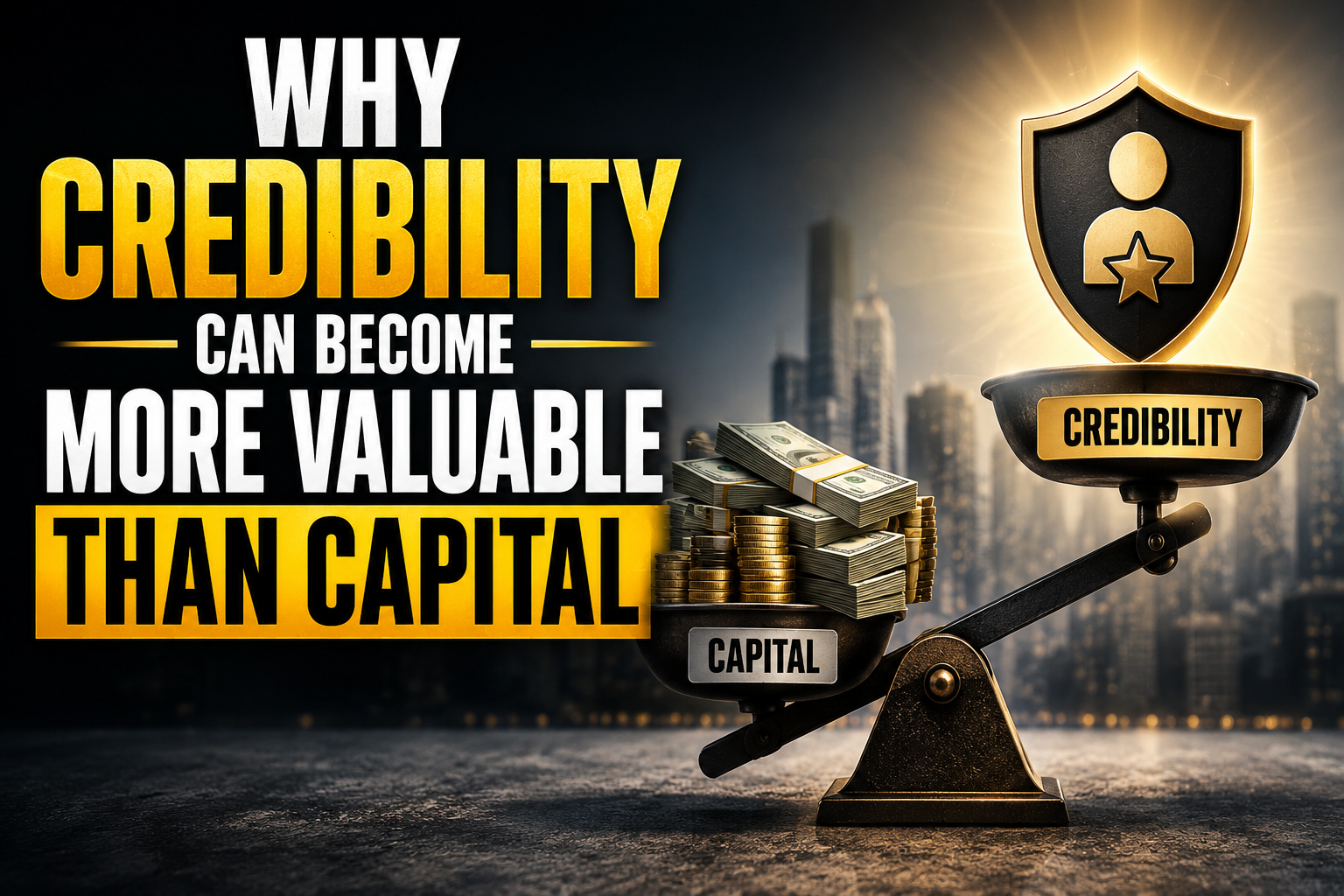
Why Credibility Can Become More Valuable Than Capital
In a world that constantly celebrates money as the ultimate measure of success, it is easy to assume that capital is the strongest force shaping opportunity. People often believe that if they only had enough money, every door would open, every problem would be solved, and every goal would be achievable. Yet in real life, there is a quieter force that often determines who gets access to money in the first place, who multiplies it, and who continues to attract it long after the initial funds are gone. That force is credibility. Credibility is the accumulated trust people place in your judgment, your consistency, your character, and your ability to deliver what you promise. Unlike capital, which can be gained or lost quickly, credibility builds slowly and compounds over time. But once it is strong enough, it begins to function like a form of currency that can outperform money itself.
Credibility works because it reduces uncertainty. In any economic system, uncertainty is expensive. Investors hesitate when they are unsure about outcomes. Customers hesitate when they are unsure about quality. Partners hesitate when they are unsure about reliability. Money is often used to compensate for that uncertainty, either by demanding higher returns or by requiring collateral. But when credibility is present, uncertainty drops dramatically. A person with strong credibility does not need to convince people repeatedly with money or persuasion. Their history speaks for them. Their consistency becomes proof. This is why two individuals with equal ideas can have completely different outcomes. One struggles to raise funds while the other attracts support effortlessly, not necessarily because the idea is better, but because trust already exists.
In many cases, credibility is what opens the first financial door. Capital rarely flows to unknown or untested individuals without hesitation. Even in informal settings, people prefer to support those who have demonstrated reliability over time. A small business owner who consistently delivers quality work will often receive informal loans, customer loyalty, and referrals long before they ever secure formal investment. That early support is not based on spreadsheets or projections but on trust built through repeated actions. The irony is that many people focus entirely on acquiring capital while neglecting the foundation that actually makes capital accessible.
Credibility also compounds in a way that capital alone cannot. Money can grow through investment, but it can also disappear through mismanagement, risk, or external shocks. Credibility, however, tends to strengthen with each positive interaction. Every promise kept reinforces it. Every successful delivery deepens it. Every honest decision during difficult moments increases it. Over time, this creates a reputation that begins to operate independently of direct persuasion. People start recommending you without being asked. Opportunities begin to arrive without active pursuit. This is the invisible return on credibility that many underestimate.
One of the most powerful aspects of credibility is that it attracts capital itself. Investors are not only investing in ideas; they are investing in people. A strong idea with a weak reputation often struggles to secure funding, while an average idea with a credible founder can attract significant backing. This happens because capital seeks safety and predictability. When people trust your judgment, they are more willing to entrust you with resources. In this sense, credibility becomes a multiplier of financial opportunity. It does not replace capital entirely, but it determines how easily capital flows toward you.
Credibility also reduces the cost of doing business. When people trust you, negotiations become simpler. Contracts become shorter. Verification processes become easier. Marketing costs decrease because word of mouth becomes a powerful tool. In contrast, a lack of credibility increases friction at every stage. You are forced to prove yourself repeatedly. You must offer discounts, guarantees, or incentives to overcome doubt. You spend more time convincing than building. This hidden cost often slows down growth far more than lack of money ever does.
Another important dimension of credibility is its role in crisis situations. Capital can help you survive temporary challenges, but credibility determines whether people stand with you when things go wrong. Businesses with strong reputations often receive second chances from customers, patience from partners, and support from stakeholders even during setbacks. On the other hand, once credibility is lost, even large amounts of capital struggle to repair the damage. Money can fix operations, but it cannot easily restore trust. That restoration requires time, consistency, and repeated proof of change.
In personal development and career growth, credibility often outweighs qualifications or initial resources. Many people assume that success depends primarily on access to funding, education, or connections. While these factors matter, credibility determines how effectively they are used. A person known for reliability will often be given more responsibility, more visibility, and more opportunities, regardless of their starting point. Over time, these opportunities translate into financial advancement. In contrast, someone who lacks credibility may have access to resources but struggle to convert them into meaningful outcomes.
The digital age has made credibility even more important. Information spreads faster than ever, and reputations are formed quickly. A single pattern of behavior can define how an individual or business is perceived across a wide audience. This means that credibility is no longer just built in private interactions but in public visibility. Consistency, honesty, and quality of output are constantly observed and evaluated. As a result, credibility has become one of the most valuable assets in online business, content creation, freelancing, and entrepreneurship.
Interestingly, credibility also influences how people perceive value itself. The same product or service can be seen as more valuable when delivered by a trusted source. This is why brands with strong reputations can charge higher prices without losing customers. People are not only paying for the product but for the assurance that comes with it. That assurance is built entirely on credibility. In this way, credibility does not just attract capital; it actively increases the value of what you offer.
However, credibility is fragile. Unlike capital, which can sometimes be recovered after loss, credibility takes longer to rebuild once broken. A single major failure of trust can erase years of accumulated reputation. This is why it requires consistent protection. Small actions matter. Honesty in minor situations builds the foundation for trust in larger ones. Reliability in simple tasks signals dependability in complex ones. Over time, these patterns form a reputation that becomes difficult to question.
Many people underestimate credibility because it does not produce immediate visible results. Capital is tangible and measurable. It can be counted, spent, invested, and tracked. Credibility, on the other hand, is invisible until it is tested. This invisibility leads some to neglect it in favor of short-term financial gains. But over time, those who prioritize credibility often find themselves in positions where capital flows more easily toward them, while those who prioritize money without trust struggle to maintain long-term stability.
In reality, credibility and capital are not enemies, but they do not operate on the same timeline. Capital is often short-term and transactional, while credibility is long-term and relational. One can be acquired quickly under the right conditions, but the other must be earned gradually. When both are present, they reinforce each other. Capital accelerates execution, while credibility ensures sustainability. But when forced to choose which to build first, credibility often provides the stronger foundation.
Ultimately, the reason credibility can become more valuable than capital is because it determines access to capital, stability of capital, and multiplication of capital. It shapes how people respond to you in both opportunity and crisis. It reduces friction in transactions, increases perceived value, and attracts long-term trust. While money can solve immediate problems, credibility shapes the conditions under which money continues to flow.
In a world that often encourages people to chase financial gain first, it becomes easy to overlook the slower but more powerful path of building trust. Yet those who focus on credibility early often find that capital follows naturally over time. Not because it is guaranteed, but because trust creates an environment where opportunity becomes easier to recognize and easier to give. In the long run, credibility does not just support wealth creation. It becomes one of the most important forms of wealth itself.

EarnSmartOnline.com.ng is dedicated to helping readers make smarter financial decisions through practical guides on online income, personal finance, technology, digital business, and wealth creation. Our goal is to provide reliable, easy-to-understand, and actionable content that empowers individuals to earn smarter, build sustainable income streams and achieve long-term financial success.
Recommended: Start Earning Online
- Ultimate Affiliate Marketing Program — learn affiliate marketing with a done-for-you sales system ($15). Check it out
- The Newbie Affiliate Guide — the beginner-friendly starter guide (~$6.68). Check it out
- Easy Dollar Maker — earn in dollars uploading AI images and videos from your phone ($17). Check it out
Disclosure: These are affiliate links. If you buy through them, I may earn a commission at no extra cost to you.



