
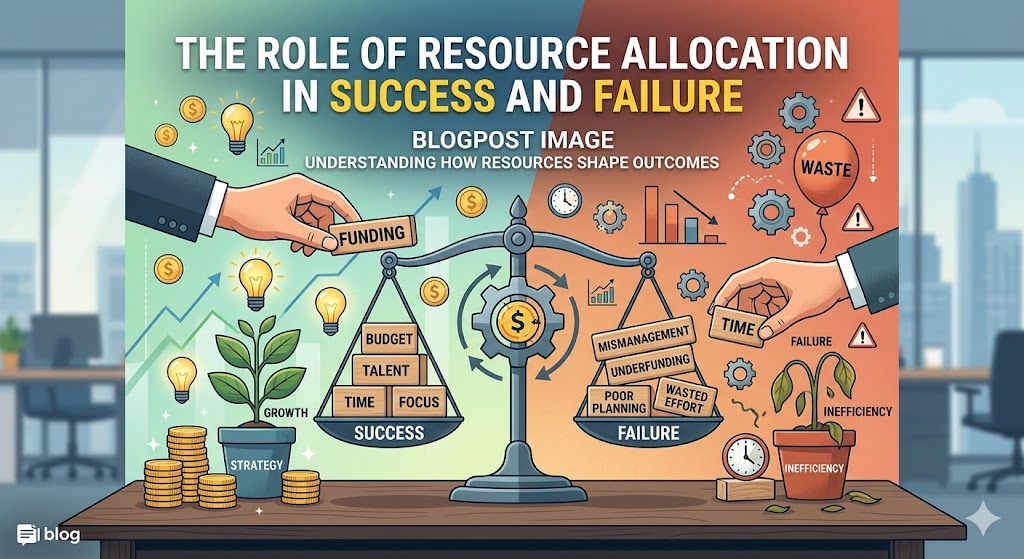
The Role of Resource Allocation in Success and Failure
Success and failure are rarely determined by talent alone. In business, finance, education, leadership, and even personal life, the way resources are allocated often matters more than how many resources exist. Two people can have the same income, the same number of hours in a day, and similar opportunities, yet one builds a stable future while the other struggles continuously. The difference is usually not luck. It is allocation.
Resource allocation simply means deciding where to put limited resources such as time, money, energy, attention, skills, and opportunities. Every person and organization operates under limitation. No one has unlimited cash, unlimited time, or unlimited focus. Because resources are finite, every choice automatically becomes a trade off. Saying yes to one thing means saying no to another. This is why allocation is so powerful. It quietly shapes outcomes long before results become visible.
In personal finance, resource allocation determines whether income becomes wealth or disappears into expenses. Many people focus on earning more money, but income alone does not create financial stability. A person earning a modest salary who allocates money toward savings, investments, emergency funds, and skill development may build long term security. Another person earning far more may spend most of it on lifestyle inflation, debt, and short term gratification. The first person is allocating resources toward future growth, while the second is allocating toward temporary consumption. Over time, the gap becomes enormous.
Time is another critical resource. Every day offers the same 24 hours to everyone, yet outcomes differ dramatically. People who consistently allocate time toward learning, planning, health, and productive work usually compound progress over years. Those who allocate most of their time to distraction, reactive tasks, and low value activities often feel busy without moving forward. Success is rarely about working nonstop. It is about directing time toward the highest value activities consistently.
Businesses rise or collapse based on allocation decisions. A company may have capital, talented employees, and market opportunities, but poor allocation can destroy it. Spending heavily on branding while neglecting product quality, hiring too quickly without systems, or expanding into too many markets at once can drain resources and create instability. On the other hand, companies that allocate capital carefully, invest in strong systems, focus on profitable customers, and prioritize long term sustainability often outperform competitors with larger budgets.
The same principle applies to governments and economies. Nations with abundant natural resources are not automatically prosperous. History shows many countries rich in oil, minerals, or land still struggle economically because resources are mismanaged or poorly allocated. Meanwhile, countries with limited natural resources sometimes achieve remarkable growth through investment in education, infrastructure, technology, and institutions. Resources themselves do not guarantee success. Their allocation does.
One of the biggest mistakes people make is confusing activity with effective allocation. Being busy is not the same as being productive. A student can spend ten hours studying inefficiently and achieve less than another student who spends four focused hours on the right material. A business owner can work all day responding to emails and meetings while neglecting strategy, customer acquisition, or product improvement. The question is not only “How much are you doing?” but “What are you allocating your effort toward?”
Attention is an underrated resource in the modern world. Social media, notifications, entertainment, and constant information compete for human focus every second. Companies spend billions trying to capture attention because attention influences behavior, spending, and decision making. When individuals allocate too much attention to distractions, they often underinvest in relationships, deep work, learning, and long term goals. Protecting attention is now a form of resource management.
Energy also matters. Not all hours are equal. Allocating demanding tasks to periods of high energy and simpler tasks to lower energy periods improves performance significantly. Many high performers succeed not because they work more hours, but because they manage energy intelligently. Burnout is often a sign of poor energy allocation rather than lack of ambition.
In leadership, resource allocation reveals priorities more clearly than words do. Organizations often claim that employees are their greatest asset, but if budgets, time, and attention are not allocated toward training, support, and healthy systems, the statement is empty. Families may say relationships matter most, but if almost no time is allocated to meaningful connection, the relationship weakens. Allocation exposes what is truly valued.
Poor resource allocation usually happens for predictable reasons. One reason is short term thinking. Humans naturally prefer immediate rewards over distant benefits. Spending money now feels more satisfying than investing for retirement decades away. Watching entertainment now feels easier than studying for a future opportunity. This bias toward the present can quietly undermine long term success.
Another reason is lack of clarity. People cannot allocate resources effectively without clear goals. If someone does not know what they are building, resources get scattered across too many directions. A business without a clear strategy wastes money on random marketing, unnecessary projects, and conflicting priorities. A person without defined goals may drift between interests without making meaningful progress in any area.
Emotions also distort allocation. Fear can cause people to avoid investing, taking calculated risks, or pursuing opportunities. Pride can push people to spend beyond their means to impress others. Anxiety can lead to hoarding resources unproductively, while overconfidence can lead to reckless expansion or spending. Effective allocation requires emotional discipline as much as analytical thinking.
Successful people and organizations tend to follow a few consistent allocation principles. First, they prioritize high impact activities. They identify the small number of actions that produce the biggest results and direct disproportionate resources there. In business, this may mean focusing on the most profitable customers or products. In personal development, it may mean mastering one valuable skill deeply instead of chasing many shallow interests.
Second, they think long term. Good allocation often feels uncomfortable in the short term because it involves sacrifice. Saving money reduces current consumption. Investing in education takes time before results appear. Building systems and habits can feel slower than chasing quick wins. But long term allocation creates compounding benefits that become powerful over time.
Third, they maintain flexibility. Resource allocation is not a one time decision. Circumstances change, markets evolve, and new information appears. Successful organizations regularly review where resources are going and adjust when necessary. Individuals should do the same with budgets, schedules, goals, and commitments.
Compounding is one of the most important effects of good allocation. Small, consistent investments of resources can produce disproportionately large outcomes over time. Saving a small amount monthly, reading regularly, exercising consistently, or improving a skill gradually may seem insignificant day to day. But over years, these allocations compound into financial security, knowledge, health, and opportunity. Conversely, small daily misallocations such as unnecessary spending, wasted time, and neglected health also compound negatively.
Failure often looks sudden from the outside, but it is usually the result of repeated poor allocation over time. A company collapses after years of inefficient spending and strategic drift. A person faces financial crisis after years of living beyond their means. A relationship breaks down after years of neglecting communication and time together. The visible failure is only the final stage of a long process of misallocation.
There is also an opportunity cost to every decision. When resources are allocated poorly, the loss is not only what was wasted. It is also what could have been built instead. Money spent impulsively is money that could have been invested. Time lost to distraction is time that could have developed a skill or strengthened a relationship. Energy spent on unnecessary conflict is energy unavailable for growth. Opportunity cost is invisible, which is why people often underestimate it.
Technology and modern life have made allocation both easier and harder. Tools for budgeting, learning, investing, and productivity are more accessible than ever. At the same time, distractions and choices have multiplied. The challenge today is not lack of opportunity but deciding where to direct limited resources amid endless options.
One practical way to improve allocation is to regularly audit your resources. Ask yourself where your money went this month, where your time went this week, what consumed most of your attention today, and whether those allocations moved you closer to your goals. This simple reflection can reveal surprising patterns. Many people discover they are unconsciously funding and feeding the very habits that hold them back.
Another useful approach is the principle of intentionality. Instead of letting circumstances decide where resources go, decide in advance. Create a budget before spending. Plan your day before distractions appear. Schedule important relationships, learning, and health activities instead of hoping they happen automatically. Intentional allocation reduces the power of impulse and chaos.
Ultimately, the role of resource allocation in success and failure is fundamental because resources shape capability. Talent without directed effort achieves little. Opportunity without preparation is wasted. Money without discipline disappears. Time without focus evaporates. Success is not merely about having resources. It is about directing them wisely toward meaningful, high value outcomes over a sustained period.
The people and organizations that thrive are usually not those with unlimited resources. They are the ones who understand that every resource is precious, every decision has a trade off, and consistent intelligent allocation compounds into extraordinary results. Failure, in many cases, is simply the long term consequence of allocating resources carelessly.

EarnSmartOnline.com.ng is dedicated to helping readers make smarter financial decisions through practical guides on online income, personal finance, technology, digital business, and wealth creation. Our goal is to provide reliable, easy-to-understand, and actionable content that empowers individuals to earn smarter, build sustainable income streams and achieve long-term financial success.
Recommended: Start Earning Online
- Ultimate Affiliate Marketing Program — learn affiliate marketing with a done-for-you sales system ($15). Check it out
- The Newbie Affiliate Guide — the beginner-friendly starter guide (~$6.68). Check it out
- Easy Dollar Maker — earn in dollars uploading AI images and videos from your phone ($17). Check it out
Disclosure: These are affiliate links. If you buy through them, I may earn a commission at no extra cost to you.



