
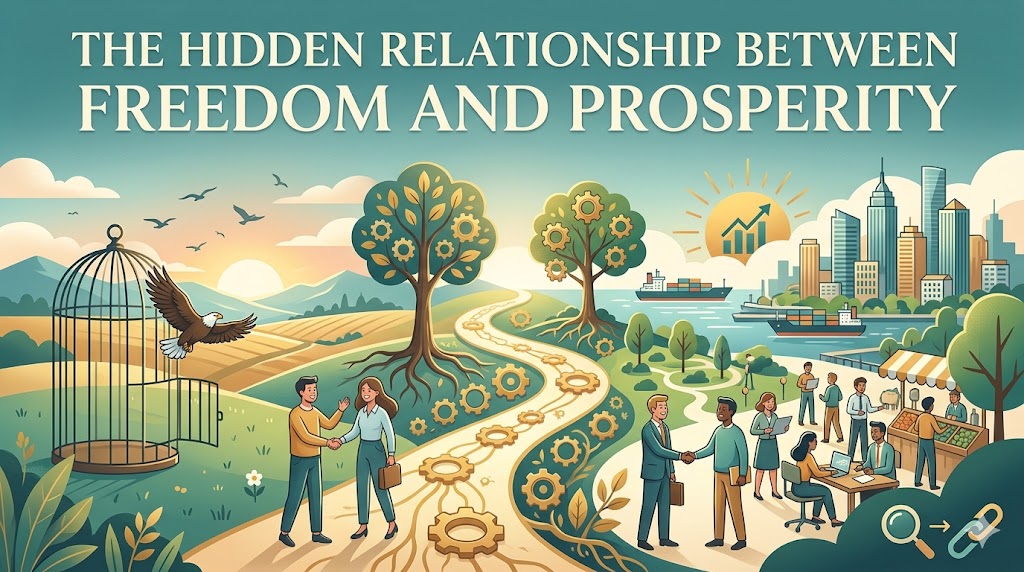
The Hidden Relationship Between Freedom and Prosperity
Most people think prosperity is mainly about money, income level, or access to resources. Freedom is often treated as a separate subject, something political or personal that has little connection to financial outcomes. But in reality, freedom and prosperity are deeply intertwined in a way that quietly shapes everything from individual success to national development. The more you understand this relationship, the clearer it becomes why some people, communities, and even countries consistently rise while others remain stuck in cycles of limitation.
At its core, prosperity is not just the presence of money. It is the ability to make choices without constant constraint. Freedom, in this sense, is not only about political systems or legal rights. It is about practical autonomy: the ability to decide how to use your time, how to deploy your skills, where to focus your energy, and what opportunities to pursue without unnecessary restriction. When this type of freedom increases, prosperity tends to follow. When it is restricted, prosperity shrinks even when income appears stable on the surface.
One of the most overlooked aspects of this relationship is that economic prosperity is built on decision space. Decision space simply means how many meaningful choices a person or group can realistically make at any given time. A person who is financially, socially, or mentally constrained has fewer options. They are forced into repetitive patterns that prioritize survival over growth. On the other hand, someone with more freedom has more room to experiment, fail, adjust, and eventually discover better outcomes. Prosperity grows in environments where decision space is wide and flexible.
This is why environments that support freedom tend to produce innovation. Innovation does not happen under extreme restriction because creativity requires room to explore. When individuals are not overly controlled by fear, debt pressure, or rigid systems, they begin to think differently. They take risks that others avoid. They invest time in learning new skills instead of only reacting to immediate pressure. Over time, this creates breakthroughs that generate wealth not just for individuals but for entire systems.
At the personal level, financial prosperity is strongly linked to how much control a person has over their time. Time is the most direct form of freedom. People who are trapped in survival cycles often trade all their time for immediate income. This limits their ability to build assets, develop high value skills, or explore alternative income streams. Meanwhile, those with greater time freedom can invest in long term thinking. They can delay gratification long enough to build structures that eventually produce passive or scalable income. The difference between these two groups is not just effort, but the degree of freedom they possess in how they use their time.
There is also a psychological dimension to this relationship. When people feel free, they tend to think more expansively. They are more willing to take initiative, engage in problem solving, and pursue long term goals. When people feel trapped, their thinking becomes reactive. They focus on immediate threats and short term survival. This shift in mindset directly affects financial outcomes because prosperity is often the result of long term strategic thinking rather than short term reactions.
Freedom also plays a major role in how people interact with opportunity. Opportunities are not evenly distributed, but access to them often depends on mobility, information, and networks. A person with greater freedom is more likely to move into environments where opportunities exist. They are more likely to meet people who can open doors for them. They are also more likely to access information that changes their perspective on what is possible. Without freedom of movement and exposure, many opportunities remain invisible even if they technically exist.
On a broader scale, economies that allow freedom of enterprise tend to generate more wealth over time. This is not because freedom automatically creates success, but because it allows competition, experimentation, and adaptation. When people are free to start businesses, innovate, and respond to market signals, resources get allocated more efficiently. Inefficiency decreases, productivity increases, and wealth begins to accumulate across different layers of society. In contrast, systems that heavily restrict economic freedom often experience slower innovation and reduced long term prosperity.
However, freedom alone is not enough. It must be paired with responsibility and discipline. Without structure, freedom can be wasted. People can have freedom of choice but still make decisions that lead to instability. This is why prosperity is not just about having freedom, but about knowing how to use it effectively. The most successful individuals and societies are those that combine freedom with strong internal discipline. They use freedom as a tool for building, not as an excuse for indulgence.
Another important aspect of this relationship is that prosperity tends to expand freedom in return. This creates a feedback loop. When people become more prosperous, they gain more options. They can choose better work, better environments, better investments, and better lifestyles. These new choices then create even more opportunities for growth. Over time, this cycle compounds, leading to exponential improvements in both freedom and prosperity. The reverse is also true. When prosperity declines, freedom shrinks, leading to fewer options and more dependence.
This feedback loop explains why escaping poverty is often more difficult than it appears. Poverty is not just a lack of money. It is a restriction of choices. When choices are limited, it becomes harder to take the kinds of risks that lead to upward mobility. This is why early stages of financial improvement often feel slow. The individual is still operating within a narrow decision space. Only after enough progress is made does the cycle begin to shift in a more favorable direction.
Technology has added a new dimension to this relationship. In the modern world, digital tools have significantly expanded certain types of freedom, especially access to information and global markets. A person with a smartphone can now learn skills, build businesses, and reach customers in ways that were previously impossible. This increase in informational freedom has created new pathways to prosperity, especially for those who know how to use it effectively. However, it has also created distractions that can reduce productivity, showing that freedom must still be directed with intention.
Education is another critical link between freedom and prosperity. Real education does not just transfer knowledge; it expands decision making ability. A well educated person has more tools to interpret situations, evaluate risks, and identify opportunities. This effectively increases their freedom because they are less dependent on others for guidance. They can navigate complexity with more confidence, which increases their ability to generate prosperity in different environments.
It is also important to recognize that not all forms of freedom produce prosperity equally. Some forms of freedom are external, such as political rights or economic systems, while others are internal, such as self control, emotional discipline, and mental clarity. Internal freedom is often more important for personal prosperity because it determines how external freedom is used. A person who is internally disciplined can turn limited external resources into meaningful outcomes, while someone without internal control may waste even abundant opportunities.
Ultimately, the relationship between freedom and prosperity is not linear but dynamic. They influence each other continuously. Freedom creates the conditions for prosperity, and prosperity expands the boundaries of freedom. When both are present and balanced, growth becomes sustainable. When either is missing, progress becomes unstable or temporary.
Understanding this relationship changes how you interpret success. It shifts the focus away from just earning money and toward building environments, habits, and systems that increase real autonomy. It also highlights why some people remain stuck even when they appear busy or hardworking. Without increasing their freedom in meaningful ways, their prosperity cannot expand beyond a certain point.
In the end, prosperity is not simply something you chase. It is something that emerges when freedom is properly structured, protected, and directed toward value creation. The more intentional you become about expanding your freedom in the right areas, the more naturally prosperity begins to grow as a result.

EarnSmartOnline.com.ng is dedicated to helping readers make smarter financial decisions through practical guides on online income, personal finance, technology, digital business, and wealth creation. Our goal is to provide reliable, easy-to-understand, and actionable content that empowers individuals to earn smarter, build sustainable income streams and achieve long-term financial success.
Recommended: Start Earning Online
- Ultimate Affiliate Marketing Program — learn affiliate marketing with a done-for-you sales system ($15). Check it out
- The Newbie Affiliate Guide — the beginner-friendly starter guide (~$6.68). Check it out
- Easy Dollar Maker — earn in dollars uploading AI images and videos from your phone ($17). Check it out
Disclosure: These are affiliate links. If you buy through them, I may earn a commission at no extra cost to you.



