
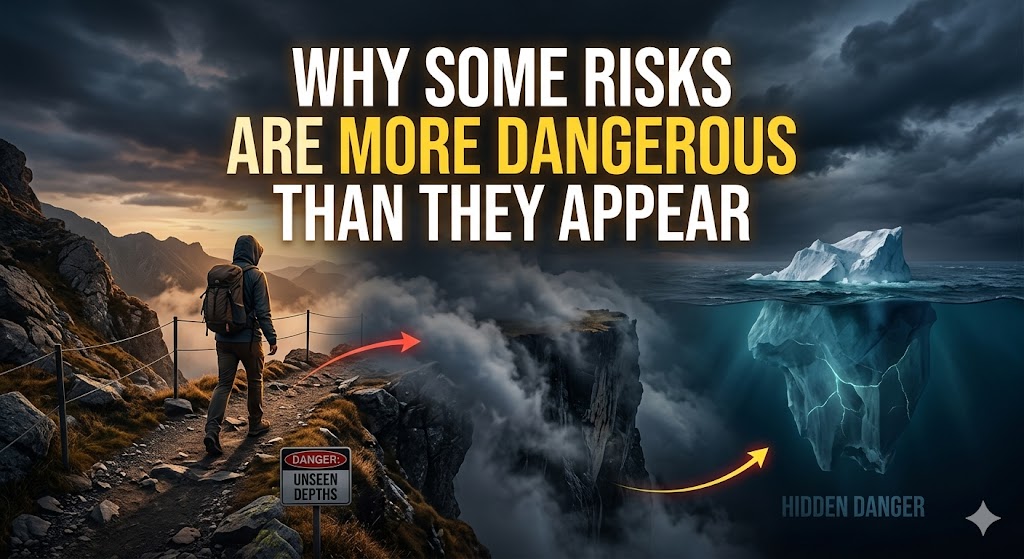
Why Some Risks Are More Dangerous Than They Appear
Most people think risk is something obvious. It looks loud, dramatic, and easy to recognize. But in reality, the most dangerous risks are often quiet. They do not announce themselves. They feel normal, even comfortable, which is exactly why they are so powerful. A truly dangerous risk is not always the one that scares you at first glance. It is the one you accept repeatedly without questioning its long term cost. That is where most people get trapped without even realizing it.
One of the biggest misunderstandings about risk is that people focus too much on immediate outcomes. If something does not cause instant loss, it is often considered safe. But risk does not always operate on a short timeline. Some risks grow slowly, compound silently, and only reveal their full impact after years. By the time the damage becomes visible, it is usually too late to reverse. This delayed reaction is what makes certain risks far more dangerous than they appear in the moment.
Take financial habits for example. Spending a little more than you earn does not feel dangerous in a single month. In fact, it often feels harmless because life continues normally. But over time, that small imbalance becomes debt, stress, and dependency. The danger was never in the single decision. It was in the repetition. This is how many people unknowingly build long term instability while believing they are managing fine.
Another overlooked category of hidden risk is comfort. Comfort feels safe, so people rarely question it. Staying in the same job for years, avoiding learning new skills, or refusing to adapt to new systems can feel like stability. But in a changing world, comfort can quietly turn into vulnerability. When external conditions shift, those who stayed too comfortable often discover that what felt safe was actually slowly reducing their options. The danger was not visible because nothing seemed to be going wrong in the short term.
Social influence also creates hidden risks. People tend to underestimate how much their environment shapes their decisions. If everyone around you normalizes poor financial behavior, emotional instability, or lack of ambition, those patterns start to feel normal. The risk is not in a single decision but in continuous exposure. Over time, your standards adjust downward without resistance. What makes this dangerous is that it does not feel like decline while it is happening.
There are also risks that come from overconfidence. When people succeed a few times, they often begin to assume they understand more than they actually do. This creates blind spots. They start taking larger risks without increasing their awareness or preparation. The danger here is not failure itself, but the illusion of control. The more confident someone becomes without proper grounding, the more likely they are to misjudge reality. And misjudging reality is one of the most expensive mistakes a person can make.
Another subtle but powerful risk is delayed consequence behavior. This happens when people prioritize immediate relief or pleasure while ignoring long term effects. It can appear in health choices, spending habits, relationships, or career decisions. The pattern is always the same. The short term reward feels small and harmless, but the long term consequence accumulates silently. Because the impact is delayed, the brain struggles to connect cause and effect. That disconnect is what makes the risk dangerous.
Technology has also introduced new forms of hidden risk. Constant distraction, for example, does not feel harmful in the moment. Checking your phone, switching attention, or consuming endless content feels like a normal part of daily life. But over time, it reduces focus, weakens deep thinking, and fragments productivity. The danger is not in any single distraction but in the long term erosion of attention. Attention is one of the most important resources for success, yet it is often traded away without realizing its value.
One of the most misunderstood risks is the risk of inactivity. Many people assume risk only comes from action, but in reality, doing nothing can be just as dangerous. Not learning, not investing time in growth, not adapting to change, or not making decisions creates a different type of exposure. Life does not stay still. When you remain inactive, everything around you continues to move forward while you stay in place. Over time, this creates a gap that becomes harder to close.
A similar hidden danger exists in procrastination. People often treat it as a harmless delay, but procrastination compounds. The longer you delay important actions, the more pressure builds, the fewer options remain, and the harder decisions become. What starts as avoidance eventually turns into crisis management. The risk is not the delay itself but the accumulation of consequences that follow it.
Relationships also carry hidden risks that are not immediately visible. Small patterns of disrespect, lack of communication, or emotional neglect may not seem serious at first. But relationships are built on accumulation. Over time, unresolved issues compound into distance and resentment. Because the breakdown is gradual, people often fail to notice when things start changing until the connection is already damaged.
Another category of underestimated risk is dependence. Depending too heavily on one source of income, one skill, one person, or one opportunity creates vulnerability. At first, it feels efficient and stable. But if that single point fails, the impact is immediate and severe. The danger lies in the lack of backup, not in the presence of the dependency itself. The stronger the reliance on one thing, the more fragile the system becomes.
Even success itself can become a hidden risk. When people achieve a certain level of comfort or recognition, they may stop evolving. They assume past success guarantees future stability. But environments change, industries evolve, and expectations shift. What worked before may not work again. The danger is stagnation disguised as achievement. Without continuous adaptation, success slowly loses its foundation.
Psychological risks are often the most invisible of all. Fear of failure, fear of judgment, or fear of change can quietly influence decisions for years. People rarely notice how much their choices are shaped by avoidance rather than intention. Over time, this leads to a life that feels safe but limited. The risk is not in taking action, but in allowing fear to quietly make decisions on your behalf.
Another subtle but powerful risk is normalization of stress. Many people become so used to pressure that they stop recognizing it as harmful. Chronic stress becomes part of daily life. Because it does not always cause immediate breakdown, it is often ignored. But over time, it affects health, clarity, and decision making. The danger is not the intensity of stress but its persistence.
What makes all these risks dangerous is not their size, but their invisibility in the moment of decision. Humans are naturally wired to respond to immediate threats, not slow developing ones. That is why the most harmful risks are often the ones that feel normal, routine, or even comfortable. They bypass attention because they do not trigger alarm signals.
Understanding this changes how you evaluate decisions. Instead of asking whether something feels safe today, a better question is what this behavior looks like if repeated for years. That shift in thinking exposes risks that are otherwise hidden. It forces you to consider accumulation, not just immediate impact.
In the end, the most dangerous risks are not the ones that explode quickly. They are the ones that blend into daily life and slowly shape outcomes without resistance. The real challenge is not avoiding risk entirely, but learning to recognize the silent ones before they compound into irreversible consequences.

EarnSmartOnline.com.ng is dedicated to helping readers make smarter financial decisions through practical guides on online income, personal finance, technology, digital business, and wealth creation. Our goal is to provide reliable, easy-to-understand, and actionable content that empowers individuals to earn smarter, build sustainable income streams and achieve long-term financial success.
Recommended: Start Earning Online
- Ultimate Affiliate Marketing Program — learn affiliate marketing with a done-for-you sales system ($15). Check it out
- The Newbie Affiliate Guide — the beginner-friendly starter guide (~$6.68). Check it out
- Easy Dollar Maker — earn in dollars uploading AI images and videos from your phone ($17). Check it out
Disclosure: These are affiliate links. If you buy through them, I may earn a commission at no extra cost to you.



