
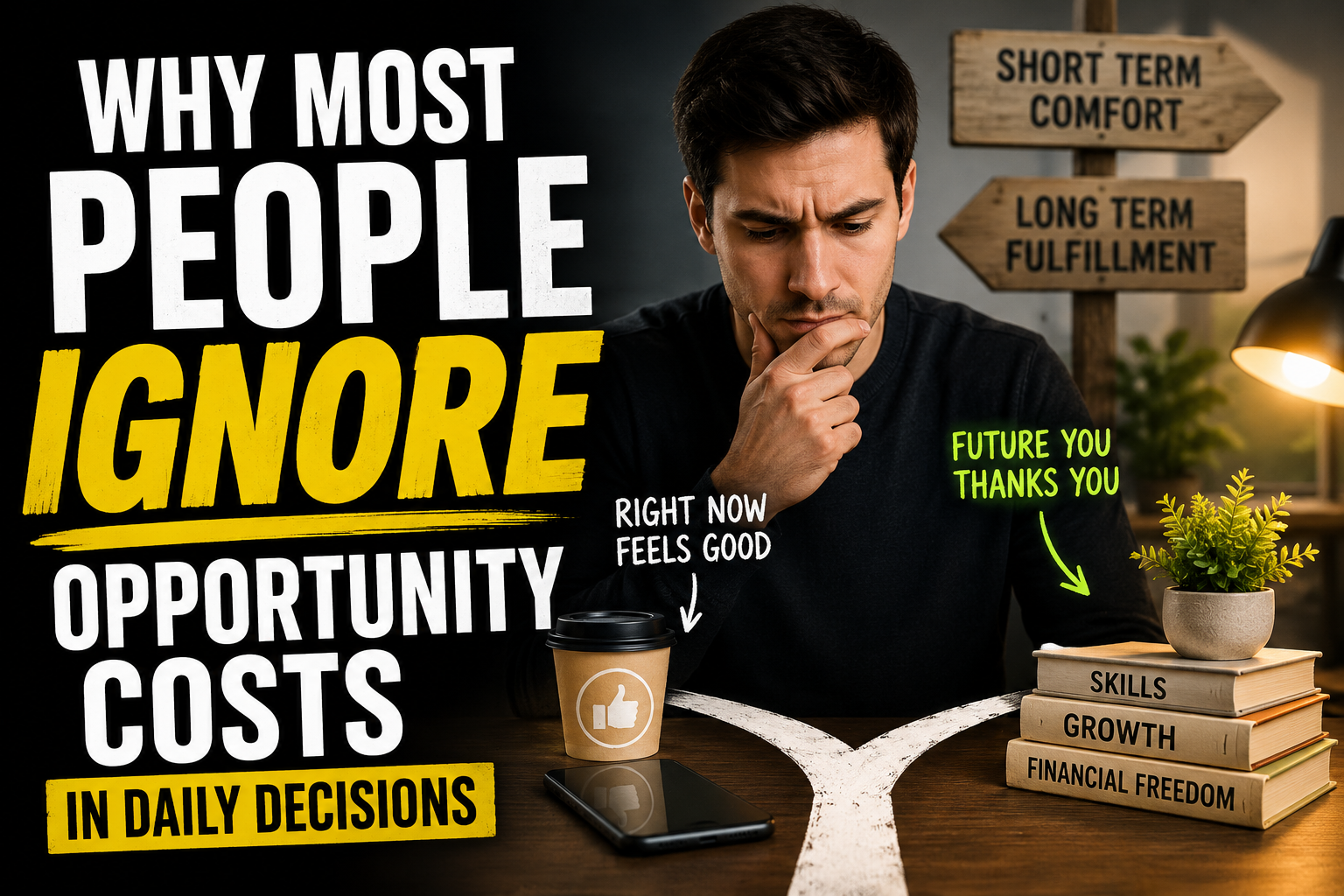
Why Most People Ignore Opportunity Costs in Daily Decisions
Most people go through life making decisions as if every choice exists in isolation. They decide what to buy, how to spend their time, where to focus their energy, and what to ignore, without fully considering what they are giving up in the process. This invisible trade off is known as opportunity cost, and it quietly shapes financial outcomes, career growth, relationships, and even long term happiness. Yet despite how powerful it is, most people barely think about it in their daily decisions. The result is a lifetime of small inefficiencies that accumulate into major limitations.
Opportunity cost is not always obvious because it does not show up as a direct expense. When someone spends money, they see the price of the item, not what that money could have become if it were used differently. When someone spends time, they see the activity they are engaged in, not the future progress they sacrificed. This blindness makes opportunity cost one of the most underestimated forces in human behavior. People focus on what is gained immediately and ignore what is quietly lost over time.
One major reason people ignore opportunity costs is because human brains are wired for immediate gratification. The mind is naturally drawn to what feels rewarding now rather than what may produce greater value later. This is why small pleasures often win over long term investments in time, money, or effort. Choosing to relax instead of learning a skill feels harmless in the moment, but the hidden cost is the compounding advantage that skill could have created over months or years. The brain does not automatically calculate these long range consequences, so people repeatedly choose comfort over strategic growth.
Another reason is that opportunity cost requires abstract thinking, and abstract thinking is mentally demanding. It is easier to evaluate what is visible than what is invisible. When someone is deciding whether to spend money on a luxury item, they can see the item, imagine using it, and feel the emotional reward. What they cannot easily see is the investment account that money could have built or the financial buffer it could have created. Because the alternative is not physically present, it is mentally discounted. This imbalance leads to consistently poor trade offs.
Social influence also plays a powerful role in distorting opportunity cost awareness. People often make decisions based on what others around them are doing rather than what is economically or personally optimal. If everyone in a social circle is spending on lifestyle upgrades, travel, or entertainment, it becomes harder to consider the hidden cost of not investing that money elsewhere. Social validation feels more immediate than long term financial security, so the opportunity cost gets ignored in favor of belonging and acceptance. Over time, this creates a cycle where entire groups reinforce the same inefficient patterns.
Another factor is the lack of financial and decision making education in early life. Most people are not taught to evaluate choices in terms of trade offs. They are taught to focus on affordability rather than long term impact. This creates a mindset where the only question asked is whether something can be paid for, not whether it is the best use of resources. Without training in thinking about alternatives, opportunity cost remains invisible even in adulthood. People grow older but never upgrade their decision making framework.
Time is the most frequently ignored form of opportunity cost, and also the most valuable. Every hour spent on low value activities is an hour that cannot be recovered or redirected. Yet many people treat time as if it is abundant and interchangeable. Scrolling through social media, engaging in unproductive conversations, or repeatedly delaying important tasks may seem insignificant individually, but collectively they represent a massive loss of potential growth. The opportunity cost of time mismanagement is often far greater than the cost of poor financial spending, because time directly controls skill development, income growth, and personal evolution.
Emotional decision making further weakens awareness of opportunity costs. People often make choices based on how they feel in the moment rather than what the decision means in the broader context of their life. Stress, excitement, boredom, and frustration can all distort judgment. For example, emotional spending is rarely about the value of the item itself but about temporarily changing a mood. The opportunity cost in this case is not just the money spent but the delayed financial stability that money could have supported. Emotional relief today often becomes financial pressure tomorrow.
Another overlooked dimension is the habit of underestimating long term compounding effects. Opportunity cost becomes most powerful when compounded over time. A small decision repeated daily can lead to dramatically different life outcomes. Choosing not to read, not to invest, not to practice, or not to plan may seem harmless in isolation, but over years it creates a significant gap between those who make slightly better choices and those who do not. The problem is that most people evaluate decisions in isolation rather than as part of a long sequence. This prevents them from seeing how small trade offs accumulate into major differences.
Modern environments also contribute to the neglect of opportunity cost. With constant access to entertainment, instant purchases, and endless distractions, people are exposed to continuous short term alternatives. Every moment presents multiple competing choices that all feel equally urgent. In such an environment, long term thinking is constantly interrupted. The easier option is usually chosen because it requires less mental effort. Over time, this creates a lifestyle built around convenience rather than optimization, where opportunity cost is rarely consciously considered.
Ultimately, ignoring opportunity costs is not just a financial issue but a life design issue. It affects career progress, relationships, personal development, and even mental well being. People who consistently fail to evaluate what they are giving up tend to stay stuck in cycles of effort without progress. On the other hand, those who learn to recognize opportunity cost begin to make more intentional decisions. They start asking not just what they gain from a choice, but what they lose by not choosing something else. This shift in thinking transforms decision making from reactive to strategic.
Understanding opportunity cost does not require perfection, but it does require awareness. Once people begin to recognize that every decision has an invisible trade off, their behavior naturally becomes more deliberate. Spending becomes more thoughtful, time becomes more valuable, and priorities become clearer. Over time, this awareness leads to better outcomes not because people make more effort, but because they waste less of what already matters.
In the end, the reason most people ignore opportunity costs is not because it is complex, but because it is invisible and uncomfortable. It forces people to confront the reality that every yes is also a no, and every choice comes with a hidden price. But once this idea is understood deeply, it becomes one of the most powerful tools for improving life outcomes. The quality of decisions improves not by increasing resources, but by understanding what each decision truly costs.

EarnSmartOnline.com.ng is dedicated to helping readers make smarter financial decisions through practical guides on online income, personal finance, technology, digital business, and wealth creation. Our goal is to provide reliable, easy-to-understand, and actionable content that empowers individuals to earn smarter, build sustainable income streams and achieve long-term financial success.
Recommended: Start Earning Online
- Ultimate Affiliate Marketing Program — learn affiliate marketing with a done-for-you sales system ($15). Check it out
- The Newbie Affiliate Guide — the beginner-friendly starter guide (~$6.68). Check it out
- Easy Dollar Maker — earn in dollars uploading AI images and videos from your phone ($17). Check it out
Disclosure: These are affiliate links. If you buy through them, I may earn a commission at no extra cost to you.



