
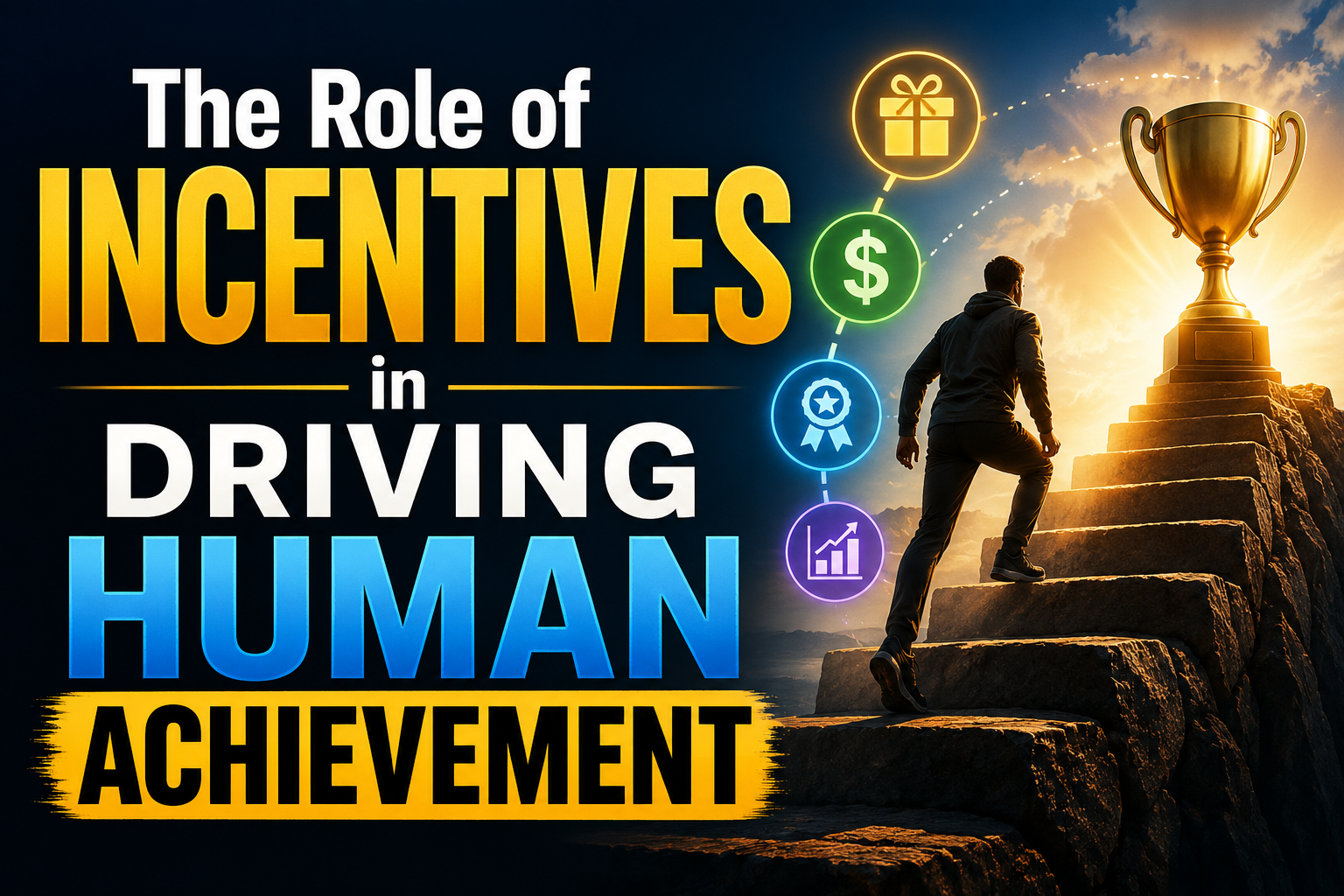
The Role of Incentives in Driving Human Achievement
Human achievement does not happen in isolation or by accident. It is shaped by a constant system of motivations, rewards, and consequences that guide how people think, decide, and act. At the center of this system are incentives, the often invisible forces that determine what individuals choose to pursue and how much effort they are willing to invest. Incentives are not limited to money or material gain. They include recognition, security, freedom, status, emotional satisfaction, and even avoidance of pain or failure. Every major advancement in human history, from personal success stories to global innovation, can be traced back to some form of incentive structure influencing behavior.
At a basic level, incentives function as psychological triggers. People are naturally inclined to move toward what they perceive as rewarding and away from what they perceive as harmful or costly. This simple mechanism explains much of human behavior in everyday life. A student studies harder when good grades are tied to scholarships or future opportunities. An employee performs better when promotions or bonuses are within reach. A business owner innovates when competition threatens market share. In each case, the incentive does not force action directly, but it reshapes perception so that effort feels worthwhile.
What makes incentives so powerful is that they operate both consciously and subconsciously. While individuals may believe they are making fully independent decisions, their choices are often influenced by underlying reward structures they may not fully recognize. For example, social approval can drive people to pursue careers, lifestyles, or achievements that align more with external validation than internal passion. Similarly, fear of failure can push individuals to work harder or avoid risks altogether. These hidden incentives can be just as influential as financial ones, if not more so in certain environments.
Economic systems are built almost entirely on incentives. Markets reward productivity, innovation, and efficiency by offering financial returns. When a product or service solves a real problem, the incentive of profit encourages more people to replicate or improve that solution. This creates a cycle of continuous improvement where individuals and organizations compete to deliver greater value. Without such incentives, there would be little motivation to innovate or improve, and progress would slow significantly. The rise of modern technology, for instance, is deeply tied to the incentive of capturing market demand and gaining financial advantage.
However, incentives do not always produce positive outcomes. Poorly designed or misunderstood incentive structures can lead to unintended consequences. When short term rewards are prioritized over long term value, individuals and organizations may engage in behaviors that appear successful on the surface but are ultimately harmful. This is visible in situations where people chase quick profits without considering sustainability, or when workers prioritize speed over quality because only output quantity is rewarded. In such cases, the incentive system is still effective, but it is directing effort in the wrong direction.
Understanding incentives also explains differences in performance among individuals who may have similar levels of talent or opportunity. Two people with equal intelligence and resources can achieve vastly different results depending on the incentives shaping their environment. One may be driven by internal goals such as mastery and independence, while the other may be influenced by external pressures such as competition or financial necessity. The stronger and clearer the incentive, the more consistent the behavior tends to be. This is why structured environments often produce more predictable outcomes than unstructured ones.
Human behavior is highly adaptive, which means people constantly adjust their actions in response to changing incentives. When incentives shift, behavior follows. If effort is rewarded, people tend to work harder. If effort is ignored or unrewarded, motivation declines. This adaptability is what allows societies, organizations, and individuals to evolve over time. It also explains why reforms or changes in systems often require careful redesign of incentive structures rather than simple instructions or motivational speeches. Without aligning incentives, even the best ideas struggle to gain traction.
Education systems provide a clear example of how incentives influence achievement. Students often focus their energy on subjects, tasks, or exams that are most heavily weighted in grading systems. If memorization is rewarded more than critical thinking, students will prioritize memorization. If creativity is rewarded, students will develop more innovative approaches. The behavior of learners reflects the incentive design of the system they are in. This demonstrates that achievement is not only a function of ability but also of how success is defined and rewarded.
In professional environments, incentives determine productivity, innovation, and job satisfaction. Employees are more likely to excel when their contributions are recognized and rewarded fairly. However, incentives are not always financial. Autonomy, respect, career growth, and meaningful work also serve as powerful motivators. In fact, many studies of workplace behavior suggest that intrinsic incentives, such as personal fulfillment and purpose, can be more sustainable than external rewards alone. When individuals feel that their work matters, they are more likely to stay committed even in the absence of immediate financial gain.
On a personal level, incentives shape habits and long term outcomes. People who successfully build positive habits often structure their environment in a way that rewards consistency. For example, someone trying to improve fitness may track progress visually, creating a sense of achievement that reinforces behavior. Similarly, someone trying to save money may use systems that make spending feel less convenient or saving feel more rewarding. These small adjustments in incentive design can lead to significant long term transformation.
One of the most overlooked aspects of incentives is their role in shaping identity. Over time, repeated behaviors reinforced by consistent incentives become part of how individuals see themselves. A person who is rewarded for discipline begins to identify as disciplined. A person who is rewarded for creativity begins to see themselves as creative. This identity reinforcement further strengthens behavior, creating a cycle where incentives and self perception continuously influence each other. This is why changing long term behavior often requires changing the underlying incentive environment first.
Incentives also play a major role in social behavior. Communities develop shared norms based on what is rewarded or punished within the group. When honesty is rewarded, trust becomes a defining feature of the community. When manipulation is rewarded, distrust becomes more common. Over time, these patterns shape the culture of entire societies. This shows that incentives are not just personal or economic tools but also cultural forces that influence how people interact on a larger scale.
The challenge with incentives is that they are often misunderstood or oversimplified. Many people assume that motivation alone is enough to drive achievement. However, motivation without structure is inconsistent. Incentives provide that structure by making desired behavior more likely and sustainable. They reduce reliance on willpower by aligning outcomes with action. When incentives are properly designed, achievement becomes a natural result of behavior rather than a constant struggle.
Ultimately, human achievement is not just about talent, effort, or opportunity. It is about how these elements interact with the incentive systems that surround them. The right incentives can unlock potential, drive innovation, and sustain long term progress. The wrong incentives can suppress growth, encourage inefficiency, and distort behavior. Understanding this dynamic is essential for anyone seeking to improve themselves, build successful systems, or influence meaningful change in the world.
When individuals learn to recognize and design incentives in their own lives, they gain a powerful advantage. They begin to see why they act the way they do and how to redirect their behavior toward more productive outcomes. Instead of fighting against lack of motivation, they create environments where the desired actions become the easiest and most rewarding choices. This shift in perspective transforms not only personal achievement but also the ability to contribute effectively in any field or endeavor.
Incentives, though often invisible, are one of the most fundamental drivers of human progress. They shape decisions, guide effort, and determine outcomes across every level of life. From individual habits to global systems, nothing escapes their influence. To understand incentives is to understand the hidden architecture behind human achievement itself.

EarnSmartOnline.com.ng is dedicated to helping readers make smarter financial decisions through practical guides on online income, personal finance, technology, digital business, and wealth creation. Our goal is to provide reliable, easy-to-understand, and actionable content that empowers individuals to earn smarter, build sustainable income streams and achieve long-term financial success.
Recommended: Start Earning Online
- Ultimate Affiliate Marketing Program — learn affiliate marketing with a done-for-you sales system ($15). Check it out
- The Newbie Affiliate Guide — the beginner-friendly starter guide (~$6.68). Check it out
- Easy Dollar Maker — earn in dollars uploading AI images and videos from your phone ($17). Check it out
Disclosure: These are affiliate links. If you buy through them, I may earn a commission at no extra cost to you.



