
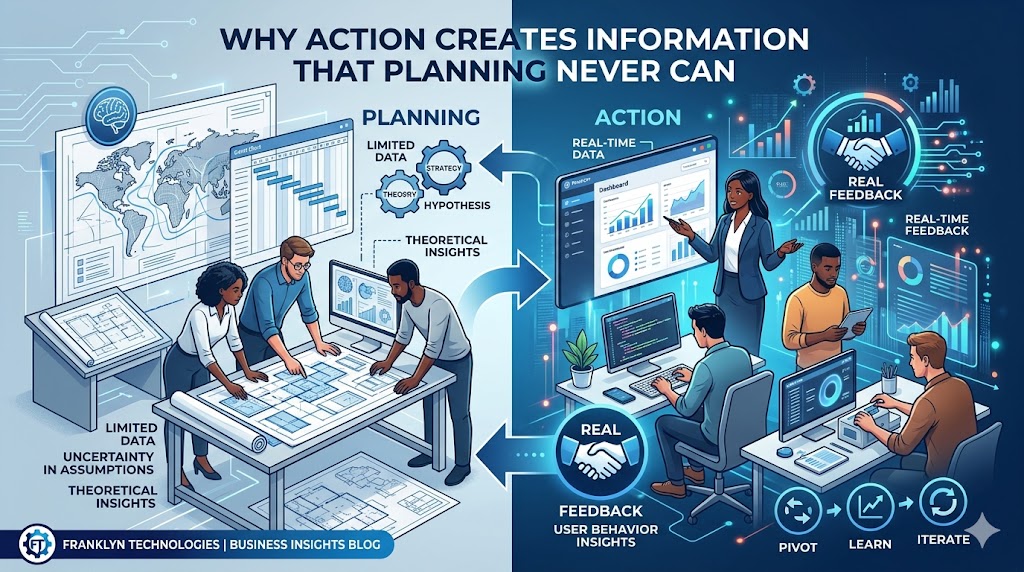
Why Action Creates Information That Planning Never Can
Most people believe that thinking longer leads to better outcomes. It feels safe to plan, to analyze, to prepare endlessly before taking a step. Planning gives the illusion of control. It makes you feel like you are reducing risk by gathering more information in your head before doing anything. But life rarely rewards the most prepared mind. Instead, life responds to movement. The truth is simple but uncomfortable. Action creates information that planning never can.
When you sit down to plan, you are working with assumptions. You are predicting outcomes based on limited knowledge, past experiences, and mental simulations. No matter how intelligent or careful you are, your mind cannot fully replicate reality. There are always variables you cannot foresee. People behave differently than expected. Markets shift. Emotions change. Timing affects everything. Planning tries to compress all of this complexity into a mental model, but the model is always incomplete.
Action changes everything because it introduces reality into the equation. The moment you act, you are no longer guessing. You are collecting feedback from the real world. That feedback is information. It tells you what works, what fails, what needs adjustment, and what is completely wrong. This is the kind of knowledge no amount of thinking can produce. You cannot think your way into accurate feedback. You must interact with reality to receive it.
This is why people who over plan often stay stuck. They confuse preparation with progress. They believe they are moving forward because their mind is active, but in reality, they are standing still. Planning without action creates a loop where the only input is more thought. The mind begins to recycle its own ideas, reinforcing fear and uncertainty instead of reducing it. The longer this continues, the harder it becomes to start, because imagination begins to exaggerate risk.
Action breaks that loop. Even small action is powerful because it generates real data. When you try something, you immediately learn something new about yourself and your environment. You discover whether your assumptions were correct or incorrect. You see what actually happens instead of what you imagined would happen. This shift from imagination to experience is where true learning begins.
One of the most important truths about success is that clarity does not come before action. It comes after action. Many people wait for clarity before they begin, but clarity is a product of engagement, not a requirement for it. You do not think your way into clarity. You act your way into it. Each step you take refines your understanding. Each mistake removes another layer of confusion. Each attempt reveals a more accurate picture of reality.
This is why early attempts at anything often feel messy. You are not supposed to have full understanding at the beginning. You are supposed to gather it. Action functions like a filter that separates what you believe from what is actually true. Without action, your beliefs remain untested. With action, they are either confirmed or corrected.
Planning is still useful, but only within limits. It helps you set direction, define intent, and organize your thoughts. However, planning becomes dangerous when it replaces action. At that point, it stops being a tool and becomes a hiding place. People hide in planning because it feels productive without exposing them to risk. There is no failure in planning, which is exactly why it is so comforting. But there is also no discovery.
Real progress requires exposure to uncertainty. When you act, you expose yourself to outcomes you did not anticipate. Some will be positive, others negative, but all of them contain information. Negative outcomes are often more valuable than positive ones because they quickly correct wrong assumptions. A failed attempt tells you exactly what does not work, which is a step closer to what does.
Action also compresses time. Instead of spending months trying to predict the perfect move, you can take a small step and learn in hours what would otherwise take weeks to imagine. This speed of learning creates an advantage that planners never experience. While others are still preparing, the person taking action is already adjusting, improving, and progressing based on real feedback.
Another important aspect of action is that it reveals hidden obstacles. Many problems do not appear in theory. They only appear in practice. You might think something is simple until you try it. Then you discover friction points you never considered. These obstacles are invisible during planning but become obvious during execution. Without action, you remain unaware of them, and ignorance slows progress more than difficulty ever could.
Action also changes your psychology. When you act, you build evidence that you are capable of doing things. This evidence strengthens confidence. Confidence built from experience is stable because it is based on reality. Confidence built from thinking alone is fragile because it is based on imagination. The more you act, the more evidence you accumulate, and the stronger your decision making becomes.
There is also a compounding effect to action. Each action produces information, and each piece of information improves the next action. Over time, this creates a feedback loop of continuous improvement. Planning does not produce this loop because it does not interact with reality. It remains static. Action is dynamic, and that dynamism is what leads to growth.
Many people misunderstand this process and assume that successful individuals plan better. In reality, successful individuals often adjust faster. They are not necessarily more certain before they begin. They are more willing to begin with incomplete understanding. Their advantage is not perfect foresight. Their advantage is rapid learning through repeated action.
The fear of action usually comes from fear of being wrong. Planning feels safe because it allows you to avoid being wrong in public. But avoiding being wrong also means avoiding being right. Every correct outcome is preceded by incorrect attempts. If you avoid all incorrect attempts, you also avoid the path that leads to correctness. Action accepts the possibility of being wrong in exchange for the possibility of learning.
This is why momentum matters. Once action begins, the process becomes easier because information starts flowing. Each step reduces uncertainty. Each result narrows decision making. Eventually, what once felt overwhelming becomes manageable because you are no longer guessing. You are responding to reality.
At a deeper level, action is how intelligence develops in real environments. Intelligence is not just stored knowledge. It is the ability to respond effectively to situations. You cannot develop this ability through thinking alone. You must engage with situations. You must observe outcomes. You must adjust behavior based on feedback. This is how competence is built.
The most successful people are not those who avoid mistakes, but those who process mistakes quickly. Action gives them the material to work with. Without action, there is nothing to improve. With action, even failure becomes useful because it contains data.
Ultimately, the difference between people who grow and people who remain stuck is not planning ability. It is willingness to act before everything is clear. Action creates clarity. Action creates feedback. Action creates direction. Planning alone cannot do any of these things. It can only prepare you for a world you will never fully understand until you step into it.
The moment you understand that action is the source of real information, your relationship with uncertainty changes. You stop waiting for perfect conditions. You start treating every attempt as data. You begin to see progress not as perfection, but as refinement. And most importantly, you realize that clarity is not found in thinking harder, but in moving forward.

EarnSmartOnline.com.ng is dedicated to helping readers make smarter financial decisions through practical guides on online income, personal finance, technology, digital business, and wealth creation. Our goal is to provide reliable, easy-to-understand, and actionable content that empowers individuals to earn smarter, build sustainable income streams and achieve long-term financial success.
Recommended: Start Earning Online
- Ultimate Affiliate Marketing Program — learn affiliate marketing with a done-for-you sales system ($15). Check it out
- The Newbie Affiliate Guide — the beginner-friendly starter guide (~$6.68). Check it out
- Easy Dollar Maker — earn in dollars uploading AI images and videos from your phone ($17). Check it out
Disclosure: These are affiliate links. If you buy through them, I may earn a commission at no extra cost to you.



