
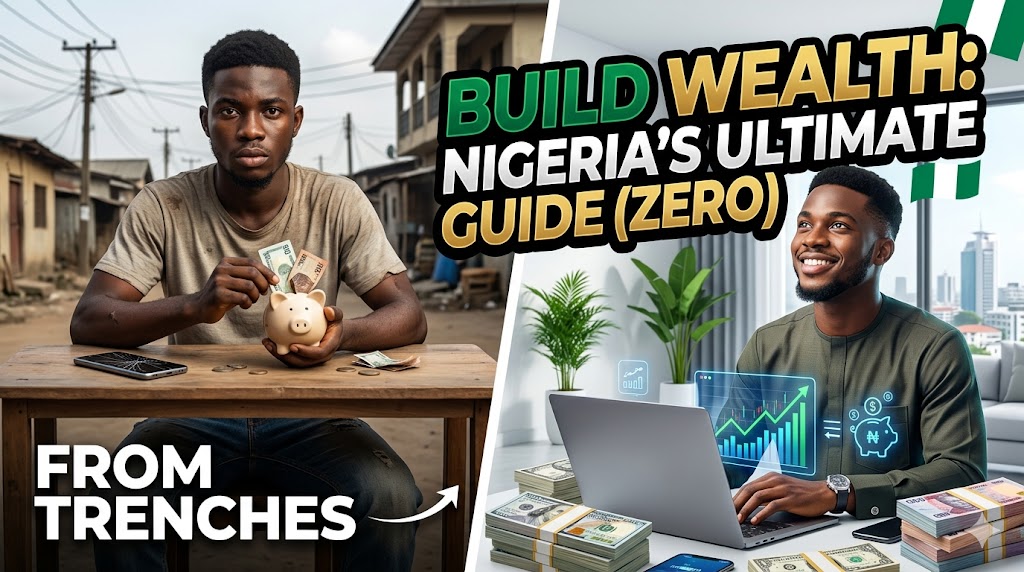
How to Build Wealth Even If You Come From a Poor Background
Let’s be honest: raising your hand in a Nigerian household and saying, “Mami, Papi, I want to be a billionaire” is a quick way to get one of two responses. Either your mom looks at you, sighs, and says, “Go and wash the plates in the kitchen before I change it for you,” or your dad shakes his head and mutters, “I hope it’s not Yahoo you want to do.” How to Build Wealth Even If You Come From a Poor Background
We laugh, but the reality behind that humor is heavy.
In Nigeria, starting from scratch feels like trying to run a marathon with your shoelaces tied together. When you come from a background where “saving for a rainy day” doesn’t make sense because it’s already pouring every single day, the concept of wealth feels like a myth. You see people on Instagram spraying cash at clubs in Victoria Island or driving SUVs through the potholes of Abuja, and you wonder: Is there a secret group chat for money that I was excluded from?
Here is the truth: Coming from a poor background in Nigeria is a massive disadvantage, but it is not a life sentence.
You don’t need a “rich uncle” in government or a father with a oil block to change your family’s trajectory. What you need is a different kind of playbook, one designed for the trenches, tailored for the Nigerian economy, and built to survive the unpredictable nature of the Naira.
Grab a cup of chilled water or a bottle of malt. Let’s talk about how to break the cycle and build real, lasting wealth when you started with absolutely nothing.
1. Unlearn the “Scarcity Mindset” (The Psychological Battle)
Before we talk about banks, investments, or side hustles, we have to talk about your mind. Poverty does something terrible to the human brain: it forces you to think only about today.
When you grow up in a house where the next meal is a miracle, your brain gets wired for immediate survival. You develop a mindset where any money that enters your hand must be spent quickly before an emergency comes and swallows it.
Have you ever noticed that the moment a little extra cash hits your account, that’s exactly when your car breaks down, your phone screen cracks, or a relative calls from the village with a medical emergency?
To build wealth, you have to break this cycle of mental programming:
- Money is not an enemy: Stop viewing money as something that just comes and goes. View it as a tool.
- The “Black Tax” Boundary: As the first child or the “bright hope” of the family, the pressure to send money home can crush your financial growth before it even starts. You cannot pour from an empty cup. You must learn to say, “I don’t have it right now,” without dying of guilt. If you ruin your financial future trying to solve every immediate family problem today, who will help them tomorrow?
- Stop the competitive suffering: In Nigeria, we sometimes wear suffering like a badge of honor. “Ah, you think you have it rough? Me, I haven’t eaten since yesterday!” Wealthy people don’t compete over who suffered most; they focus on who is solving the most problems.
2. Your Income is Your Greatest Weapon (The High-Income Skill Shift)
Let’s dismantle a popular piece of financial advice that doesn’t work for poor people: “Just save 10% of your income.”
If your total income is ₦40,000 a month as a school teacher or a sales boy, saving 10% means you are putting away ₦4,000 a month. In one year, you will have ₦48,000. With inflation rates in Nigeria, that ₦48,000 cannot even buy a standard bag of rice by December.
The Bitter Truth: You cannot save your way out of poverty when your income is low. You have an income problem, not a savings problem.
To build wealth, your primary focus must be increasing your earning capacity. And in the 2020s, the fastest way to do that is through High-Income Skills. These are skills that companies and individuals willingly pay premium amounts for because they directly affect their revenue.
High-Income Skills You Can Learn for Free Online:
| Skill | What It Means | Where to Learn |
| Data Analysis | Helping businesses make sense of numbers to make more money. | YouTube, Google Coursera (Financial Aid available) |
| Copywriting/Content Writing | Writing words that make people buy products or services. | YouTube, HubSpot Academy |
| UI/UX Design | Designing how websites and mobile apps look and feel. | YouTube, Figma tutorials, Coursera |
| Digital Marketing & Ads | Running Facebook, Google, and TikTok ads for businesses. | Google Digital Garage, Meta Blueprint |
| Software Development | Coding apps, websites, and software systems. | freeCodeCamp, Odin Project, YouTube |
You don’t need a university degree from a private school to learn these. If you have a smartphone, an internet connection, and the discipline to stay awake during data-friendly midnight browsing sessions, you can learn any of these skills in 6 to 12 months.
Once you acquire a skill, don’t just look for jobs in Nigeria. Target the global market. Earning $500 a month while living in Nigeria completely changes your financial reality.
3. The Power of the “Side Hustle” (The Multi-Income Stream Strategy)
If you look at the wealthiest people in Nigeria, from the billionaires in Forbes to the comfortable middle-class aunties in your church, they all have one thing in common: Multiple streams of income.
In a volatile economy like ours, relying on a single salary is financial suicide. If that company downsizes, or if the business closes, you are back to square one.
If you have a 9-to-5 job, you need a side hustle. If you are a student, you need a side business.
How to choose a profitable Nigerian side hustle:
- Low Startup Cost: Don’t choose a side hustle that requires you to rent a shop or buy expensive machinery. Look for service-based businesses or dropshipping models where you act as the middleman.
- Solves an Immediate Problem: Nigerians spend money on food, clothing, shelter, education, and entertainment. Can you supply foodstuffs to busy working mothers? Can you source quality thrift clothes (Okrika) from Yaba or Balogun market and sell them to corporate workers online?
- Scalable via Social Media: Your market isn’t just your street. Use Instagram, TikTok, and WhatsApp Status effectively. Don’t just post pictures of products; tell stories, show behind-the-scenes processes, and build trust. In Nigeria, people buy from people they trust.
4. The Anatomy of Saving and Budgeting in an Inflation-Ridden Economy
We’ve established that you can’t save your way out of poverty, but that doesn’t mean you shouldn’t save at all. Once your income begins to grow, saving becomes the shield that protects you from falling back into poverty.
However, saving Naira in a traditional bank account is like pouring water into a basket. Inflation will eat the value before you can say “Up Nepa.”
The New Rules of Saving for the Nigerian Youth:
- Don’t save to keep; save to invest: Your savings should have a target. You are either saving to buy an asset, learn a new skill, or launch a business.
- Save in foreign currency or stablecoins: Use fintech apps (like PiggyVest, Cowrywise, or secure crypto platforms) to save your money in US Dollars or dollar-backed stablecoins (like USDT/USDC). This preserves your purchasing power against the devaluation of the Naira.
- Automate your savings: Don’t wait until the end of the month to save “what is left.” What is left will always be zero. Set your fintech app to automatically deduct a specific percentage the moment your salary or business revenue hits your account.
The 50/30/20 Rule (Adapted for Nigeria):
When money enters your hand, split it intentionally:
- 50% for Needs: Rent, food, transportation, electricity, data (yes, data is a need in this digital age!).
- 30% for Wants & Family (Black Tax): Detty December, new clothes, and the money you send back home.
- 20% for Savings & Investments: Your ticket out of the trenches.
5. Investing Wisely: Moving from Survival to Wealth
Once you have managed to scrape together some savings, the next step is investment. This is where many people from poor backgrounds get scammed. Because we want to escape poverty quickly, we become vulnerable to “Get Rich Quick” schemes.
If anyone promises you 50% ROI (Return on Investment) in one month, run! They are not trying to help you; they are trying to use your remaining money to fund their own lifestyle. Think of MMM, Loom, and the countless agricultural investment scams that crashed over the years.
Real wealth building takes time. Here are the safest and most reliable investment vehicles for beginners in Nigeria:
1. High-Yield Fixed Income and Treasury Bills
These are low-risk investments where you lend money to the government or large corporations. The returns might not make you a millionaire overnight, but your capital is safe, and the interest rates are often better than traditional banks.
2. Nigerian Real Estate (The Land Flipping Strategy)
You don’t need ₦50 million to start investing in real estate. Look for developing areas on the outskirts of major cities (places like Ibeju-Lekki or Mowe-Ibafo years ago, or new growth areas in Oyo, Ogun, or Rivers states). Buy affordable parcels of land, hold them for a few years as the area develops, and sell them for a massive profit. This is called land banking.
3. Eurobonds and Global Equities
Through modern fintech platforms, you can buy fractions of shares in global companies like Apple, Microsoft, or Google. You are investing in economies stronger than ours, meaning your wealth grows in a stable currency.
4. Investing in Yourself (The Best ROI)
The best investment you will ever make is in your own mind. Buy books, attend masterclasses, pay for mentorship, and learn how money works. A person who knows how to make money can lose everything today and build it all back by tomorrow.
6. The Danger of “Lifestyle Creep” (Avoiding the Trap of Looking Rich)
This is perhaps the biggest trap for anyone who successfully transitions from a poor background to a comfortable income level.
When you grow up lacking many things, good clothes, fancy phones, fine dining, the moment you start making money, there is a strong urge to overcompensate. You want to prove to the world (and to your village people) that you have “arrived.”
- Your income increases from ₦150,000 to ₦500,000, and suddenly you move from a decent one-room apartment to a luxury two-bedroom apartment that takes 70% of your annual salary.
- You upgrade your iPhone every year on credit or by emptying your savings.
- You start hanging out at expensive lounges every weekend, buying drinks you can barely afford just to look big in front of friends.
This is called Lifestyle Creep (or lifestyle inflation).
[Poor Background] ──> [High Income] ──> [Luxury Expenses] ──> [Still Broke, Just Elevated]
If your expenses grow at the exact same rate as your income, you will remain broke, the only difference is that you will be a broke person who wears designer clothes.
True wealth is quiet. It’s not about how much you spend; it’s about how much you keep and how much your assets generate for you while you sleep. Keep your head down, live below your means for a few years, and let your investments fund your luxury later.
7. Build a Circle of Progress (Your Network is Your Net Worth)
You cannot build wealth while hanging out with people who have a poverty mindset.
If your friends spend every weekend discussing who won Big Brother Naija, criticizing the government without offering solutions, or planning how to borrow money to buy clothes for an Aso-Ebi party, you need to change your circle.
This doesn’t mean you should abandon your childhood friends because they are poor. It means you must actively seek out relationships with people who challenge you to grow.
- Find friends who share business ideas instead of gossip.
- Join communities of tech enthusiasts, investors, or entrepreneurs.
- Look for mentors who have walked the path you want to walk and learn from their mistakes.
In Nigeria, information is currency. Sometimes, the only thing standing between you and a life-changing opportunity is a conversation with the right person.
The First Generation to Break the Chain
Building wealth when you come from a poor background is hard work. It requires tears, sleepless nights, sacrifices, and a level of discipline that will make people call you “stingy” or “boring.”
But think about the alternative: remaining in the same financial state, passing the same struggles down to your children, and letting the cycle continue.
You did not choose the family you were born into, but you have 100% control over the kind of life you build for yourself and the legacy you leave behind. Let the struggles of your past be the fuel that drives you, not the anchor that holds you down.
Start small today. Learn that skill. Save that extra ₦5,000. Cut off that unnecessary expense. Open that foreign currency savings account.
The road out of the trenches is long, but every single step you take brings you closer to financial freedom. You can do this. Oya, clear the doubt from your mind, get up, and let’s go get this money legitimately.
What is the biggest financial challenge you are facing right now on your wealth-building journey?
Let’s talk about it in the comments below!

EarnSmartOnline.com.ng is dedicated to helping readers make smarter financial decisions through practical guides on online income, personal finance, technology, digital business, and wealth creation. Our goal is to provide reliable, easy-to-understand, and actionable content that empowers individuals to earn smarter, build sustainable income streams and achieve long-term financial success.
Recommended: Start Earning Online
- Ultimate Affiliate Marketing Program — learn affiliate marketing with a done-for-you sales system ($15). Check it out
- The Newbie Affiliate Guide — the beginner-friendly starter guide (~$6.68). Check it out
- Easy Dollar Maker — earn in dollars uploading AI images and videos from your phone ($17). Check it out
Disclosure: These are affiliate links. If you buy through them, I may earn a commission at no extra cost to you.



