
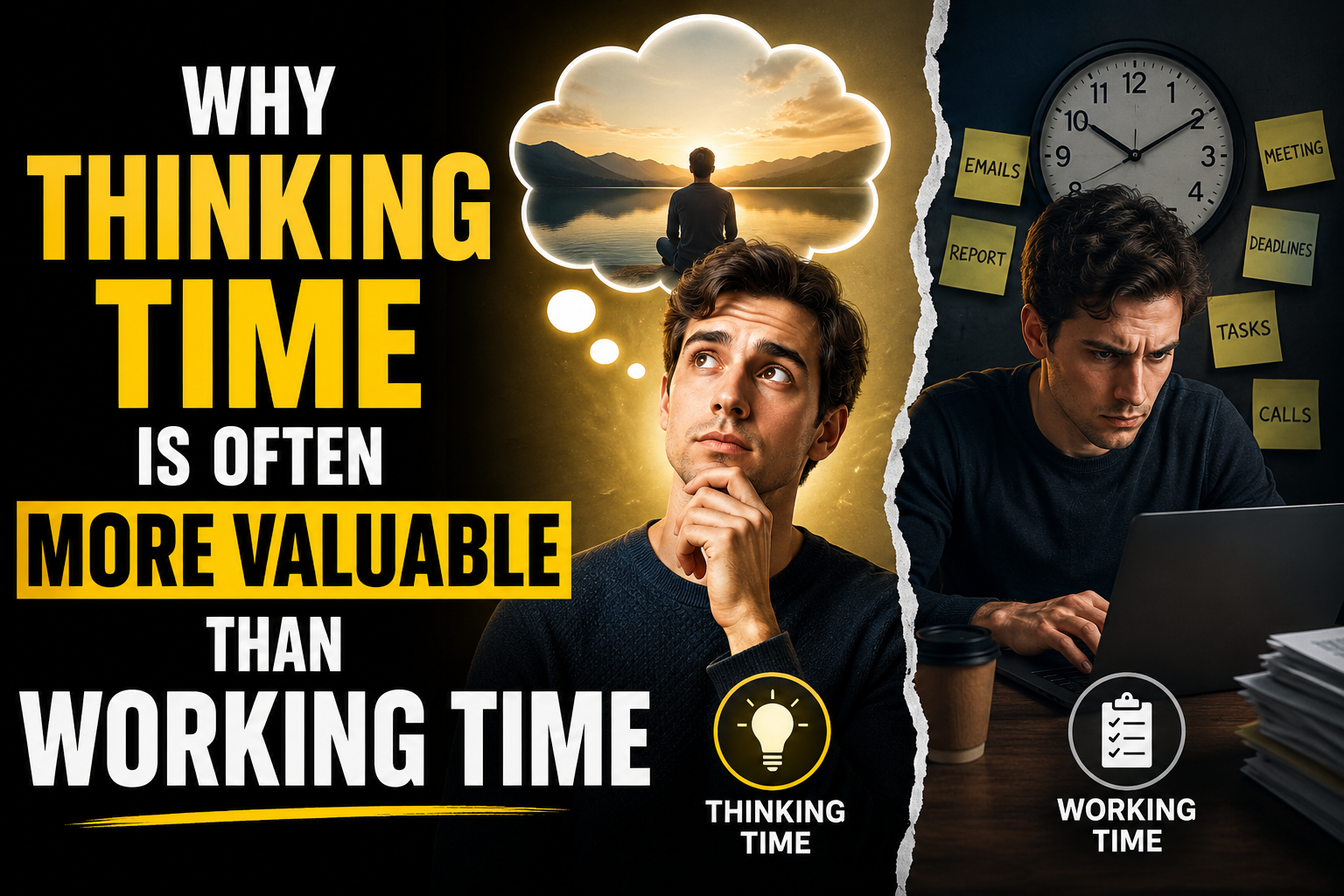
Why Thinking Time Is Often More Valuable Than Working Time
Thinking time is often more valuable than working time, yet most people mistakenly reverse the two. They treat action as the highest form of productivity and reflection as laziness. In reality, the quality of your thinking determines the quality of your output, while working time simply executes what your thinking has already designed. If the thinking is weak, no amount of work can produce strong results. If the thinking is strong, even a small amount of work can create disproportionate impact.
The modern world rewards speed, activity, and constant motion. People are praised for being busy, not necessarily for being effective. Many wake up and immediately enter execution mode, responding to messages, attending meetings, completing tasks, and checking off lists. At the end of the day, they feel productive because they were active for long hours. But activity is not the same as progress. Without structured thinking time, work becomes repetition rather than creation. You can spend ten hours working and still move in circles if the direction was never properly thought through.
Thinking time is where clarity is born. It is the space where problems are defined correctly before solutions are attempted. Most failures in life and business do not come from poor execution alone but from incorrect understanding of the problem. When you rush into working without thinking deeply, you end up solving the wrong problem efficiently. That is one of the most expensive mistakes in any system. A correct solution applied to a wrong problem is still a failure, even if the effort feels impressive.
One of the reasons thinking time feels less valuable is because it produces no immediate visible output. Working time produces tangible results like completed tasks, finished projects, and measurable activity. Thinking time produces invisible results such as insight, clarity, strategy, and perspective. Yet invisible results often determine all visible outcomes. A well thought out plan can guide months of execution. A poorly thought out plan can waste years of effort. The difference is not in effort but in direction.
In many cases, the most successful people are not those who work the hardest but those who think the most effectively before acting. They spend time analyzing patterns, questioning assumptions, and considering consequences. They are not always the fastest movers, but they are often the most accurate decision makers. Their advantage is not more work but better thinking before work begins.
Thinking time is also where leverage is created. Work alone is linear. More work equals more output, but only within limits. Thinking creates systems, and systems multiply output without requiring equal increases in effort. For example, someone who spends time thinking about how to automate a process can save hundreds of hours of future work. Someone who thinks about how to structure content once can produce scalable results over time. The leverage comes from the quality of thought, not the quantity of effort.
Another important role of thinking time is error prevention. Many people believe productivity is about speed of correction, but the real advantage lies in avoiding unnecessary errors in the first place. Thinking deeply allows you to simulate outcomes mentally before committing resources in real life. It helps you see risks before they become expensive problems. Working time often involves reacting to mistakes, but thinking time reduces the need for reaction altogether.
There is also a psychological reason people undervalue thinking time. It feels uncomfortable to sit without immediate action. The mind associates inactivity with laziness because society reinforces constant motion. However, deep thinking is not inactivity; it is high level processing. It is the difference between running randomly and planning a precise route before moving. One drains energy, the other directs it.
Another hidden truth is that thinking time improves the quality of working time. When thinking is clear, work becomes focused. Tasks become more intentional, decisions become faster, and execution becomes smoother. Without thinking, working time is scattered. You start multiple things, switch priorities often, and struggle to maintain direction. With thinking, even limited working hours become highly productive because every action is aligned with a larger strategy.
Thinking time is also where creativity lives. Most people assume creativity happens during work, but it often emerges during reflection. When the mind is not forced to execute, it begins to connect ideas, form patterns, and generate new possibilities. This is why some of the best ideas appear during quiet moments rather than during active work sessions. Creativity requires mental space, and thinking time provides that space.
Another important aspect is decision fatigue. If all your time is consumed by working, you are constantly making small decisions under pressure. Over time, this reduces mental energy and leads to poorer choices. Thinking time allows you to pre decide certain patterns, frameworks, and strategies. This reduces cognitive load during execution and preserves mental strength for higher level decisions.
People often confuse being busy with being valuable. But busyness is not a measure of impact. Someone can be busy all day doing low value tasks while another person spends hours thinking and produces a single idea that changes everything. The difference is not effort but strategic clarity. Thinking time is what separates routine workers from strategic creators.
In business and personal life, the cost of not thinking is often invisible until it becomes too large to ignore. Poor decisions compound over time. Bad strategies waste years. Wrong directions drain energy. Most of these problems could have been avoided with sufficient thinking time at the beginning. That is why thinking is not a luxury; it is a form of risk management.
There is also a compounding effect in thinking. The more you think deeply, the better your thinking becomes. Patterns become clearer, judgment improves, and intuition sharpens. Over time, you begin to recognize consequences faster and make better decisions with less effort. This compounding effect does not happen with mindless working. Repetition alone does not guarantee improvement, but reflective thinking during and after work does.
Working time is important, but it is limited by physical and temporal constraints. Thinking time is scalable because it improves everything that follows it. One hour of deep thinking can save ten hours of poor execution. One clear insight can replace weeks of trial and error. One strategic decision can outperform months of hard labor.
The challenge is not finding time to think, but valuing thinking enough to protect it. Many people fill every available moment with activity, leaving no room for reflection. But without reflection, action becomes directionless. And directionless action, no matter how fast, rarely leads to meaningful outcomes.
Ultimately, thinking time is where success is designed, and working time is where it is delivered. If the design is weak, the delivery cannot compensate. But if the design is strong, even modest execution can produce remarkable results. This is why thinking time is often more valuable than working time. It determines not just how much you do, but what your doing actually means.

EarnSmartOnline.com.ng is dedicated to helping readers make smarter financial decisions through practical guides on online income, personal finance, technology, digital business, and wealth creation. Our goal is to provide reliable, easy-to-understand, and actionable content that empowers individuals to earn smarter, build sustainable income streams and achieve long-term financial success.
Recommended: Start Earning Online
- Ultimate Affiliate Marketing Program — learn affiliate marketing with a done-for-you sales system ($15). Check it out
- The Newbie Affiliate Guide — the beginner-friendly starter guide (~$6.68). Check it out
- Easy Dollar Maker — earn in dollars uploading AI images and videos from your phone ($17). Check it out
Disclosure: These are affiliate links. If you buy through them, I may earn a commission at no extra cost to you.



