
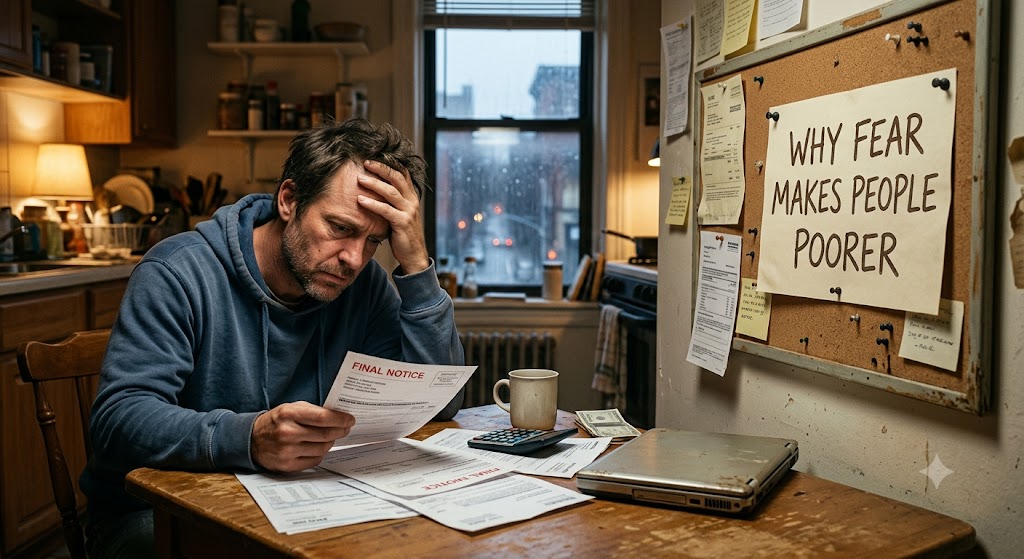
Fear is one of the most powerful emotions human beings experience. It exists to protect us from danger, but when it begins to control financial decisions, career choices, business opportunities, and personal growth, it quietly becomes one of the greatest causes of poverty. Many people believe that becoming poor is simply the result of low income, bad luck, or a difficult economy. While these factors certainly play a role, they often overlook the invisible force that keeps countless people trapped in financial struggles for years. That invisible force is fear. Understanding why fear makes people poorer is one of the most important lessons anyone can learn because financial success is not determined by money alone. It is also determined by mindset, courage, decision making, and the willingness to act despite uncertainty.
Fear rarely announces itself openly. It disguises itself as caution, patience, perfectionism, or waiting for the right moment. It convinces people that tomorrow is a better day to start a business, apply for a better job, learn a valuable skill, invest money, or pursue an opportunity. Days become weeks, weeks become years, and before they realise it, opportunities have disappeared while their financial situation remains unchanged. Fear has quietly stolen not only their money but also their time, which is often far more valuable.
One of the biggest reasons fear makes people poorer is because it prevents action. Wealth is usually created through action. Businesses are built because someone decided to begin. Investments grow because someone was willing to invest. Careers improve because someone applied for a promotion or accepted a challenging role. Skills become profitable because someone spent months or years learning them. Every financial breakthrough begins with a decision followed by action. Fear interrupts this process before it even starts. Instead of taking the first step, fearful individuals remain exactly where they are, hoping circumstances will magically improve.
Fear also encourages people to remain inside their comfort zone. While comfort feels safe, it rarely produces significant financial growth. Many people remain in jobs they dislike because they fear unemployment. Others refuse to negotiate higher salaries because they fear rejection. Some avoid starting businesses because they fear failure. Ironically, remaining comfortable often creates greater financial insecurity in the long run than taking calculated risks. A comfortable salary that never increases cannot compete with rising living costs, inflation, and unexpected expenses. Over time, the comfort zone quietly transforms into a financial prison.
Another reason fear makes people poorer is because it discourages learning. Every profitable skill begins with being a beginner. Someone learning programming will make mistakes. A new investor will experience uncertainty. An aspiring entrepreneur will face confusion. Fear convinces people that not knowing enough is a reason not to start. They spend years collecting information instead of applying it. They watch successful people from a distance while convincing themselves they need one more course, one more book, or one more year of preparation. Knowledge without action rarely creates wealth.
Fear of failure is perhaps the greatest financial enemy of all. Society often treats failure as something embarrassing instead of something educational. As a result, many people avoid opportunities simply because they cannot guarantee success. Yet almost every wealthy entrepreneur, successful investor, respected executive, and accomplished professional has experienced failure. The difference is that successful individuals treat failure as feedback rather than a permanent identity. Fearful people see failure as proof they should never have tried. This difference in perspective creates enormous differences in financial outcomes over time.
The fear of losing money also keeps many people poor. While nobody enjoys financial losses, refusing to invest because of fear often creates an even greater loss through missed opportunities. Money sitting idle for years may feel safe, but inflation quietly reduces its purchasing power. Meanwhile, carefully researched investments, businesses, and productive assets have the potential to generate long term growth. Successful wealth builders understand that every investment carries some level of risk, but they also recognise that avoiding every risk carries its own hidden cost.
Fear influences spending habits as well. Some people spend impulsively because they fear missing out on experiences, trends, or social approval. Others accumulate possessions to hide feelings of insecurity. Instead of investing in assets that generate future income, they purchase liabilities that lose value almost immediately. Fear of appearing unsuccessful often pushes individuals into lifestyles they cannot genuinely afford. Expensive phones, fashionable clothes, luxury cars, and unnecessary celebrations may temporarily impress others, but they frequently create long term financial pressure through debt and reduced savings.
The fear of criticism has destroyed countless dreams before they even began. Many aspiring entrepreneurs never launch businesses because they worry about what family, friends, or neighbours might say if they fail. Others hide their ambitions because they fear being laughed at. Ironically, the same people whose opinions create fear often contribute nothing towards improving the individual’s financial future. Allowing the opinions of others to determine financial decisions can become an invisible chain that limits progress for decades.
Fear also causes people to underestimate themselves. Self doubt convinces capable individuals that they are unqualified, inexperienced, or incapable of achieving success. This often leads to accepting lower salaries, refusing leadership opportunities, and avoiding competitive industries where greater rewards exist. Confidence alone does not guarantee success, but the absence of confidence frequently guarantees missed opportunities. Believing that you have nothing valuable to offer prevents others from discovering the value you actually possess.
One of the less obvious ways fear makes people poorer is through procrastination. Procrastination is often mistaken for laziness, but many cases are driven by fear. Fear of making the wrong decision causes endless delays. Fear of imperfection leads people to keep improving projects that never get released. Fear of rejection prevents applications from being submitted. Every delay has a financial cost because opportunities are often time sensitive. Markets change, industries evolve, and competitors move ahead while fearful individuals continue waiting.
Fear can also damage relationships that are important for financial success. Business partnerships, networking opportunities, mentorships, and collaborations all require vulnerability and trust. Fear of rejection causes many people to isolate themselves professionally. They avoid attending events, introducing themselves to influential people, or asking successful individuals for advice. Yet many careers and businesses grow through relationships rather than qualifications alone. Courageous conversations often create opportunities that cannot be found in textbooks.
Another reason fear makes people poorer is that it encourages short term thinking. Fearful people focus on immediate survival instead of long term prosperity. They may avoid investing in education because it costs money today, even though it could dramatically increase future earnings. They may reject business opportunities because initial effort feels uncomfortable, ignoring the possibility of future financial independence. Long term wealth usually requires short term sacrifice, but fear magnifies temporary discomfort until it appears impossible to overcome.
Why Fear Makes People Poorer
Economic uncertainty often amplifies fear. During difficult financial periods, many people stop investing in themselves, postpone business expansion, and avoid calculated opportunities because they fear making mistakes. While caution is wise during uncertain times, complete inaction can be equally dangerous. History shows that many successful companies, innovations, and fortunes were created during economic downturns because courageous individuals recognised opportunities where others saw only problems.
Fear frequently spreads through social influence. Families, friends, and communities sometimes unintentionally pass fearful beliefs from one generation to another. Children who constantly hear statements like “money is too difficult to make,” “rich people are dishonest,” or “business always fails” may grow into adults who unconsciously limit their own financial potential. These beliefs become invisible barriers that shape decisions without being questioned. Replacing inherited fear with informed thinking is an essential step towards financial growth.
The media can also strengthen financial fear. Constant exposure to negative economic news, market crashes, unemployment statistics, and financial scandals may create the impression that success is impossible. While staying informed is important, living in constant fear of negative headlines often leads to paralysis. Wealthy individuals usually seek balanced information. They acknowledge risks while actively searching for opportunities hidden within changing conditions.
Fear often convinces people that someone else has all the advantages. They believe successful individuals were born wealthy, connected, or exceptionally talented. This comparison creates discouragement and excuses for inaction. Although unequal opportunities certainly exist, history contains countless examples of individuals who built remarkable wealth despite humble beginnings. Focusing entirely on disadvantages distracts from identifying the opportunities that genuinely exist.
One powerful characteristic of fear is that it exaggerates consequences. The mind imagines catastrophic outcomes far more often than realistic ones. Someone considering a business imagines bankruptcy instead of gradual learning. Someone thinking about changing careers imagines unemployment instead of improved income. Someone considering public speaking imagines humiliation instead of professional growth. These exaggerated fears create emotional barriers that rarely reflect reality.
Financial education helps reduce fear because knowledge replaces uncertainty with understanding. Learning about budgeting, investing, entrepreneurship, taxation, saving, debt management, and wealth building gives individuals greater confidence when making financial decisions. Ignorance creates fear because the unknown always feels threatening. Education does not eliminate risk, but it significantly improves the ability to evaluate and manage it intelligently.
Developing courage does not mean ignoring risks or behaving recklessly. Courage means making informed decisions despite uncertainty. Every worthwhile financial decision involves some level of uncertainty because nobody can predict the future perfectly. Entrepreneurs cannot guarantee business success. Investors cannot predict every market movement. Employees cannot guarantee promotions. Yet progress belongs to those willing to move forward while accepting that uncertainty is a natural part of growth.
Small acts of courage often create surprisingly large financial rewards over time. Asking for a salary increase, learning a profitable digital skill, launching a side business, investing consistently, networking with professionals, or creating valuable online content may appear insignificant individually. However, compounded over years, these decisions can dramatically improve financial circumstances. Wealth rarely appears overnight. More often, it grows from repeated courageous actions performed consistently.
One important lesson is recognising the difference between fear and wisdom. Wisdom evaluates risks carefully before acting. Fear prevents action regardless of available evidence. Wisdom encourages preparation. Fear encourages endless postponement. Wisdom seeks solutions. Fear magnifies problems. Learning to distinguish between these two voices can transform both financial and personal decision making.
Another overlooked aspect is that fear often creates dependence. Individuals who constantly fear independence may become financially dependent on employers, family members, governments, or other people for extended periods. While support systems are valuable during difficult times, long term financial independence usually requires accepting greater responsibility, developing valuable skills, and making decisions that initially feel uncomfortable.
Technology has created countless opportunities for income generation that previous generations never imagined. Freelancing, blogging, content creation, e commerce, affiliate marketing, software development, online consulting, digital products, remote work, and online education allow individuals to earn beyond traditional employment. Yet many people never explore these opportunities because fear convinces them that success belongs only to others. Every successful online entrepreneur was once a beginner facing uncertainty.
Fear also affects negotiations. Whether buying property, discussing salaries, closing business deals, or setting prices for services, fearful individuals frequently accept less than they deserve simply to avoid conflict. Over an entire career, these small compromises can amount to enormous financial losses. Learning respectful negotiation skills is not about greed but about recognising personal value.
Resilience is one of the greatest antidotes to fear. Financial setbacks happen to almost everyone. Businesses fail, investments decline, jobs disappear, and unexpected expenses arise. Resilient people recover because they view setbacks as temporary events rather than permanent identities. Fearful individuals often interpret one disappointment as evidence that future success is impossible. This belief becomes a self fulfilling prophecy because they stop trying altogether.
Generational wealth is rarely created by people who allow fear to dominate every decision. Families that build lasting prosperity usually embrace education, disciplined investing, responsible entrepreneurship, continuous learning, and calculated risk taking. They teach future generations not merely how to earn money but how to think about money. They understand that courage combined with wisdom creates opportunities that fear can never access.
Ultimately, why fear makes people poorer is not simply because fear exists but because fear influences daily decisions in subtle ways. Every postponed opportunity, every abandoned dream, every rejected challenge, every avoided investment, every unspoken negotiation, and every ignored idea carries a financial consequence. While fear promises safety, it often delivers stagnation. Meanwhile, thoughtful courage opens doors to growth, learning, opportunity, and prosperity.
Financial success is never guaranteed, regardless of courage or intelligence. However, allowing fear to control every important decision almost guarantees missed opportunities. The individuals who gradually improve their financial lives are rarely those who never experience fear. They are those who recognise fear, evaluate the situation carefully, prepare themselves as much as possible, and move forward anyway. Money follows value, value follows action, and meaningful action usually requires courage. By replacing fear with informed confidence, continuous learning, disciplined decision making, and persistent effort, anyone can dramatically improve their chances of building lasting financial security and escaping the invisible cycle that keeps so many people poorer than they need to be.

EarnSmartOnline.com.ng is dedicated to helping readers make smarter financial decisions through practical guides on online income, personal finance, technology, digital business, and wealth creation. Our goal is to provide reliable, easy-to-understand, and actionable content that empowers individuals to earn smarter, build sustainable income streams and achieve long-term financial success.
Recommended: Start Earning Online
- Ultimate Affiliate Marketing Program — learn affiliate marketing with a done-for-you sales system ($15). Check it out
- The Newbie Affiliate Guide — the beginner-friendly starter guide (~$6.68). Check it out
- Easy Dollar Maker — earn in dollars uploading AI images and videos from your phone ($17). Check it out
Disclosure: These are affiliate links. If you buy through them, I may earn a commission at no extra cost to you.



