
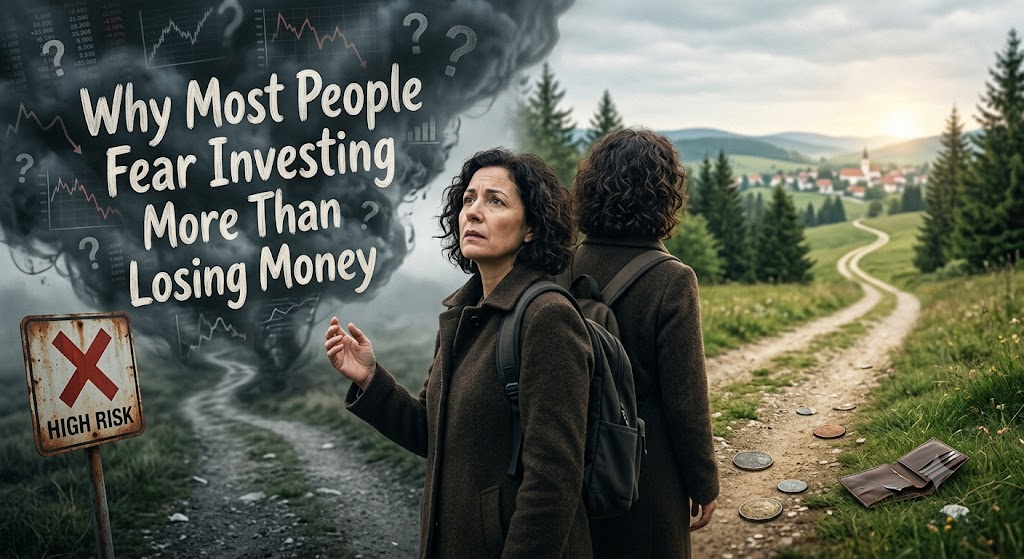
Why Most People Fear Investing More Than Losing Money is a question that reveals something uncomfortable about human behaviour. Most people want financial security, greater income and a better future, yet many hesitate when an opportunity requires them to put their money to work. They may complain about inflation, rising living costs, poor salaries and the difficulty of building wealth, but when the conversation turns to investing, fear suddenly takes control. The irony is that many people are more frightened by the possibility of losing money through an investment than they are by the guaranteed loss of purchasing power that can happen when money simply sits unused.
This fear is not necessarily a sign of financial irresponsibility. In many cases, it is a natural human response. Money represents more than numbers in a bank account. It represents food, shelter, education, family responsibilities, emergencies, freedom and the possibility of a better life. When people work hard to earn their money, the thought of losing even a portion of it can feel deeply painful. Investing introduces uncertainty, and uncertainty makes people uncomfortable. The human brain often prefers a certain small loss to an uncertain larger gain, even when accepting the certain loss may be financially damaging over time. Why Most People Fear Investing More Than Losing Money
Consider someone who keeps ₦1,000,000 in a savings account for years because they are afraid that investing it could result in losing money. They may feel safe because the money remains visible in their account. They can open their banking app at any time and see the balance. Psychologically, that feels reassuring. However, if prices continue increasing while the money earns little or no meaningful return, the person may gradually lose purchasing power. The balance may still say ₦1,000,000, but that ₦1,000,000 may no longer buy what it could have bought several years earlier. The money has not disappeared from the account, but its economic power has weakened.
This is one of the biggest misunderstandings surrounding investing. People often define loss only as seeing a lower number in their account. If they invest ₦500,000 and the value temporarily falls to ₦450,000, they immediately think, “I have lost ₦50,000.” But if they leave ₦500,000 untouched for years while inflation steadily reduces what that money can purchase, they may not think of that as a loss. The first loss is visible. The second is invisible. Human beings naturally react more strongly to visible losses than invisible ones.
This psychological tendency is one reason why Why Most People Fear Investing More Than Losing Money is such an important financial question. Investing forces people to confront uncertainty, while doing nothing creates an illusion of safety. The problem is that doing nothing with money is still a financial decision. Choosing not to invest does not eliminate risk. It simply replaces one type of risk with another.
Inflation is one of the most important examples. When the prices of goods and services rise, the purchasing power of money falls. If your money grows at a rate lower than inflation over a long period, your real wealth can decline even though your bank balance appears stable. This is why financially educated people do not look only at how much money they have. They also consider what their money can actually buy and whether their wealth is growing faster than the forces working against it.
Another reason people fear investing is that they have seen others lose money. Someone may have a friend who invested in a business that failed. Another person may have lost money in a poorly understood financial product. Someone else may have bought an asset at an inflated price and sold it after a major decline. These experiences can create powerful emotional stories. Instead of concluding that the investment was poorly researched or excessively risky, a person may conclude that investing itself is dangerous.
This is where financial education becomes extremely important. Investing is not one single activity. There are different asset classes, strategies, time horizons and levels of risk. Buying a speculative asset because someone promised quick profits is not the same thing as building a diversified long term investment portfolio. Putting all your money into one business is not the same as gradually investing across different assets. Understanding these differences can transform fear into informed caution.
Fear becomes especially dangerous when it prevents people from learning. A person who says, “I do not understand investing, so I will never invest,” may remain financially vulnerable for decades. A better approach is to say, “I do not understand investing yet, so I will learn before putting significant money into it.” There is a major difference between avoiding something permanently and taking time to understand it.
Many people also fear investing because they believe they need a large amount of money to begin. They imagine wealthy investors sitting in expensive offices and moving millions between accounts. This perception makes investing appear inaccessible. In reality, the amount required to begin depends heavily on the investment vehicle and the market involved. More importantly, the habit of investing can matter enormously over a long period. Someone who consistently invests manageable amounts and learns along the way may build stronger financial habits than someone who waits for the perfect moment or a huge amount of capital.
The fear of investing can also come from a desire for certainty. People often want guarantees before they commit their money. They want to know exactly how much they will receive, when they will receive it and whether they can avoid losses completely. Unfortunately, meaningful wealth building rarely comes with perfect certainty. Even keeping money in cash has risks. Inflation, currency movements, economic changes and unexpected expenses can all affect financial security.
Why Most People Fear Investing More Than Losing Money
The goal of intelligent investing is therefore not to eliminate all risk. That is impossible. The goal is to understand risk, manage it and make decisions that match your financial situation, goals and time horizon. Someone saving money for an emergency that may be needed next month should approach investing very differently from someone building wealth for twenty years from now.
Time is another major factor that changes how investing should be viewed. Short term market movements can be frightening because prices can rise and fall rapidly. But long term investing operates differently. Historically, many productive assets have generated returns over extended periods despite experiencing significant temporary declines along the way. This does not mean every investment will recover or that losses are impossible. It means investors need to understand the difference between temporary volatility and permanent loss.
A person who checks an investment every five minutes may experience more anxiety than someone who understands why they invested in the first place. Emotional reactions can cause investors to buy when prices are rising because everyone is excited and sell when prices are falling because everyone is afraid. This behaviour can turn temporary market volatility into permanent losses.
The fear of losing money can therefore create a strange cycle. Someone is afraid of investing, so they avoid it. Later, they become frustrated because their money is not growing fast enough. They then become attracted to a supposedly guaranteed opportunity promising unusually high returns. Because they lack investment knowledge, they may fail to recognise the warning signs. They invest too aggressively, suffer a loss and become even more convinced that investing is dangerous. The real problem was not necessarily investing. It was the combination of fear, lack of education and poor risk management.
Another reason people fear investing more than losing money is emotional attachment to cash. Having money available creates a feeling of control. You can see the balance. You can transfer it. You can spend it. You know where it is. Investments can feel different because their value may fluctuate. This creates psychological discomfort, especially for people who grew up in environments where financial instability was common.
For someone who has struggled financially, saving money can represent safety. That feeling should not be dismissed. Building an emergency fund and maintaining sufficient liquidity are important parts of financial planning. The problem begins when fear turns cash into the only financial strategy. Cash can protect short term stability, but long term wealth creation usually requires money to be deployed productively in some way.
Investing is essentially about putting capital to work. When you invest in a productive asset, you are attempting to participate in the economic activity that creates value. Businesses generate revenue. Companies develop products and services. Property can generate rental income. Bonds can provide interest. Certain funds provide exposure to collections of assets. The exact risks and returns vary widely, but the underlying idea is that money can potentially produce more money rather than simply sitting idle.
This does not mean people should blindly invest every naira they have. That would be another form of financial irresponsibility. Before investing, people should consider their income stability, debts, emergency savings, financial goals, investment horizon and ability to tolerate losses. Money needed for immediate necessities should not casually be exposed to investments that could fluctuate significantly.
The right question is therefore not, “How can I invest without ever losing money?” A better question is, “How can I make informed investment decisions while managing the possibility of loss?” That shift in thinking is powerful because it moves the person from seeking impossible certainty to developing financial competence.
Financial literacy can reduce investment fear dramatically. When people understand compound growth, diversification, asset allocation, inflation, volatility, fees, liquidity and risk, investing becomes less mysterious. Knowledge does not eliminate uncertainty, but it makes uncertainty easier to navigate.
Compound growth is particularly important because time can become one of an investor’s greatest advantages. When investment returns are reinvested, future returns can potentially be earned on previous returns. Over many years, this can produce significant growth. The earlier someone understands this concept, the more seriously they may take consistent investing. Waiting until the future feels perfectly safe can be expensive because time cannot be recovered.
This is also why delaying investing indefinitely can create another form of risk. Someone may spend ten years waiting for the economy to become stable, the market to stop falling, their salary to increase or the perfect investment opportunity to appear. Then they discover that another decade has passed. Markets will always have uncertainty. Economies will always experience challenges. There will always be reasons to wait.
Successful investors are not people who predict every market movement correctly. They are often people who develop disciplined systems and understand what they own. They accept that some investments will perform poorly. They recognise that uncertainty is part of the process. They focus on decisions that are within their control, such as saving consistently, diversifying appropriately, controlling unnecessary fees, avoiding excessive debt and maintaining a long term perspective.
There is also a major difference between fear and caution. Fear says, “Never invest because you might lose money.” Caution says, “Understand the investment before you commit money.” Fear avoids knowledge. Caution seeks knowledge. Fear reacts emotionally. Caution evaluates evidence. Fear sees every loss as proof that investing is bad. Caution understands that different investments carry different levels and types of risk.
People should also be careful about comparing themselves with investors who appear successful online. Social media is filled with screenshots of profits, expensive cars and stories about people who supposedly turned small amounts into fortunes overnight. What is often missing is the full picture. You rarely see the losses, failed investments, debt, leverage, family support or years of work behind the success story. Comparing your financial journey with someone’s carefully selected highlights can create unrealistic expectations and encourage dangerous decisions.
The opposite problem is equally harmful. Some people see someone lose money and conclude that investing is a scam. But losing money does not automatically mean an investment was fraudulent. Risk is inherent in many legitimate investments. The important question is whether the risk was understood and whether the investment was appropriate for the investor’s circumstances.
A healthy financial mindset accepts that money can be lost, but it also recognises that money can lose value through inaction. This is one of the most important lessons behind Why Most People Fear Investing More Than Losing Money. The fear of an immediate and visible loss can cause people to ignore a slower and less obvious financial erosion.
Imagine two people who each have the same amount of money. One refuses to learn about investing and keeps everything in a low yielding account for twenty years. The other spends years learning about personal finance, develops an appropriate investment strategy and accepts reasonable levels of risk. Neither person has a guaranteed outcome. The second person could experience market declines. However, the second person has at least recognised that long term financial security requires more than simply protecting today’s balance.
Ultimately, investing should not be viewed as gambling, nor should it be treated as a guaranteed path to riches. It is a tool. Like any tool, its usefulness depends on how it is used. A hammer can build something or cause damage. Money can be saved, invested, spent or wasted. The key is understanding the purpose behind each decision.
The fear of investing is understandable, especially when money is difficult to earn and financial mistakes can have serious consequences. But fear should not become an excuse for financial ignorance. The safest long term financial strategy is rarely the one that simply avoids every form of uncertainty. Instead, it is the one that understands uncertainty, prepares for it and makes informed decisions despite it.
If you have been afraid to invest, you do not necessarily need to jump into the market tomorrow. Start by learning. Understand basic investment principles. Learn the difference between saving and investing. Understand inflation. Study diversification. Learn how risk works. Examine investment options available in your country. Understand fees and taxation where applicable. Most importantly, never put money into something simply because someone promises extraordinary returns.
The goal is not to become fearless. The goal is to become financially informed enough that fear no longer makes every decision for you. You can respect risk without worshipping it. You can protect your money without keeping every naira permanently idle. You can acknowledge the possibility of losing money while also recognising the possibility of losing purchasing power by doing nothing.
Perhaps the most important lesson is this: money is not truly safe simply because it is untouched. Financial safety is about maintaining and increasing your ability to meet your needs and achieve your goals over time. Sometimes that requires saving. Sometimes it requires investing. Sometimes it requires reducing debt. Sometimes it requires increasing your income. Wealth is rarely created by one decision. It is built through a collection of informed decisions repeated consistently over many years.
Why Most People Fear Investing More Than Losing Money ultimately comes down to the difference between visible risk and invisible risk. A falling investment balance gets your attention immediately. Inflation quietly reducing your purchasing power may barely get noticed. A market decline can create panic. Years of stagnant financial growth can feel normal. But both situations can affect your financial future.
The answer is not to ignore investment risk. It is to understand it. The answer is not to invest blindly. It is to invest intelligently and according to your circumstances. The answer is not to chase quick wealth. It is to develop habits that can support long term financial growth.
Your money has a job to do. If all it does is sit still while the cost of living rises, you may be protecting the number you see while losing some of the value behind that number. Learning how to make informed financial decisions can help you move beyond that illusion of safety.
Investing will always involve uncertainty. There will always be market downturns, economic challenges, unexpected events and moments when you question your decisions. But financial growth has never required the absence of uncertainty. It requires knowledge, patience, discipline and a willingness to make thoughtful decisions.
The people who build lasting wealth are not necessarily those who never experience losses. They are often those who understand that losses, volatility and uncertainty are part of the financial landscape and learn how to manage them. Instead of asking whether investing is completely safe, ask whether remaining financially passive for decades is truly safe either.
Sometimes the greatest financial risk is not losing money. It is never learning what your money could have become.
The uncomfortable truth is that people often fear losing money today more than they fear becoming poorer tomorrow.
That is the psychological trap at the centre of investing. A person can watch inflation quietly destroy purchasing power for ten years and feel completely comfortable because their bank balance still looks familiar. But let that same person invest and watch the value temporarily fall by 10%, and suddenly investing becomes “dangerous”.
The brain reacts to the visible loss.
It ignores the invisible one.
That is why the smartest financial conversation is not simply about protecting money. It is about understanding what your money is doing while you are protecting it.
A million naira sitting untouched for years may feel safer than a million naira invested intelligently. But if prices keep rising, the question is not merely how much money remains in the account. The question is what that money will still be capable of buying.
This is where financial maturity begins.
You do not need to become reckless. You do not need to throw your savings into the next internet investment promising 300% returns. You do not need to become obsessed with the stock market.
You need to understand risk well enough to stop confusing “not moving” with “safe.”
The biggest financial breakthrough for many people comes when they realise that there are two sides to risk.
There is the risk of investing.
And there is the risk of never investing.
One can be dramatic and visible. The other can be slow, quiet and almost impossible to notice until years have passed.
The real enemy is not fear.
It is financial ignorance disguised as safety.

EarnSmartOnline.com.ng is dedicated to helping readers make smarter financial decisions through practical guides on online income, personal finance, technology, digital business, and wealth creation. Our goal is to provide reliable, easy-to-understand, and actionable content that empowers individuals to earn smarter, build sustainable income streams and achieve long-term financial success.
Recommended: Start Earning Online
- Ultimate Affiliate Marketing Program — learn affiliate marketing with a done-for-you sales system ($15). Check it out
- The Newbie Affiliate Guide — the beginner-friendly starter guide (~$6.68). Check it out
- Easy Dollar Maker — earn in dollars uploading AI images and videos from your phone ($17). Check it out
Disclosure: These are affiliate links. If you buy through them, I may earn a commission at no extra cost to you.



