
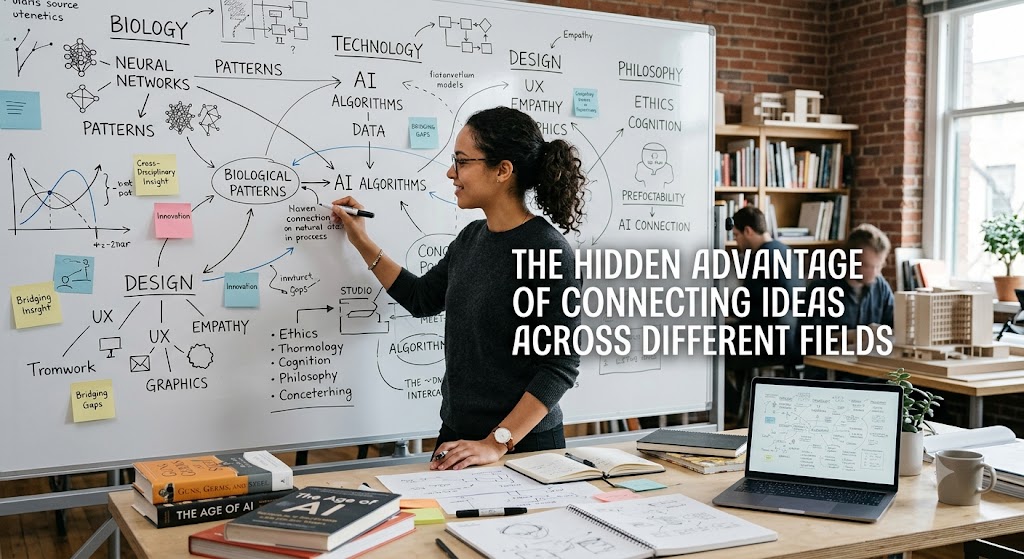
The Hidden Advantage of Connecting Ideas Across Different Fields
In a world where information is expanding faster than ever before, one of the greatest competitive advantages a person can develop is the ability to connect ideas across different fields. While many people focus on becoming experts in a single area, history repeatedly shows that groundbreaking innovations, successful businesses, remarkable inventions, and extraordinary solutions often emerge when knowledge from one discipline is applied to another. The hidden advantage of connecting ideas across different fields lies in the ability to see opportunities that others overlook, solve problems from fresh perspectives, and create value in ways that specialists working in isolation may never imagine.
Modern society often encourages people to stay within clearly defined boundaries. Students choose a major, professionals specialise in one career path, and businesses focus on one industry. Although specialisation has undeniable benefits, it can also create intellectual blind spots. When people limit themselves to a single field of knowledge, they may unknowingly ignore solutions that already exist elsewhere. By contrast, individuals who explore different disciplines develop a broader understanding of how systems work, allowing them to combine concepts that appear unrelated at first glance.
Innovation rarely happens because someone invents something entirely new from nothing. More often, innovation is the result of combining existing ideas in unique ways. Every major advancement in technology, healthcare, business, education, engineering, and communication has been influenced by concepts borrowed from other disciplines. This process of connecting ideas enables people to recognise patterns, transfer successful strategies, and adapt proven methods to entirely different situations.
One of the greatest examples of interdisciplinary thinking is found in the evolution of modern technology. Smartphones, for instance, are not simply products of computer science. They combine telecommunications, software engineering, psychology, industrial design, behavioural science, marketing, photography, materials science, economics, and even art. The success of these devices depends not only on technical performance but also on user experience, emotional appeal, and consumer behaviour. This demonstrates that meaningful progress often occurs at the intersection of multiple fields rather than within the boundaries of a single discipline.
Business leaders who consistently outperform competitors usually possess an exceptional ability to connect unrelated ideas. They study psychology to understand customers, economics to understand markets, technology to improve efficiency, design to improve products, and communication to strengthen their brands. Rather than relying solely on industry knowledge, they borrow successful principles from various fields to create stronger business strategies. This broader perspective allows them to anticipate trends before others recognise them.
The same principle applies to personal development. Someone interested in financial success may benefit greatly from studying behavioural psychology because money decisions are heavily influenced by emotions rather than logic alone. Learning about history can improve leadership because it reveals timeless lessons about human behaviour, conflict, negotiation, and decision making. Understanding biology may improve productivity by teaching how sleep, nutrition, and exercise affect mental performance. Knowledge becomes exponentially more valuable when different subjects begin supporting one another.
Creative thinking flourishes when people expose themselves to diverse sources of knowledge. Writers who read only books within their own genre often struggle to produce original work. Those who explore science, philosophy, economics, history, sociology, technology, and psychology usually develop richer ideas and more engaging perspectives. The ability to connect seemingly unrelated concepts allows creativity to expand far beyond ordinary thinking.
Many successful entrepreneurs deliberately study industries completely unrelated to their own. A restaurant owner may learn efficiency from manufacturing. A software developer may improve user experience by studying architecture. A teacher may enhance classroom engagement by borrowing storytelling techniques from filmmakers. A healthcare provider may improve patient care by adopting customer service principles used in luxury hotels. None of these improvements require reinventing the wheel. They simply require recognising that useful ideas often exist outside familiar territory.
Problem solving becomes significantly easier when people understand multiple disciplines. Most difficult problems cannot be solved using the same thinking that created them. Complex challenges usually involve economic, social, psychological, technological, environmental, and organisational factors simultaneously. Someone capable of integrating knowledge from several fields can approach these problems from multiple angles instead of relying on one limited perspective.
Artificial intelligence provides another excellent example of interdisciplinary innovation. Its development depends on mathematics, statistics, neuroscience, linguistics, computer science, philosophy, ethics, psychology, and engineering. Each discipline contributes essential insights that strengthen the overall technology. Without collaboration across these fields, modern AI would not exist in its current form.
Connecting ideas also improves decision making. People who study only finance may evaluate investments differently from those who combine finance with psychology, political science, technology trends, and demographic analysis. Broader knowledge allows better forecasting because real-world events rarely operate within isolated categories. Economic changes influence politics, politics influence technology, technology influences consumer behaviour, and consumer behaviour influences markets.
Another hidden advantage is adaptability. The world changes rapidly, and careers continue evolving as automation, artificial intelligence, and global competition reshape industries. Individuals with broad interdisciplinary knowledge can transition more easily because they possess transferable thinking skills rather than narrow technical knowledge alone. They recognise similarities between different environments and adapt their expertise accordingly.
Pattern recognition is one of the most valuable cognitive abilities a person can develop. Connecting ideas across different fields strengthens this skill by exposing the brain to recurring structures found throughout nature, business, science, mathematics, history, and human behaviour. Successful investors often recognise market patterns because they understand psychology. Great leaders identify organisational problems because they understand systems thinking. Exceptional inventors recognise technological opportunities because they observe patterns across unrelated industries.
Curiosity plays an essential role in developing interdisciplinary thinking. Curious individuals naturally explore topics beyond their immediate responsibilities. They ask questions, read widely, experiment frequently, and remain open to unfamiliar ideas. This intellectual flexibility allows them to discover unexpected connections that others overlook simply because they never ventured outside their specialised fields.
History consistently rewards people who think across boundaries. Many revolutionary discoveries occurred because someone applied existing knowledge to a completely different context. Scientific breakthroughs, artistic movements, engineering innovations, and business revolutions frequently emerged from combining established concepts rather than inventing entirely new ones. The ability to connect ideas transforms ordinary knowledge into extraordinary insight.
Education systems are gradually recognising the importance of interdisciplinary learning. Employers increasingly value individuals who can communicate effectively, analyse data, understand technology, collaborate across departments, solve complex problems, and think creatively. These capabilities emerge not from memorising isolated facts but from integrating knowledge across multiple domains.
Reading remains one of the simplest ways to develop this advantage. Instead of reading only within one area of interest, individuals can intentionally diversify their learning. Exploring economics, philosophy, psychology, biology, engineering, history, communication, design, leadership, and technology creates a mental library filled with concepts waiting to connect. Over time, these connections become increasingly automatic.
Travelling also contributes significantly to interdisciplinary thinking. Exposure to different cultures, customs, industries, and lifestyles broadens perspective. Experiences outside one’s familiar environment challenge assumptions and encourage flexible thinking. Every new experience becomes another potential source of ideas that may later combine with existing knowledge to solve unexpected problems.
Networking with people from different professions provides similar benefits. Conversations with engineers, artists, teachers, healthcare professionals, scientists, entrepreneurs, economists, designers, and researchers expose individuals to unique perspectives that rarely appear within a single profession. These interactions often spark ideas that no textbook could provide.
Organisations increasingly encourage cross-functional collaboration because innovation accelerates when diverse expertise comes together. Marketing teams benefit from data scientists. Engineers benefit from designers. Financial analysts benefit from behavioural psychologists. Product developers benefit from customer service representatives. Each discipline contributes knowledge that strengthens the final outcome.
The digital age has made interdisciplinary learning easier than at any previous point in history. Online courses, podcasts, documentaries, books, academic journals, webinars, and educational platforms allow anyone to explore virtually any subject from anywhere in the world. The barriers separating different fields have never been lower, creating unprecedented opportunities for lifelong learning.
One common mistake is believing that learning outside one’s profession wastes time. In reality, the opposite is often true. Knowledge acquired from unrelated fields frequently becomes the source of the most valuable insights because competitors rarely possess the same combination of expertise. Unique combinations of knowledge create unique competitive advantages.
This principle also applies to leadership. Effective leaders understand finance, communication, psychology, negotiation, organisational behaviour, technology, conflict resolution, and strategic planning. Leadership itself is inherently interdisciplinary because leading people requires understanding multiple dimensions of human behaviour and organisational systems.
Innovation depends heavily on diversity of thought. Teams composed of individuals with different educational backgrounds, professional experiences, cultural perspectives, and problem-solving approaches consistently generate more creative solutions than groups where everyone thinks similarly. Diversity creates more opportunities for connecting unrelated ideas into valuable innovations.
Perhaps the greatest hidden advantage of connecting ideas across different fields is that it changes how people think rather than simply increasing what they know. Instead of memorising isolated facts, interdisciplinary thinkers develop flexible mental models capable of adapting to new challenges. They become more resilient, more innovative, and more capable of recognising opportunities hidden in plain sight.
As technology continues transforming industries, the ability to synthesise knowledge from multiple disciplines will become increasingly valuable. Routine tasks may become automated, but creativity, strategic thinking, complex problem solving, and interdisciplinary innovation remain deeply human strengths. Those who cultivate these abilities position themselves for long-term relevance regardless of how rapidly the world changes.
Ultimately, success in the modern economy belongs not only to specialists but also to connectors. People who build bridges between different ideas, industries, cultures, technologies, and disciplines become catalysts for innovation because they see relationships invisible to others. Every book read outside your profession, every conversation with someone from a different background, every unfamiliar subject explored, and every new experience gained expands the network of ideas inside your mind. Over time, these connections become the source of original thinking, smarter decisions, stronger businesses, and meaningful innovation. The hidden advantage of connecting ideas across different fields is not merely acquiring more knowledge. It is developing the rare ability to transform scattered information into practical wisdom, and in an increasingly complex world, that ability may become one of the most valuable assets anyone can possess.

EarnSmartOnline.com.ng is dedicated to helping readers make smarter financial decisions through practical guides on online income, personal finance, technology, digital business, and wealth creation. Our goal is to provide reliable, easy-to-understand, and actionable content that empowers individuals to earn smarter, build sustainable income streams and achieve long-term financial success.
Recommended: Start Earning Online
- Ultimate Affiliate Marketing Program — learn affiliate marketing with a done-for-you sales system ($15). Check it out
- The Newbie Affiliate Guide — the beginner-friendly starter guide (~$6.68). Check it out
- Easy Dollar Maker — earn in dollars uploading AI images and videos from your phone ($17). Check it out
Disclosure: These are affiliate links. If you buy through them, I may earn a commission at no extra cost to you.



