
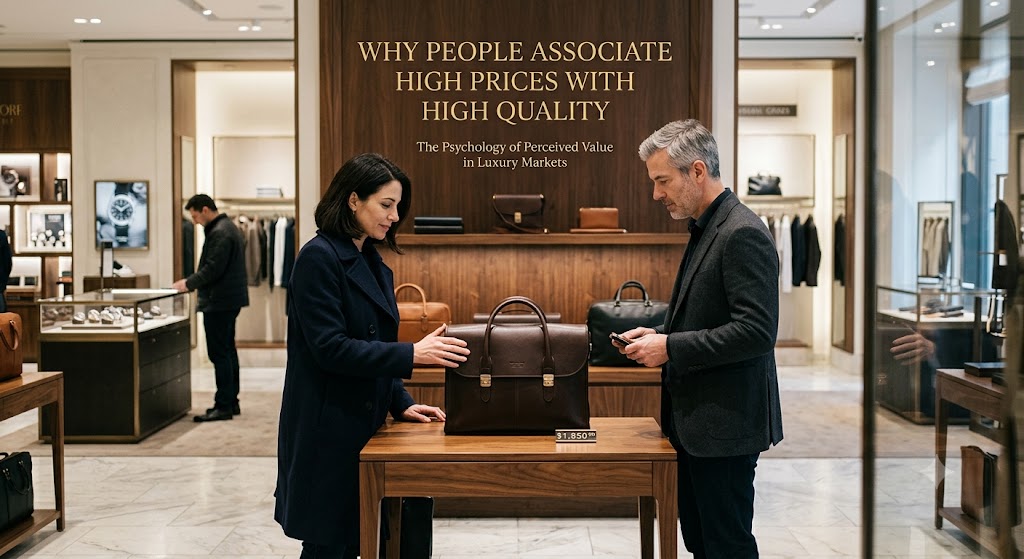
Why do people often assume that an expensive product must be better than a cheaper alternative? Walk into a shop and place two similar products side by side, one costing ₦5,000 and another costing ₦50,000, and many people will immediately believe the more expensive product is superior. Sometimes that assumption is correct. Often, however, it is not. The interesting question is not simply whether expensive products are better, but why people associate high prices with high quality in the first place.
The relationship between price and perceived quality is deeply connected to human psychology. People do not always have enough information, time, knowledge or experience to determine the actual quality of a product before buying it. When faced with uncertainty, the brain looks for shortcuts. Price becomes one of those shortcuts. If something costs significantly more, people may interpret the higher price as evidence that the manufacturer used better materials, invested more effort, provided better service or created a more valuable product.
This psychological tendency is known as the price quality effect. It describes the tendency for consumers to perceive products with higher prices as being of higher quality, even when the actual difference in quality may be small or nonexistent. The fascinating part is that this perception can influence buying behaviour before a person has even tested the product.
Imagine two bottles of perfume sitting on a shelf. One costs ₦15,000 while the other costs ₦150,000. If the packaging, branding and presentation are carefully designed, many consumers will expect the ₦150,000 perfume to smell better, last longer and feel more luxurious. If they are told that the expensive perfume contains rare ingredients and was created by a famous fragrance house, their expectations become even stronger. The price itself becomes part of the story.
This is one reason luxury brands can charge significantly more than ordinary brands for products that may perform similar basic functions. A handbag carries personal belongings. A watch tells time. A pair of trainers protects your feet. A car transports people. Yet some versions of these products cost many times more than others. Why People Associate High Prices With High Quality.
The difference is not always about physical functionality. Consumers may be purchasing craftsmanship, design, exclusivity, heritage, status, experience, identity or social recognition. In other words, the price may reflect the entire experience surrounding the product rather than simply the physical object itself.
People also associate high prices with quality because price can act as a signal when information is limited. Suppose you know very little about smartphones. You want to buy one but do not understand processors, camera sensors, battery technology, display panels or software optimisation. You see one phone for ₦150,000 and another for ₦900,000. Without researching their specifications, you may instinctively assume the ₦900,000 phone is better.
That assumption may be reasonable in some situations, but it is still an assumption. The expensive phone may have a better camera, faster processor and longer software support. But it may also contain features you do not need. You could spend six times more without receiving six times the practical value.
This illustrates an important distinction between price, quality and value. Price is what you pay. Quality is how well something performs relative to what it is supposed to do. Value is what you believe you receive in exchange for what you spend.
These three things are related, but they are not identical.
A product can be expensive and high quality. It can also be expensive and poor quality. A cheap product can be surprisingly excellent, while another cheap product can be unreliable and frustrating. Price alone cannot tell the whole story.
However, consumers often use price because evaluating quality independently requires effort. Researching reviews, comparing specifications, checking warranties, investigating materials, understanding production methods and testing alternatives all take time. A simple price comparison takes seconds.
This is where mental shortcuts become powerful.
The human brain constantly makes decisions using limited information. If we had to investigate every detail about everything we purchased, everyday life would become exhausting. Instead, we rely on signals and previous experiences. Price is one of those signals.
If someone has repeatedly purchased expensive products that performed well, they may develop a stronger association between price and quality. They may begin to believe that paying more is the safest way to avoid disappointment.
This belief can become particularly strong when purchasing products where quality is difficult to judge before use.
Think about a restaurant. You can look at the menu, photographs and reviews, but you cannot fully experience the food until you eat it. A restaurant charging ₦50,000 per person may create an expectation of superior food compared with a restaurant charging ₦5,000. Sometimes the expensive restaurant genuinely offers better ingredients, service, atmosphere and culinary expertise. But sometimes part of what customers are paying for is location, branding, interior design, exclusivity and reputation.
The same principle applies to hotels. A five star hotel may provide larger rooms, better service, stronger security, superior facilities and a more carefully designed guest experience. But a traveller who simply needs a clean and comfortable place to sleep may receive greater value from a much cheaper hotel.
This is why asking whether something is expensive is often less useful than asking whether it is worth the price.
Branding also plays a major role in creating the perception that high prices indicate high quality. Companies invest enormous amounts of money in visual identity, packaging, advertising, celebrity endorsements, store design and customer experience. These elements influence how consumers interpret the product.
A beautifully designed package can make an ordinary product feel premium. A prestigious shop can make a product appear more valuable. A famous person using a product can make consumers believe that it represents success. Even the language used to describe a product can affect perception.
Words such as premium, professional, exclusive, handcrafted, elite, luxury and advanced create expectations before consumers have evaluated the actual product.
Once expectations are established, people can interpret their experiences through those expectations.
If someone believes an expensive wine must taste better than a cheap wine, they may pay closer attention to the expensive wine and describe its taste using more positive language. Their experience may genuinely feel better because their expectations influence perception.
This does not mean consumers are foolish. It means perception is an important part of human decision making.
Our brains do not experience products in a completely objective way. Expectations, context, memories, emotions and social influences all affect how we interpret experiences.
The power of expectation can even influence satisfaction after purchase. Imagine spending ₦500,000 on a pair of shoes. You may feel excited about the purchase. Because you spent so much money, you may naturally look for reasons to justify the decision. You notice the stitching, packaging, comfort and design. You tell yourself that the shoes feel different from cheaper alternatives.
Now imagine buying another pair for ₦15,000 and discovering that they are surprisingly comfortable. You may still perceive them as less valuable because the lower price created a lower expectation.
This is one reason businesses carefully manage pricing. Price is not merely a number attached to a product. It communicates information.
A very low price can sometimes create suspicion. Consumers may wonder what is wrong with the product. Is the material poor? Is it fake? Is it old stock? Is the seller desperate? Is there no warranty? Is the product unreliable?
At the same time, a very high price can create confidence. Consumers may assume that the company would not charge so much unless the product justified it.
Businesses understand this psychology. Some deliberately price products higher because they know consumers use price as an indicator of quality.
This does not automatically mean that high priced products are scams. Pricing is often influenced by many legitimate costs, including research and development, skilled labour, materials, logistics, customer support, warranties, marketing, taxes, retail expenses and distribution.
A company that uses better materials and employs highly skilled workers may genuinely need to charge more. A company providing long term customer support may also have higher operating costs.
However, price can also contain a significant amount of branding and positioning.
Consider a designer handbag. A basic handbag may cost ₦30,000. A luxury handbag could cost ₦3 million or more. The luxury version may indeed involve superior craftsmanship and materials, but the enormous difference in price cannot always be explained by materials alone. Part of the value comes from the brand, scarcity, design, heritage and status associated with owning it. Why People Associate High Prices With High Quality.
Why People Associate High Prices With High Quality
This is where social perception becomes important.
Humans are social creatures. We constantly observe what other people buy, wear and use. Products can communicate identity. A person may purchase an expensive watch not simply because it tells time better, but because the watch communicates achievement, taste, wealth or belonging.
The same principle applies to cars, clothing, phones, houses, restaurants and even education.
People sometimes use prices to estimate social status. A person carrying an expensive phone may be perceived differently from someone carrying a cheap phone. Someone driving an expensive car may be assumed to be more successful. Someone wearing a designer outfit may be considered more fashionable.
These assumptions may be completely wrong, but they influence behaviour.
This creates a fascinating cycle. A product becomes associated with wealth or prestige. People want the social meaning attached to it. Demand increases. The company maintains premium positioning. Consumers continue interpreting the high price as evidence of quality.
Over time, the price becomes part of the product’s identity.
Scarcity makes this even stronger. When something is difficult to obtain, people often perceive it as more valuable. Limited edition products, rare collectibles, exclusive memberships and restricted experiences can command high prices partly because people want what others cannot easily access.
This demonstrates that consumers do not purchase functionality alone. They purchase meaning.
A cheap chair and an expensive designer chair may both allow someone to sit. But the expensive chair may represent design, status, craftsmanship or personal taste. Whether that additional meaning is worth the extra money depends entirely on the buyer.
This is why value is subjective.
A ₦2 million laptop might be completely unnecessary for someone who only browses social media and writes documents. For a professional video editor, software developer, engineer or designer, however, the same machine could save hours of work and generate additional income.
The product has not changed. The value has changed because the user’s needs are different.
This is one of the most important lessons consumers can learn. Never confuse expensive with valuable.
Before paying more, ask what exactly you are receiving in exchange for the additional money.
Are the materials genuinely better? Is the product more durable? Does it perform better? Does it have a stronger warranty? Is customer support superior? Will it save time? Will it reduce future costs? Is it safer? Does it solve a problem that cheaper alternatives cannot solve?
These questions help separate genuine quality from perceived quality.
Consumers should also be careful about using price as their primary measure of quality because businesses can manipulate perception. A product can be made to look premium without being particularly good.
Beautiful packaging does not guarantee durability. A famous brand does not guarantee that every product it sells is excellent. A high price does not guarantee superior performance.
Likewise, a low price does not automatically mean poor quality.
Some businesses can sell excellent products cheaply because they operate efficiently, have low overheads, manufacture at scale or use direct distribution. Others may charge less because they are new and have not yet built a prestigious brand.
Sometimes you are paying for the product. Sometimes you are paying for the brand. Sometimes you are paying for convenience. Sometimes you are paying for status. Sometimes you are paying for all four.
Understanding this can dramatically improve financial decision making.
One of the biggest mistakes consumers make is trying to look successful instead of becoming financially secure. People sometimes purchase expensive items because they want other people to believe they are doing well.
The danger is that appearances can become expensive.
Someone may finance an expensive car while struggling to pay rent. Someone may buy designer clothes while having no emergency savings. Someone may purchase the latest smartphone while owing several people money.
The product may communicate wealth while the financial reality communicates something completely different.
True financial intelligence requires understanding the difference between looking wealthy and building wealth.
This does not mean expensive products are bad. There is nothing inherently wrong with buying premium products when you can genuinely afford them and appreciate what they offer. The problem begins when price becomes a substitute for thinking.
If you have the money and a premium product genuinely gives you better performance, comfort, durability or enjoyment, the purchase may make perfect sense.
But if you are paying more primarily because you believe expensive automatically means better, you may be vulnerable to manipulation.
The smartest consumer is not necessarily the person who always buys the cheapest option. Nor is it the person who always buys the most expensive option.
The smartest consumer understands what they need, researches alternatives and chooses the option that provides the best combination of quality, usefulness and value.
Sometimes that option will be cheap.
Sometimes it will be expensive.
The key is knowing why you are paying the price.
Ultimately, people associate high prices with high quality because price provides a convenient signal in a world where quality is often difficult to measure. Branding, social status, expectations, scarcity, reputation and personal experience all reinforce that association.
But price is a clue, not proof.
The next time you see something expensive and immediately think, “It must be better,” pause for a moment.
Ask yourself what evidence you actually have.
Is it genuinely better, or does it simply look better?
Are you paying for quality, or are you paying for perception?
Are you buying usefulness, or are you buying status?
Are you purchasing something that improves your life, or something that helps other people form an impression of you?
These questions can completely change the way you spend money.
The most expensive product is not always the highest quality. The cheapest product is not always the best value. And sometimes the greatest financial decision is not choosing between cheap and expensive, but learning to recognise the difference between price and worth.
In a world where businesses compete aggressively for attention and consumers are constantly exposed to luxury lifestyles, understanding the psychology of pricing has become more important than ever. Once you understand why people associate high prices with high quality, you become less vulnerable to the simple assumption that expensive automatically means superior.
You stop asking, “How much does it cost?”
You start asking, “What am I actually getting?”
And that is a much more powerful question.

EarnSmartOnline.com.ng is dedicated to helping readers make smarter financial decisions through practical guides on online income, personal finance, technology, digital business, and wealth creation. Our goal is to provide reliable, easy-to-understand, and actionable content that empowers individuals to earn smarter, build sustainable income streams and achieve long-term financial success.
Recommended: Start Earning Online
- Ultimate Affiliate Marketing Program — learn affiliate marketing with a done-for-you sales system ($15). Check it out
- The Newbie Affiliate Guide — the beginner-friendly starter guide (~$6.68). Check it out
- Easy Dollar Maker — earn in dollars uploading AI images and videos from your phone ($17). Check it out
Disclosure: These are affiliate links. If you buy through them, I may earn a commission at no extra cost to you.



