
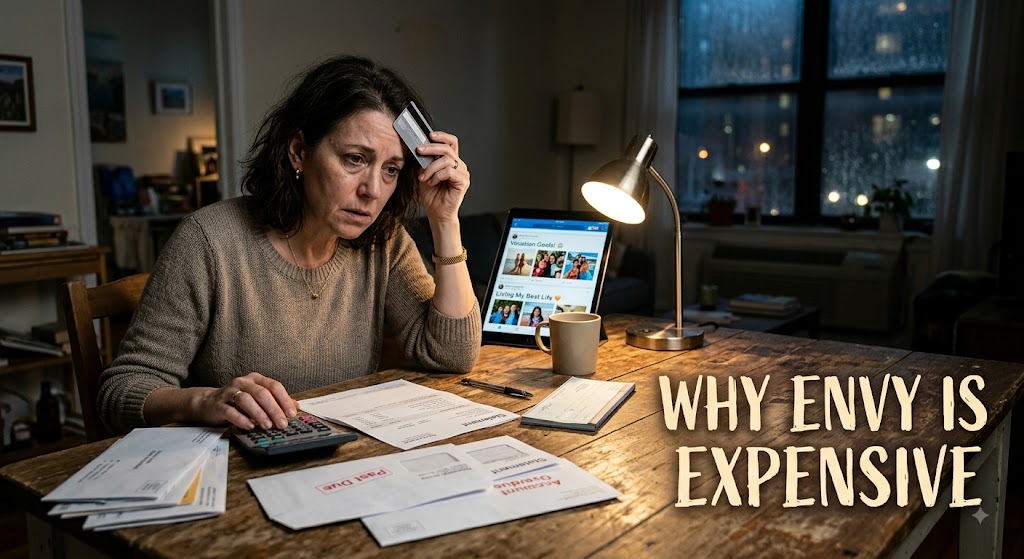
Why Envy Is Expensive is a question worth asking because envy is often treated as a harmless human emotion. People laugh about it, hide it behind jokes, or dismiss it as something everyone experiences from time to time. Yet envy can quietly become one of the most expensive emotions a person carries. It can cost money, relationships, opportunities, peace of mind, confidence, productivity and even years of personal growth. The strange thing about envy is that the person being envied may never lose anything at all, while the person experiencing envy can lose almost everything that actually matters.
Envy begins when we look at what someone else has and become dissatisfied with what we have. It may be another person’s money, house, car, marriage, business, career, appearance, education, social status, popularity or success. Sometimes it is not even something material. You can envy someone’s confidence, peace, discipline, talent, opportunities or ability to enjoy life. The dangerous part is that envy does not simply say, “I want what they have.” It can eventually whisper something more destructive: “I cannot be happy until I have what they have.”
That is where the real cost begins.
Why Envy Is Expensive becomes clearer when you understand that envy changes your attention. Instead of concentrating on your own journey, you start monitoring somebody else’s. Instead of asking what you can build, you start asking why someone else is ahead. Instead of appreciating your progress, you begin measuring your life against another person’s highlight reel. Your attention, which could have been invested in learning, building, saving, creating or improving yourself, becomes trapped in comparison.
Attention is valuable. Time is valuable. Energy is valuable. When envy consumes all three, you are paying a price even when no money leaves your bank account.
One of the biggest costs of envy is unnecessary spending. A person sees a friend buy a new car and suddenly their own perfectly functional vehicle feels embarrassing. Someone buys an expensive phone and suddenly an older device seems unacceptable. A neighbour renovates their house and the pressure to renovate begins. Someone posts a luxury holiday online and suddenly an ordinary weekend feels like failure.
This is how envy turns into financial pressure.
You may not even want the thing initially. You want it because somebody else has it. That distinction matters. There is a difference between buying something because it genuinely improves your life and buying it because you are desperate to prove that you can keep up with somebody else.
Envy can make people borrow money they cannot comfortably repay. It can encourage unnecessary credit card spending, reckless loans, impulsive purchases and lifestyle inflation. It can convince someone to spend tomorrow’s money simply to impress people today. The purchase may provide a few minutes of satisfaction, but the debt can remain for months or years.
That is one reason Why Envy Is Expensive is not merely a motivational statement. It is also a financial lesson.
A person who constantly compares their possessions with those of others may never feel financially secure because there will always be someone with more. Even after reaching a certain level, another person will appear richer, more successful or more fashionable. If your happiness depends on being ahead of other people, you have created a game that cannot be won.
There is always another level.
There is always another car.
There is always another house.
There is always another business owner making more money.
There is always another person travelling further, wearing better clothes, gaining more followers or receiving more attention.
If comparison becomes your financial strategy, you can spend your entire life trying to purchase evidence that you are doing well.
Envy also becomes expensive because it steals focus from personal development. Imagine two people who both discover that another person is achieving impressive results. One becomes curious and asks, “What can I learn from this?” The other becomes bitter and asks, “Why should that person have it?”
The first person has turned somebody else’s success into information. The second person has turned it into emotional pain.
That difference can change an entire life.
Instead of studying successful people, learning from them and identifying the habits behind their results, an envious person may spend hours criticising them. They may call them lucky, connected, privileged, overrated or undeserving without actually understanding what happened behind the scenes. This creates a dangerous illusion because criticism can feel productive even when it produces nothing.
Why Envy Is Expensive
You can spend three hours explaining why someone does not deserve success and still be exactly where you were before you started.
Meanwhile, the person you envy may continue building.
Envy is also expensive because it damages relationships. Friendships can become competitions. Siblings can secretly compete over income, possessions and achievements. Colleagues can become enemies simply because one person receives an opportunity the other wanted. Even family relationships can become uncomfortable when success enters the room.
Sometimes people do not dislike you because you have done something wrong. They dislike the version of themselves they see when they look at you.
Your progress may remind them of their own postponed dreams. Your discipline may expose their inconsistency. Your success may force them to confront decisions they have avoided. Instead of dealing with those feelings honestly, they may direct their frustration towards you.
This is one of the saddest consequences of envy. It can make people attack the very relationships that could have helped them grow.
An envious person may stop celebrating friends. They may become unusually quiet when good news is announced. They may minimise achievements, search for flaws or make sarcastic comments. Eventually, people notice. Trust weakens. Conversations become guarded. Opportunities for collaboration disappear.
The person experiencing envy may believe they are protecting themselves from feeling inferior, but they are actually isolating themselves.
Envy can also destroy opportunities because bitterness makes it difficult to recognise useful connections. Imagine someone in your industry becoming successful. Instead of studying their strategy or building a relationship with them, you resent them. Years later, an opportunity emerges that could have benefited both of you, but the relationship was never developed because resentment stood in the way.
You did not lose the opportunity because the other person was successful.
You lost it because you could not emotionally tolerate their success.
That is expensive.
Another hidden cost of envy is the destruction of gratitude. Gratitude does not mean pretending that everything is perfect. It means recognising what is valuable in your life while continuing to pursue improvement. Envy attacks that balance. It makes you stare so intensely at what you lack that you become blind to what you already possess.
A person can have a healthy body, supportive family, useful skills, a functioning business, loyal friends and countless opportunities, yet remain miserable because they are obsessed with somebody else’s life.
Meanwhile, someone else may look at their life and think they are incredibly fortunate.
This is why comparison is so dangerous. It changes the measurement system inside your mind.
You stop asking, “Am I growing?”
You start asking, “Am I ahead of them?”
Those are completely different questions.
Personal growth is measured against your previous self. Envy measures you against someone else.
When you measure yourself against your past, progress is possible. When you measure yourself against everybody around you, dissatisfaction becomes almost guaranteed.
Social media has made this problem even more powerful. Every day, people are exposed to carefully selected images of other people’s lives. You see the holiday but not the financial pressure behind it. You see the successful business but not the failed ventures that came before it. You see the wedding but not the difficult conversations. You see the achievement but not the years of rejection. You see the finished product but rarely the unfinished struggle.
Then you compare your entire life to somebody else’s best moments.
That is not a fair comparison.
The internet can make thousands of people appear to be winning simultaneously while making you feel like the only person who is behind. If you are not careful, envy can turn social media into a daily reminder of everything you believe you lack.
This is another reason Why Envy Is Expensive. It can make you psychologically dissatisfied with a life that is actually progressing.
Envy can also make success harder because it creates impatience. You begin wanting the results somebody else has without wanting to endure the process that produced those results. You see the entrepreneur driving the expensive car but do not see the years of uncertainty. You see the creator with millions of followers but do not see the thousands of pieces of content that nobody watched. You see the athlete holding the trophy but do not see the training.
Envy wants the harvest without respecting the planting season.
That mindset can cause people to chase shortcuts. They jump from one opportunity to another because they want instant results. They abandon good strategies too quickly. They make reckless decisions because somebody else appears to be moving faster.
But speed is not always progress.
Sometimes the person who appears to be behind is building something sustainable while the person who appears to be ahead is simply moving loudly.
Envy can also become expensive professionally. A colleague gets promoted and instead of improving your skills, you spend your energy complaining about favouritism. Another business receives attention and instead of improving your product, you spend your time monitoring their activities. A competitor launches something successful and you become obsessed with finding reasons they will eventually fail.
Competition can be healthy when it pushes you to improve. Envy becomes destructive when another person’s progress becomes more important to you than your own.
The solution is not to pretend envy does not exist. Envy is a human emotion. You may experience it occasionally. The important question is what you do after recognising it.
When you feel envy, pause and investigate it.
What exactly do you want?
Is it the person’s money?
Their freedom?
Their confidence?
Their discipline?
Their business?
Their relationships?
Their recognition?
Their lifestyle?
Once you identify the real desire, you can transform envy into information.
If you envy someone’s financial success, perhaps you need better financial habits. If you envy someone’s fitness, perhaps you need greater discipline. If you envy someone’s career, perhaps you need additional skills. If you envy someone’s confidence, perhaps you need to work on your self respect.
The person you envy may unknowingly be showing you something about yourself.
That does not mean you should copy their entire life. It means you should identify the lesson.
There is a powerful difference between envy and inspiration. Envy says, “I hate that they have it.” Inspiration says, “They have shown me what may be possible.”
Both emotions can begin with the same observation, but they lead in opposite directions.
You can see somebody else’s success and become smaller, or you can see it and become more determined.
You can use another person’s achievement as evidence that life is unfair, or you can use it as evidence that a certain result is possible.
You can spend your energy wishing they would fall, or you can spend that same energy building yourself.
This is where the cost of envy becomes especially painful. The person you envy may never know that you spent years thinking about them. They may never know how angry you were. They may never know how much their success affected your mood. They are living their life while you are emotionally paying rent inside a comparison you created.
That is an expensive place to live.
The healthiest response to envy is not pretending that you do not want more. Wanting more is not wrong. Ambition is not wrong. Desire is not wrong. The problem begins when your desire for more becomes hatred towards someone who already has more.
You can want the house without hating the homeowner.
You can want the business without wishing failure on another entrepreneur.
You can want financial freedom without resenting someone who achieved it before you.
You can admire another person’s success while still respecting your own journey.
Your life does not become less valuable because somebody else is doing well.
Someone else’s success does not subtract from your potential.
Someone else’s achievement does not cancel your progress.
And someone else’s wealth does not automatically make you poor.
The goal should be to build a life that makes sense for you rather than a life designed to impress people who may not even be watching.
This is particularly important with money. Financial freedom requires discipline, patience and the ability to distinguish between needs, genuine goals and social pressure. If envy controls your spending, your income can increase while your financial situation remains fragile.
You can earn more and still feel broke because your definition of enough keeps moving.
You can buy a bigger house and still feel inadequate because someone else has a bigger one.
You can upgrade your phone and still feel behind because someone else bought the latest model.
You can increase your income and still feel unsuccessful because your neighbour earns more.
There is no financial plan strong enough to protect a person who has made comparison their definition of success.
Real wealth includes the ability to enjoy what you have without constantly needing strangers to validate it.
That does not mean settling for less. It means building from contentment rather than insecurity.
There is a huge difference between saying, “I am grateful for what I have, and I want to build more,” and saying, “I cannot respect what I have because someone else has something better.”
The first creates growth.
The second creates endless dissatisfaction.
Ultimately, Why Envy Is Expensive because envy charges you for something you never needed to buy. It charges you with lost time, wasted energy, damaged relationships, unnecessary spending, poor decisions, reduced productivity and emotional exhaustion. It takes attention away from your own opportunities and redirects it towards somebody else’s life.
The good news is that you can stop paying the bill.
The next time you feel envy rising, do not immediately attack the person who triggered it. Ask yourself what their success is revealing about your own desires. Turn comparison into research. Turn jealousy into discipline. Turn frustration into action. Turn admiration into learning.
You do not need to become somebody else to build a meaningful life.
You need to become more intentional about becoming yourself.
There will always be people ahead of you in some areas and people behind you in others. That is normal. Life is not a single race with one finish line. Someone may have more money while you have more time. Someone may have more followers while you have deeper relationships. Someone may have a bigger business while you have greater peace. Someone may achieve a dream at twenty five while you achieve yours at forty five.
Different journeys do not make one life worthless.
So protect your attention. Protect your finances. Protect your relationships. Protect your peace. Celebrate people when you genuinely can, learn from them when possible and return your focus to the work that belongs to you.
Because while envy is busy asking why somebody else is winning, life is quietly asking you a much more important question.
What are you doing with your own opportunity?
That is the question worth answering.
And perhaps the most valuable lesson behind Why Envy Is Expensive is this: another person’s success becomes expensive only when you allow it to become a substitute for your own progress. You cannot control who gets ahead of you, who receives opportunities first or who becomes successful before you. But you can control whether their success becomes a reason for bitterness or a reason to build.
Do not spend your life keeping score in somebody else’s game.
Build your own.
Your future is too valuable to finance somebody else’s success with your peace.

EarnSmartOnline.com.ng is dedicated to helping readers make smarter financial decisions through practical guides on online income, personal finance, technology, digital business, and wealth creation. Our goal is to provide reliable, easy-to-understand, and actionable content that empowers individuals to earn smarter, build sustainable income streams and achieve long-term financial success.
Recommended: Start Earning Online
- Ultimate Affiliate Marketing Program — learn affiliate marketing with a done-for-you sales system ($15). Check it out
- The Newbie Affiliate Guide — the beginner-friendly starter guide (~$6.68). Check it out
- Easy Dollar Maker — earn in dollars uploading AI images and videos from your phone ($17). Check it out
Disclosure: These are affiliate links. If you buy through them, I may earn a commission at no extra cost to you.



