
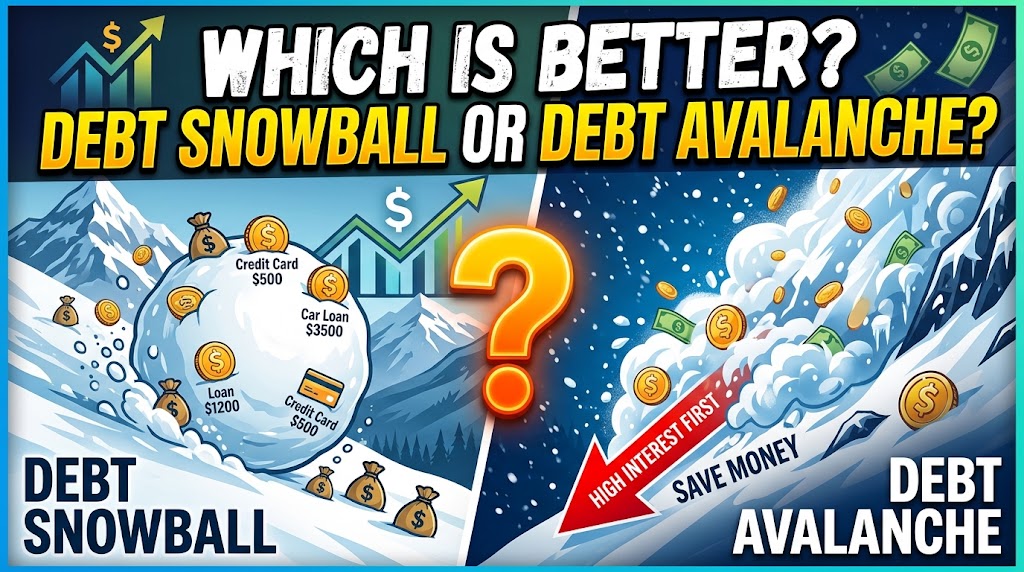
Which is better, debt snowball or debt avalanche? This is one of the most common questions asked by people who are serious about getting out of debt and taking control of their financial future. Whether the debt comes from credit cards, personal loans, student loans, medical bills, business obligations or other financial commitments, finding an effective repayment strategy can make a significant difference in how quickly debt is eliminated and how motivated a person remains throughout the process.
Which is better, debt snowball or debt avalanche?
The debate surrounding Which is better, debt snowball or debt avalanche? has existed for years because both methods have helped millions of people successfully pay off debt. Each approach offers unique advantages and potential drawbacks. The best choice often depends not only on mathematical calculations but also on human behaviour, motivation and personal circumstances.
Debt can feel overwhelming, especially when multiple balances are competing for attention each month. Many people make the mistake of paying debts randomly, sending extra money wherever they feel like at the time, without following a structured plan. While any payment is better than no payment, a lack of strategy can slow progress and make the journey toward financial freedom seem endless. This is why financial experts often recommend either the debt snowball method or the debt avalanche method.
To understand which strategy may be better, it is important to understand how each method works. The debt snowball method focuses on paying off debts from the smallest balance to the largest balance. Regardless of interest rates, the smallest debt becomes the first target. Minimum payments continue on all debts, but any extra money available goes toward eliminating the smallest balance as quickly as possible. Once that debt is paid off, the money previously used for it is added to the payment for the next smallest debt. The process continues until all debts are eliminated.
The debt avalanche method follows a different approach. Instead of focusing on balances, it focuses on interest rates. The debt with the highest interest rate receives all extra payments while minimum payments continue on other debts. Once the highest interest debt is eliminated, attention shifts to the debt with the next highest interest rate. This process continues until all debts are paid off.
At first glance, both methods appear very similar. In both cases, borrowers continue making minimum payments on all obligations while directing additional funds toward one target debt at a time. However, the order in which debts are attacked creates very different experiences.
The debt snowball method became popular largely because of its psychological benefits. People who use this approach often experience quick victories early in the repayment journey. Eliminating a small debt can provide a powerful sense of accomplishment. Seeing one account disappear completely can create momentum and motivation that encourages continued discipline.
Imagine a person with five debts. The smallest debt is only £200 while the largest debt is several thousand pounds. Using the debt snowball method, that £200 balance may disappear within a few weeks. Suddenly, the person has one less bill to worry about. The number of debts decreases. Confidence increases. The repayment journey begins to feel manageable.
These early wins should not be underestimated. Personal finance is not purely mathematical. Human emotions play a major role in financial decision making. Many people struggle with debt not because they cannot calculate interest rates but because they lose motivation. They become discouraged, frustrated or overwhelmed. The debt snowball method directly addresses this challenge by creating visible progress.
The debt avalanche method appeals to a different type of thinker. It focuses on efficiency. Since higher interest debts cost more money over time, paying them first typically reduces the total interest paid throughout the repayment process. In many situations, the avalanche method allows borrowers to become debt free faster and spend less money overall.
For example, imagine one debt carries an interest rate of 25 percent while another carries an interest rate of 5 percent. From a mathematical perspective, it makes sense to attack the 25 percent debt first because it is growing much faster. Every extra payment reduces future interest charges more effectively.
This is why financial analysts often describe the debt avalanche method as the financially optimal approach. It maximises efficiency and minimises interest costs. If two individuals have identical debts and identical payment amounts, the person using the avalanche method will often save more money in interest than the person using the snowball method.
However, mathematics does not always determine real world success. One of the biggest criticisms of the debt avalanche method is that it can delay emotional rewards. A high interest debt may not necessarily be the smallest debt. In some cases, borrowers may spend months paying aggressively toward a large balance before seeing an account disappear entirely.
This can create frustration. The person is making progress, but the progress may feel invisible. Without visible milestones, motivation can weaken. Some individuals become discouraged and eventually abandon the strategy altogether.
This highlights an important reality behind the question, Which is better, debt snowball or debt avalanche? The best strategy is not necessarily the one that looks best on paper. The best strategy is often the one a person can consistently follow until the final debt is eliminated.
Behavioural economists have long recognised that people do not always act according to pure logic. Emotions, habits, stress and motivation influence financial decisions. A strategy that keeps someone engaged and committed may ultimately produce better results than a theoretically superior strategy that is abandoned halfway through.
Consider someone who has struggled with debt for years. Their confidence is low. Their financial stress is high. They often feel hopeless whenever they look at their account balances. For such a person, eliminating a small debt quickly can provide evidence that change is possible. That psychological boost may be exactly what they need to stay focused.
On the other hand, someone who enjoys spreadsheets, calculations and long term planning may find greater satisfaction in knowing they are minimising interest costs. Such individuals may have no problem waiting longer for visible victories because they understand the mathematical advantages of the avalanche approach.
Another factor worth considering is the size of the interest rate differences. If all debts have similar interest rates, the mathematical advantage of the avalanche method may be relatively small. In such situations, the motivational benefits of the snowball method may outweigh the modest interest savings offered by the avalanche approach.
Conversely, if one debt carries an extremely high interest rate while others have much lower rates, the avalanche method may provide substantial savings. Ignoring a very high interest debt in favour of smaller balances could become costly over time.
Financial stress also plays a role in this discussion. Many people experience anxiety when managing multiple accounts. Every additional debt represents another payment due date, another balance and another financial obligation. The snowball method reduces the number of active debts more quickly, which can create a sense of simplicity and control.
This reduction in complexity can be valuable. A person with ten separate debts may feel overwhelmed. Eliminating three or four smaller debts early can make the financial situation feel significantly less intimidating, even if the total debt remains substantial.
There is also a practical advantage to reducing the number of debts. Fewer accounts mean fewer opportunities to miss payments, incur penalties or make administrative mistakes. Simplification can contribute to better financial management overall.
Some critics argue that the debt snowball method ignores mathematics entirely. This criticism is not entirely fair. While the snowball method does not prioritise interest rates, it still leads to debt elimination. The difference lies in the path chosen, not the destination. The goal remains the same: becoming debt free.
Similarly, some critics suggest that the debt avalanche method is too cold and analytical. However, many people successfully use the avalanche strategy and remain highly motivated because they appreciate its efficiency. For them, watching interest costs decline is rewarding enough.
An interesting compromise has emerged in recent years. Some borrowers use a hybrid approach. They begin with the snowball method to gain momentum and confidence, then transition to the avalanche method once they have eliminated a few smaller debts. Others prioritise a particularly stressful debt regardless of balance or interest rate simply because removing it provides emotional relief.
This flexibility demonstrates that personal finance should remain personal. Financial strategies are tools, not rigid rules. The purpose of a debt repayment method is to help individuals achieve financial freedom, not to force them into a one size fits all system.
Technology has also made debt management easier than ever. Budgeting applications, financial tracking tools and debt calculators can help borrowers compare different strategies and estimate repayment timelines. By visualising progress, many people find it easier to remain committed regardless of which method they choose.
Another important consideration is cash flow. Individuals with very limited disposable income may benefit more from the psychological encouragement of the snowball method because progress can feel slow when extra payments are small. Quick wins may provide the emotional fuel necessary to continue.
Those with larger amounts of disposable income may see substantial interest savings through the avalanche method because they can direct significant extra payments toward high interest balances. In such cases, the mathematical advantages become more pronounced.
The question of Which is better, debt snowball or debt avalanche? also depends on personal goals. If the primary objective is reducing financial stress as quickly as possible, the snowball method may have an advantage. If the primary objective is paying the least amount of interest possible, the avalanche method often wins.
Financial education often focuses heavily on numbers, but debt is rarely just a numerical issue. Debt can affect mental health, relationships, sleep quality and overall well being. The emotional burden of debt is real. Any repayment strategy that successfully helps someone escape that burden deserves serious consideration.
Research into behavioural finance suggests that small victories can have a powerful impact on long term success. Humans are naturally motivated by progress. Completing tasks creates satisfaction. Crossing goals off a list feels rewarding. The snowball method taps directly into these psychological tendencies.
Meanwhile, the avalanche method aligns with principles of optimisation and efficiency. It rewards patience and discipline. People who appreciate long term gains over short term gratification may find this approach highly appealing.
One mistake borrowers should avoid is becoming paralysed by the choice itself. Some people spend so much time debating Which is better, debt snowball or debt avalanche? that they delay taking action altogether. The reality is that either method is far better than having no strategy at all.
The most important factor is consistent action. Regular payments, disciplined budgeting and avoiding new debt often matter more than the specific repayment order chosen. A perfect strategy implemented poorly will underperform a good strategy implemented consistently.
Budgeting also remains essential regardless of the repayment method selected. Without controlling spending and creating room for extra debt payments, neither strategy can reach its full potential. Debt repayment works best when combined with responsible financial habits and a commitment to living within one’s means.
Building an emergency fund alongside debt repayment can also prevent setbacks. Unexpected expenses often force people back into debt. Even a modest emergency fund can reduce the likelihood of relying on credit cards or loans during financial emergencies.
As people progress through their debt repayment journey, they often discover that the greatest benefit extends beyond the money saved. Paying off debt creates freedom. It increases financial flexibility. It reduces stress. It allows income to be directed toward savings, investments and future goals rather than past obligations.
Ultimately, the answer to Which is better, debt snowball or debt avalanche? depends on the individual. The debt snowball method often wins in terms of motivation, momentum and psychological encouragement. The debt avalanche method often wins in terms of mathematical efficiency and interest savings.
Neither approach is universally superior in every situation. Each serves a different purpose. One prioritises human behaviour. The other prioritises financial optimisation. The most effective choice is the one that aligns with your personality, financial circumstances and ability to remain committed over time.
If seeing quick victories motivates you, if reducing the number of debts brings peace of mind and if emotional momentum helps you stay disciplined, the debt snowball method may be the better choice. If minimising interest costs, maximising efficiency and following a mathematically optimal strategy matter most to you, the debt avalanche method may be more suitable.
In the end, becoming debt free is not about winning an argument between two strategies. It is about creating a plan, sticking to it and continuing forward until every balance reaches zero. Whether you choose the debt snowball method or the debt avalanche method, the real victory comes from taking control of your finances and refusing to let debt dictate your future.

EarnSmartOnline.com.ng is dedicated to helping readers make smarter financial decisions through practical guides on online income, personal finance, technology, digital business, and wealth creation. Our goal is to provide reliable, easy-to-understand, and actionable content that empowers individuals to earn smarter, build sustainable income streams and achieve long-term financial success.
Recommended: Start Earning Online
- Ultimate Affiliate Marketing Program — learn affiliate marketing with a done-for-you sales system ($15). Check it out
- The Newbie Affiliate Guide — the beginner-friendly starter guide (~$6.68). Check it out
- Easy Dollar Maker — earn in dollars uploading AI images and videos from your phone ($17). Check it out
Disclosure: These are affiliate links. If you buy through them, I may earn a commission at no extra cost to you.



