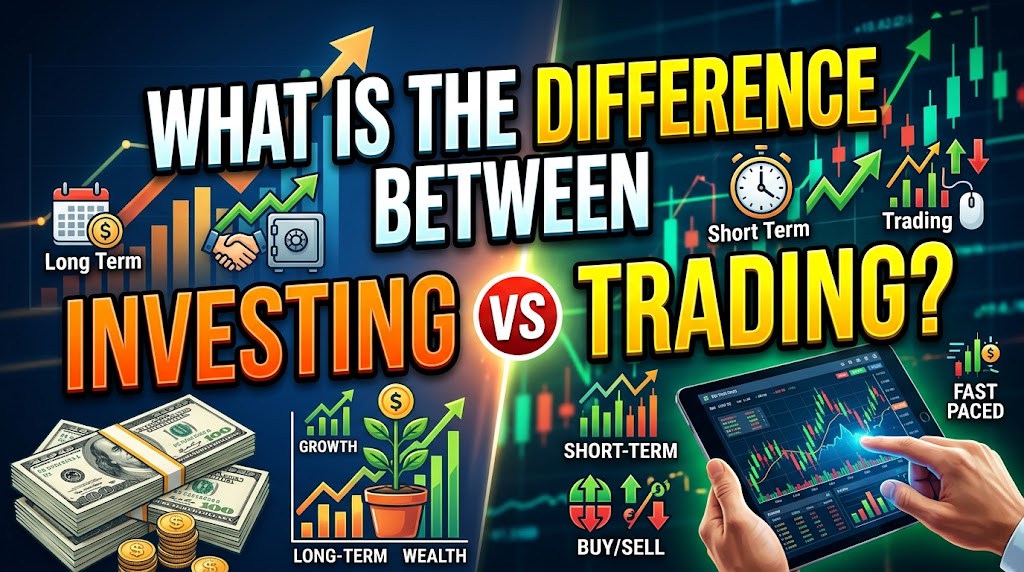
What is the difference between investing and trading?
When I first became interested in making money from financial markets, I honestly thought investing and trading were basically the same thing. Money goes into an asset, the asset increases in value, and you make money. Simple, right?
Not exactly.
The more I learnt about money, the more I realized that one of the biggest mistakes beginners make is using the words investing and trading as if they mean the same thing. They both involve putting money into financial assets with the expectation of making a profit, but the way the money is deployed, the time involved, the risks taken and the decisions made can be very different.
This became particularly clear to me when I started paying more attention to how people talked about stocks, cryptocurrency, foreign exchange and other financial markets. Someone could say, “I am investing in this company,” while another person could say, “I am trading this stock,” even though both people had bought the same asset.
That raised an important question for me: What is the difference between investing and trading?
The simplest explanation I found is that investing generally focuses on building wealth over a longer period, while trading usually focuses on taking advantage of shorter term price movements. An investor may buy an asset because they believe its value will grow over several years. A trader may buy the same asset because they believe its price is likely to move in a particular direction over the next few minutes, hours, days or weeks.
That difference in time horizon affects almost everything else.
When you invest, you are usually thinking about the bigger picture. You might look at a company’s business model, revenue, profitability, management, competitive position, industry and long term prospects before deciding whether to buy its shares. You are essentially asking yourself whether the asset has the potential to become more valuable over time.
Trading tends to involve a different type of thinking. A trader may pay close attention to price movements, market trends, trading volume, charts, technical indicators, economic announcements and other factors that could influence the price over a shorter period.
This does not mean every investor ignores short term price movements or every trader uses charts. There are many different strategies within both investing and trading. However, the underlying objective and time horizon often provide the clearest distinction.
For example, imagine that I buy shares of a company because I believe the company will still be growing and generating strong profits ten years from now. If the share price falls shortly after I buy it, I might not immediately panic. My original reason for buying was based on the company’s long term potential.
Now imagine another person buys those same shares because they expect the price to rise over the next few days. If the price moves in the opposite direction, the trader may close the position quickly to limit the loss.
The asset is the same, but the strategy is different.
This is one of the most important things I learnt when trying to understand the difference between investing and trading. The difference is not necessarily the asset itself. It is often the intention, strategy, time horizon and method used to make money from that asset.
Investing is generally associated with long term wealth creation. An investor might purchase shares, bonds, mutual funds, exchange traded funds, property or other assets and hold them for an extended period.
The investor may benefit from capital appreciation, dividends, interest, rental income or other forms of returns depending on the asset.
For instance, someone could buy shares in a profitable company and hold them for many years. If the company continues to grow, the value of the shares could increase. The company might also distribute part of its profits to shareholders as dividends.
The investor may not need to buy and sell every week to make money.
This is something I find particularly interesting because many beginners assume that making money from the financial markets requires constant activity. It does not necessarily work that way.
Sometimes, doing less can actually be part of the strategy.
Trading, on the other hand, usually involves buying and selling assets more frequently in an attempt to profit from price movements. A trader may hold an asset for seconds, minutes, hours, days or weeks depending on the trading strategy.
There are different forms of trading. Day traders generally open and close positions within the same trading day. Swing traders may hold positions for several days or weeks. Some traders focus on very short term price movements, while others operate over longer periods.
The important point is that trading generally places greater emphasis on timing.
An investor may ask, “Where will this company be in ten years?”
A trader may ask, “Where could this price move next?”
Those are very different questions.
Another major difference between investing and trading is how people commonly analyse opportunities.
Investors often use fundamental analysis. This involves examining information about an asset to determine its underlying value or long term potential. For a company, this could include revenue, earnings, debt, cash flow, business model, management and industry conditions.
A trader may use technical analysis, which focuses heavily on price and market data. Charts, patterns, support and resistance levels, momentum and trading volume may all be considered when making decisions.
However, it would be inaccurate to say that investors only use fundamental analysis and traders only use technical analysis. Some investors use technical indicators, while some traders consider fundamental information. The distinction is more about the overall strategy than a rigid set of rules.
Another difference I noticed is the frequency of transactions.
An investor might buy an asset today and hold it for years without selling. A trader may execute several transactions in a single day.
That difference can have a major impact on costs.
Buying and selling assets can involve transaction fees, spreads, commissions, taxes and other expenses depending on the market and platform being used. The more frequently someone trades, the more important these costs become.
This is one reason why beginners should not look at the potential profit from a single trade without considering the complete picture.
If someone makes a small profit on many trades but pays significant costs along the way, the final result may be very different from what they expected.
Risk is another major difference between investing and trading.
Both involve risk. Investing is not automatically safe, and trading is not automatically dangerous. The level of risk depends on the asset, strategy, diversification, amount invested, leverage, market conditions and many other factors.
However, short term trading can expose someone to rapid price movements. A trader may have to make decisions quickly, particularly when using strategies that depend on short term market movements.
Leverage can increase this risk considerably because it allows a trader to control a larger position with a smaller amount of their own money. While leverage can magnify gains, it can also magnify losses.
This is one area where I believe beginners need to be particularly careful. Seeing someone online turn a small amount of money into a large amount through trading can create the impression that trading is an easy shortcut to wealth.
The reality is much more complicated.
There is also a psychological difference between investing and trading.
Imagine buying an asset and seeing it lose 15 percent of its value within a few weeks. An investor with a long term strategy may decide to hold if the original investment thesis remains intact. A trader might have already exited the position according to a predetermined risk management rule.
Trading can require discipline because emotions can interfere with decision making. Fear can cause someone to exit too early. Greed can cause someone to hold a losing position for too long. Excitement can encourage someone to enter a trade without properly analysing the risk.
Investing has psychological challenges too. Watching a long term portfolio decline during a market downturn can be uncomfortable. An investor may be tempted to sell simply because everyone else appears to be panicking.
In both cases, emotional decision making can have consequences.
Another important difference is the amount of time and attention required.
Long term investing can sometimes be relatively passive after an investment has been selected, although it still requires research, monitoring and periodic review.
Trading can demand considerably more attention depending on the strategy. Someone engaging in short term trading may need to monitor markets, analyse charts, follow economic announcements and manage open positions.
This does not mean trading always requires someone to sit in front of a computer all day. Different trading strategies have different requirements. But generally, shorter time horizons tend to require more active decision making.
This is where personal circumstances become important.
Someone with a full time job, family responsibilities and limited time may approach financial markets differently from someone whose primary occupation is trading. Neither approach is automatically right for everyone.
The important thing is understanding what you are actually doing with your money.
One mistake I have seen repeatedly is someone calling themselves an investor when they are actually speculating on short term price movements without understanding the risks involved.
There is nothing inherently wrong with trading. There is also nothing inherently wrong with investing. The problem begins when someone enters a strategy without understanding it.
For example, a person might buy a cryptocurrency because they saw a social media post claiming that its price would “explode” soon. If they intend to sell when the price rises shortly afterwards, they are effectively engaging in short term speculation or trading, even if they call it an investment.
Understanding your strategy is more important than the label.
Another difference between investing and trading is how success is commonly measured.
An investor might evaluate performance over several years. They may consider total return, dividends, capital appreciation and the growth of their portfolio.
A trader may evaluate performance based on individual trades, monthly results, win rate, risk to reward ratios, drawdowns and overall trading performance.
For example, a trader could have several losing trades and still have a profitable month if the winning trades generate enough profit to offset the losses. This is why simply counting the number of winning trades does not tell the entire story.
Investors also need to understand that historical performance does not guarantee future results.
An asset that performed exceptionally well in the past may not continue doing so. A successful company can experience difficulties. An industry can change. Economic conditions can shift. Regulations can change. Consumer behaviour can evolve.
The same applies to trading strategies. A strategy that worked under one market condition may perform differently under another.
This brings me to something that changed the way I think about money: investing and trading are not simply different ways of making quick money. They are different approaches to managing capital with different objectives, risks and time horizons.
When someone tells me they want to start investing, one of the first questions I think they should ask themselves is why.
Are they trying to build wealth for retirement?
Are they saving towards a long term financial goal?
Are they trying to generate income?
Are they looking for short term opportunities?
Are they willing to spend significant time learning and monitoring the market?
How much money can they afford to lose?
What level of risk can they tolerate?
These questions matter because your financial objective should influence the strategy you choose.
It is also possible for a person to both invest and trade. The two approaches do not have to be mutually exclusive.
Someone could have a long term investment portfolio while also allocating a separate amount of money to trading. If they do this, however, they need to understand that the two activities have different objectives and risk management requirements.
Keeping the money and strategies separate can also make it easier to evaluate what is actually working.
For someone just starting out, education should come before excitement.
I learnt that financial markets can make complicated concepts look deceptively simple. You see a chart moving upward and it is tempting to think, “If I had bought earlier, I would have made money.”
But hindsight is one of the most dangerous teachers in financial markets because the decision looks obvious after the price has already moved.
Before putting money into any investment or trade, it is worth understanding the asset, the risks, the fees, the potential return, the time horizon and what could cause the original idea to fail.
You should also be careful about taking financial advice from social media personalities simply because they display screenshots of profits, expensive cars or impressive lifestyles. A screenshot of a winning trade does not tell you how many losing trades happened before or after it.
Likewise, someone talking confidently about an investment does not mean they can predict the future.
The more I learnt about investing and trading, the more I realised that financial success is not simply about finding an asset that will go up. It is also about managing risk, understanding your objectives and having a strategy you can actually follow.
So, what is the difference between investing and trading?
Investing generally focuses on long term ownership and wealth creation, while trading generally focuses on shorter term opportunities arising from price movements. Investors may spend more time studying the underlying value and long term prospects of an asset, while traders often place greater emphasis on price behaviour, timing and market movements.
Investing can involve holding assets for years or even decades. Trading can involve holding positions for seconds, minutes, hours, days or weeks depending on the strategy.
Investing may require patience and the ability to tolerate short term market fluctuations. Trading may require more frequent decision making, strict risk management and greater attention to market movements.
Neither term should automatically be interpreted as a guarantee of profit.
Both involve risk.
Both require knowledge.
Both can result in losses.
And both require discipline.
The biggest lesson for me is that the goal should not be to choose an impressive sounding financial activity. The goal should be to understand where your money is going and why.
If you are building long term wealth, you need to understand investing.
If you are considering short term market opportunities, you need to understand trading.
And if you want to do both, you need to understand the difference well enough to avoid confusing a short term trade with a long term investment.
The financial markets do not care what you call your activity. A losing position does not become an investment simply because you refuse to sell it. Likewise, a short term trade does not become a long term investment merely because the price moved against you.
Your strategy matters.
Your time horizon matters.
Your risk management matters.
And perhaps most importantly, your understanding matters.
That is why the question “What is the difference between investing and trading?” is much more important than it initially appears. It is not simply a question about terminology. It is a question about how you intend to use your money, how long you intend to keep it invested, how much risk you are prepared to take and what you expect your money to accomplish.
Once you understand that distinction, financial markets become a little easier to navigate because you are no longer confusing activity with strategy.
You are beginning to understand the difference between putting money to work for the future and attempting to profit from movements in the market today.

EarnSmartOnline.com.ng is dedicated to helping readers make smarter financial decisions through practical guides on online income, personal finance, technology, digital business, and wealth creation. Our goal is to provide reliable, easy-to-understand, and actionable content that empowers individuals to earn smarter, build sustainable income streams and achieve long-term financial success.
Recommended: Start Earning Online
- Ultimate Affiliate Marketing Program — learn affiliate marketing with a done-for-you sales system ($15). Check it out
- The Newbie Affiliate Guide — the beginner-friendly starter guide (~$6.68). Check it out
- Easy Dollar Maker — earn in dollars uploading AI images and videos from your phone ($17). Check it out
Disclosure: These are affiliate links. If you buy through them, I may earn a commission at no extra cost to you.